

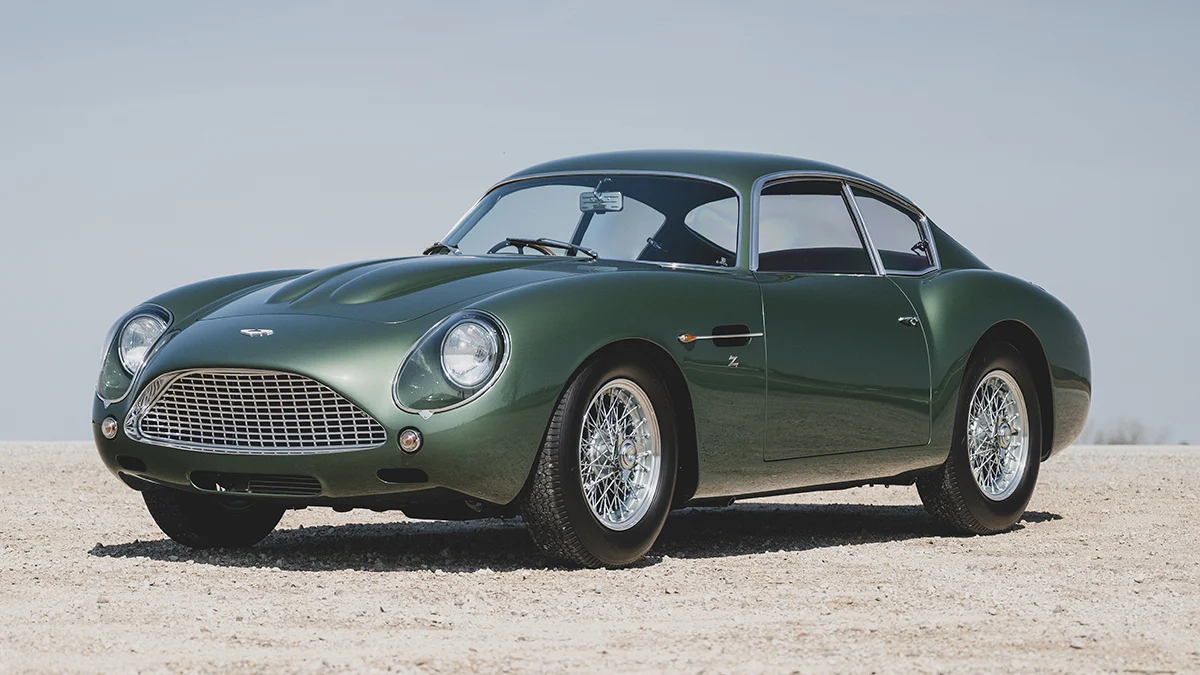
In the rarefied atmosphere of the classic car market, certain vehicles transcend the status of "collector’s item" to become artifacts of cultural and mechanical history. For the elite tier of automotive enthusiasts, the winning trifecta of provenance, rarity, and aesthetic significance is the holy grail. While the Ferrari 250 GTO often claims the spotlight as the world’s most expensive car, there exists a machine from the same era that is arguably more exclusive and historically intriguing: the Aston Martin DB4 GT Zagato.
With only 19 examples ever produced, the DB4 GT Zagato represents the pinnacle of 1960s Anglo-Italian collaboration. As one of these storied chassis—specifically No. 0186/R—prepares to cross the block at the RM Sotheby’s Monterey Auction this August, the automotive world is once again reminded why this model occupies a pedestal all its own.
The Genesis of an Icon: A "Ferrari Killer"
The story of the DB4 GT Zagato began at the 1960 Earls Court Motor Show, where Aston Martin unveiled the vehicle as a direct challenge to the dominance of Maranello. The standard DB4 GT was already a formidable machine, but Aston Martin sought to trim the fat and sharpen the handling to create a true “Ferrari killer.”
To achieve this, the company turned to the legendary Milanese coachbuilder Zagato. They assigned the project to Ercole Spada, a young visionary who had joined the firm just eight months prior. Tasked with reimagining the British grand tourer, Spada applied a signature Italian lightness to the chassis, stripping away excess weight and refining the aerodynamics. The result was a stunning fusion of British engineering and Italian flair, featuring a more curvaceous, aggressive silhouette and a high-performance 3.7-liter inline-six engine capable of producing upwards of 314 horsepower.
Despite the model’s lackluster performance at the 1961 24 Hours of Le Mans—where, owing to a series of mechanical misfortunes, none of the entries crossed the finish line—the car’s reputation as a track weapon was cemented elsewhere. It was a car born to race, and it possessed a charisma that eclipsed its early competitive stumbles.
A Chronology of Distinction: Chassis No. 0186/R
The specific example heading to Monterey, chassis No. 0186/R, holds a unique place in the model’s history. Unlike many of its peers that remained in Europe, this car was dispatched to Australia in December 1961.

The Early Racing Years
The car’s competitive debut was nothing short of sensational. Under the stewardship of owner Laurie O’Neill, the Zagato was entered into the 1962 GT Handicap at Calder. With the legendary three-time Australian Grand Prix champion Doug Whiteford behind the wheel, the car claimed a dominant victory. This was not a one-off performance; Whiteford steered the Aston to two additional victories that same season, effectively proving the car’s superiority on the track. However, as the 1960s progressed, changing FIA regulations rendered the car ineligible for various high-level competitions, leading to its eventual retirement from active racing.
Stasis and Rebirth
Following its racing career, the car traversed several ownership changes, eventually slipping into a period of dormancy that lasted nearly two decades. It remained in static storage, preserved like a time capsule until the 1990s, when the siren call of the U.K. historic racing circuit brought it back to the track.
The turn of the millennium marked a new chapter for 0186/R. Its then-steward committed to a comprehensive, no-expense-spared restoration, returning the car to the Zagato factory in Milan for a ground-up rejuvenation. The results were immediate and profound: the car secured a "Best of Show" award at the 2002 Louis Vuitton Concours d’Elegance. This success served as a catalyst for a decade of dominance on the global concours circuit, including class wins at the prestigious Villa d’Este and the Pebble Beach Concours d’Elegance.
In 2018, the car underwent a further 10-month, meticulous renewal by the specialists at Kevin Kay Restorations. This work ensured that every detail—from the interior upholstery to the engine bay—remained true to its original specifications. When it returned to Pebble Beach in 2019, it was selected as a finalist for Best of Show, reaffirming its status as one of the finest-preserved examples in existence.
Supporting Data: Why Rarity Drives Value
To understand why the DB4 GT Zagato is valued in the eight-figure range, one must look beyond its beauty and analyze the data of scarcity.
- Production Volume: Only 19 original DB4 GT Zagatos were built. Compared to the 36 (or 39, depending on the source) Ferrari 250 GTOs, the Aston Martin is significantly harder to come by.
- Coachwork: The Zagato body is a masterclass in weight reduction. By replacing steel components with aluminum and removing bumpers and other extraneous features, the car achieved a power-to-weight ratio that was revolutionary for its time.
- Restoration Provenance: A major factor in the value of 0186/R is the "chain of custody" regarding its maintenance. The involvement of both the original coachbuilder (Zagato) and top-tier specialists like Kevin Kay provides a documented paper trail that satisfies even the most discerning collectors.
Official Perspectives: The Market Experts
Gord Duff, the president of RM Sotheby’s, has been an outspoken advocate for the significance of this particular chassis. "It has the rarity, competition purpose, Italian coachwork, and design that define the very top of the market," Duff noted.

According to Duff, the car is "among the most desirable and important Aston Martins ever offered." His appraisal is reflected in the auction estimate, which places the vehicle in the $12 million to $15 million range. This estimate is not merely a reflection of the car’s mechanical components; it is an acknowledgment of the market’s insatiable demand for "Blue Chip" assets that combine history, beauty, and scarcity.
The Implications for the Collector Market
The upcoming sale at the RM Sotheby’s Monterey Auction will serve as a bellwether for the ultra-high-end collector car market. In recent years, the market has seen a shift toward "investment-grade" vehicles—those that not only provide the joy of ownership but also act as reliable hedges against inflation and market volatility.
The DB4 GT Zagato is the epitome of this trend. While many modern hypercars are produced in the hundreds, the 1962 Zagato belongs to an era when craftsmanship was driven by the pursuit of engineering perfection rather than computerized manufacturing. As the auction date approaches, potential buyers are not just bidding on a piece of machinery; they are bidding on the right to act as the temporary custodian of a significant piece of motoring heritage.
Whether it finds a home in a private museum, a climate-controlled vault, or is driven on the occasional rally, chassis 0186/R remains a testament to a time when Aston Martin dared to challenge the best in the world—and in doing so, created an icon that has never lost its luster. As the hammer falls in Monterey, it will likely confirm that the allure of the "Ferrari killer" remains as potent today as it was on the track in 1962.
 Evan Lee Salim
 Asep Darmawan
 Laily UPN
