

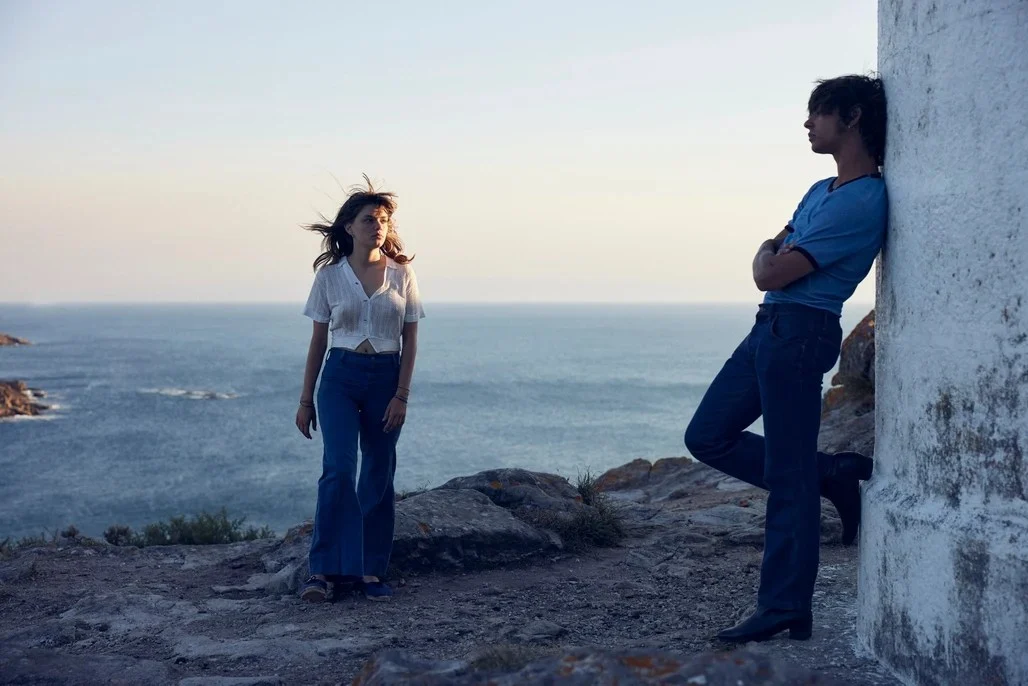
The coastline of Galicia, with its mist-shrouded Atlantic horizons and rugged cliffs, serves as the final backdrop for one of the most significant cinematic projects of the decade. Spanish filmmaker Carla Simón, a director who has spent her career excavating the silences of her own upbringing, has arrived at a definitive crossroads. With the U.S. release of Romería via Janus Films, Simón concludes a trilogy of memory that has not only defined her career but has also reshaped the landscape of contemporary European "autofiction."
Romería is more than a film; it is an act of emotional anthropology. Following her acclaimed debut Summer 1993 and the Golden Bear-winning Alcarràs, Simón’s latest work delves into the most painful and previously obscured chapters of her lineage: the lives of her biological parents, their descent into heroin addiction during the 1980s, and the legacy of the AIDS crisis that ultimately claimed them.
Main Facts: A Pilgrimage into the Past
Set primarily in 2004, Romería follows 18-year-old Marina (played by newcomer Llúcia Garcia), a stand-in for a teenage Simón. Marina travels to the seaside town of Vigo to meet her paternal grandparents, a family she has never known. Her objective is ostensibly pragmatic—she needs their endorsement for a film school scholarship—but her true journey is one of reconstruction.
The film is structured as a dialogue between two eras. In 2004, Marina navigates the awkward, often hostile reception from a family that has buried the memory of her father, Alfonso, under layers of shame and silence. Interspersed with this journey are 1980s-set sequences narrated through the voiceover of Marina’s mother’s diaries. These sequences are not merely flashbacks but are presented as a "fictionalized retelling," a way for a daughter to imagine the love story that preceded her own tragedy.
Visually, the film marks a high point for Simón’s collaboration with cinematographer Hélène Louvart. Lensed with a glittering, coastal beauty that contrasts sharply with the gritty reality of the subject matter, the film captures the "sublime and the harrowing" in equal measure. The casting of Llúcia Garcia is central to the film’s power; Garcia performs a dual role, playing both the teenage Marina and, in an ecstatic and agonizing drug-fueled sequence, her own mother.

Chronology: The Evolution of a Cinematic Memoir
To understand the weight of Romería, one must trace the chronological development of Simón’s filmography, which mirrors her own journey of self-discovery and healing.
1993–2004: The Real-Life Foundation
The seeds of Simón’s work were planted in tragedy. In 1993, at the age of six, Simón lost her mother to AIDS-related complications, having already lost her father to the same disease. She was sent to live with her aunt and uncle in a rural part of Catalonia. It wasn’t until 2004, the year in which Romería is set, that Simón—then a budding filmmaker herself—began to actively investigate the specifics of her parents’ lives, discovering her mother’s letters and the hidden history of her father’s family in Galicia.
2017: ‘Summer 1993’
Simón’s debut feature was an intimate, child’s-eye view of grief. It focused on the immediate aftermath of her mother’s death, capturing the confusion of a six-year-old girl trying to integrate into a new family. The film was a critical sensation, establishing Simón as a master of directing non-professional child actors and a poignant chronicler of domestic life.
2022: ‘Alcarràs’
While Summer 1993 was intensely personal, Alcarràs broadened the scope to the collective. It focused on a family of peach farmers facing eviction, drawing on Simón’s adoptive family’s history in rural Catalonia. The film won the Golden Bear at the Berlin International Film Festival, making Simón the first Spanish female director to win the top prize at a major "Big Three" festival.
2025–2026: The Arrival of ‘Romería’
Romería premiered in competition at the Cannes Film Festival in 2025. Its journey to the United States in June 2026 represents the final chapter of this cycle. During the film’s promotional tour, Simón revealed that the project’s completion coincided with the birth of her second child—a biological and creative synchronization that signaled her readiness to move beyond her own biography.

Supporting Data: Contextualizing the "Years of Lead and Heroin"
The "enrichment" of Romería comes from its historical context. To prepare her cast and ground the film in reality, Simón drew on the dark history of Spain in the mid-1980s. While the country was celebrating the Movida Madrileña and a new era of democratic freedom, a heroin epidemic was quietly hollowing out a generation.
Historical Context: The Stigma of the 80s
During the mid-80s, Spain saw a massive spike in intravenous drug use, which led to the country having one of the highest HIV/AIDS rates in Europe by the early 90s. Simón’s film highlights the specific social baggage of this era:
- The Silence of the Bourgeoisie: In the film, Marina’s paternal grandparents represent a class of Spaniards who viewed addiction not as a medical crisis, but as a moral failing to be hidden.
- The Dual Stigma: The film touches on the intersection of drug addiction, disease, and homophobia, as families struggled to reconcile their traditional values with the reality of the epidemic.
The Creative Process: Rehearsals and References
Simón’s methodology is rigorous. For Romería, she supervised three months of rehearsals, filming the process on a digital camcorder to mimic the "handicam" aesthetic Marina uses in the film. To help Llúcia Garcia understand the "ecstatic despair" of the 1980s drug scene, Simón curated a specific watch list of films:
- Arrebato (1979): Ivan Zulueta’s cult horror film about heroin and the "vampiric" nature of cinema.
- The Panic in Needle Park (1971): Jerry Schatzberg’s gritty portrayal of addiction in New York.
- Christiane F. (1981): The harrowing German film about teenage drug use in Berlin.
- More (1969): Barbet Schroeder’s sun-drenched tragedy set in Ibiza.
Simón also provided Garcia with her own mother’s actual letters, which were adapted into the film’s diary entries, ensuring that the dialogue between the past and present remained grounded in primary sources.
Official Responses: Healing Through the Lens
The reaction to Romería has been deeply personal, particularly within Simón’s own family. The filmmaker has often spoken about the "permission" required to tell these stories.

Simón told IndieWire that her uncle, with whom she is very close, not only read the script but eventually appeared in the film as a lawyer. "They all understood my need to make the film," Simón stated. "Even though it obviously opened their memory as well… for some of them, it was actually healing. For some, it was a bit painful, but they are OK."
Critics have hailed the film as a "visual masterpiece," noting that Simón’s ability to blend documentary-style intimacy with "visually breath-stopping" cinematography creates a unique sensory experience. Janus Films, the prestigious U.S. distributor, positioned the film as a major cultural event, emphasizing its role in "closing the door" on a specific era of Spanish history.
Implications: From Memory to the Future
The completion of Romería marks a significant shift for Carla Simón. After three films deeply rooted in her own life, she has announced that her fourth feature will be a musical. This departure suggests that the "emotional anthropologist" has finished her excavation.
The End of the Autobiographical Cycle
Simón’s transition away from autobiography is a deliberate choice. "I feel I explored them all already," she said of her biological and adoptive families. "Cinema has the possibility to get you to know worlds and universes that you wouldn’t somehow, no? That’s why, at the moment, I don’t need to explore my personal life anymore."
A Legacy of "Autofiction"
Simón’s trilogy will likely be studied as a definitive example of how personal trauma can be converted into universal art. By fictionalizing her life, she has provided a voice for the "AIDS orphans" of the 80s and 90s, a generation whose stories were often suppressed by national shame.

As Romería begins its theatrical run in the United States, it stands as a testament to the power of the camera to act as both a scalpel and a bandage. For Carla Simón, the film is a final letter to the parents she barely knew—a way to finally let them rest while she turns her gaze toward the future.
“Romería” is currently playing in select theaters across the United States.
 Lina Hope
 Asep Darmawan
 Jia Lissa
