

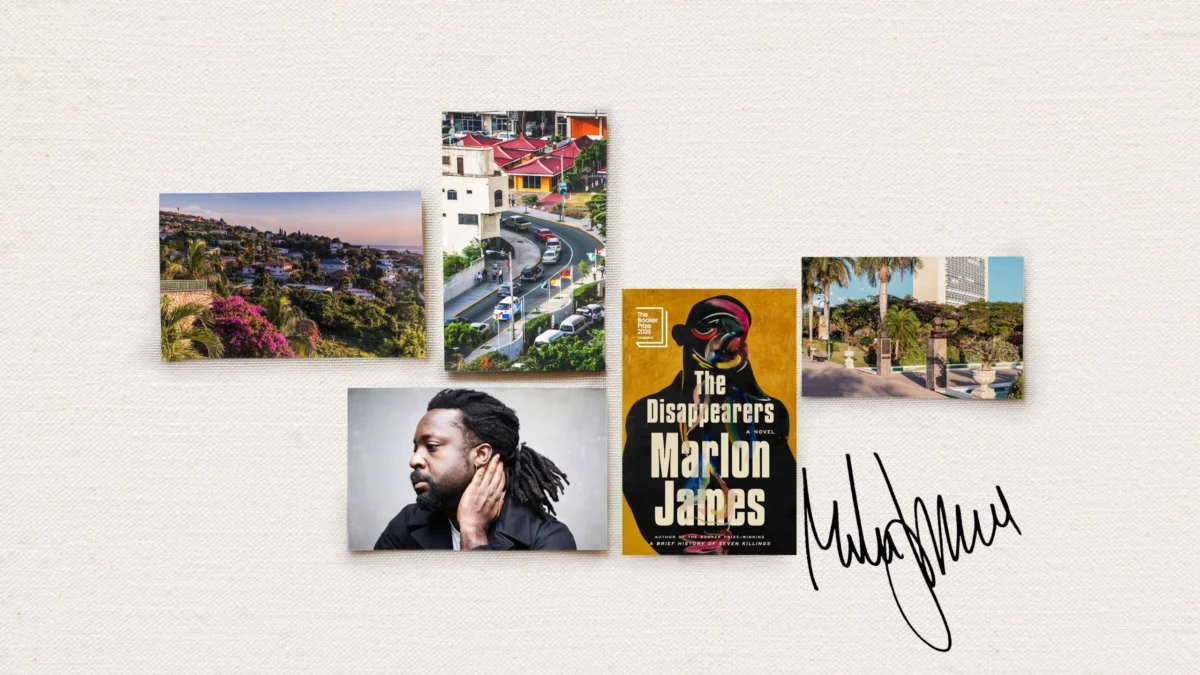
In his latest literary undertaking, the Booker Prize-winning author turns his gaze toward the shadows of his homeland to excavate a hidden, resilient past.
For the acclaimed novelist Marlon James, the process of writing has always been an act of investigation. However, with his latest novel, The Disappearers, the geography of his research shifted from the abstract to the deeply personal. A sprawling, 640-page narrative set against the volatile backdrop of 1980s and 90s Jamaica, the book chronicles the lives of a group of queer men who, while rehearsing a play, become the targets of a violent hate crime. As they navigate a society grappling with the specter of colonialism, the encroaching AIDS crisis, and the rigid social frameworks of the era, the survivors’ stories serve as a mirror to the complex, often silenced history of queer life in the Caribbean.
To build this world, James undertook a pilgrimage back to his hometown of Kingston. For an author who once distanced himself from the realities of Jamaican queer life—having spent his youth, as he puts it, "praying away the gay"—this journey was not merely professional. It was an act of reclamation.
The Geography of Silence: A Chronology of Research
James’s journey to write The Disappearers began in 2023, spanning two years of intensive field research. His approach was that of an ethnographer: he conducted dozens of interviews across Jamaica, as well as with members of the Jamaican diaspora in New Orleans, Toronto, and Montreal.
The Lost Era (1940s–1980s)
Contrary to the popular narrative that paints Jamaica as a monolithic space of unwavering homophobia, James’s research unearthed a vibrant, albeit clandestine, past. He discovered that in earlier decades, Kingston hosted a flourishing queer scene. Establishments like Fanny Hill, The Closet, and the jazz-centric Andante were hubs of culture where drag queens performed for diverse audiences, including celebrities and the political elite.
The Turning Point (1990s)
The late 1980s and 90s marked a sharp decline in this public visibility. James attributes this primarily to the intersection of the AIDS crisis and the island’s deeply religious social fabric. As preachers and public figures characterized the epidemic as divine retribution, the queer nightlife that had existed in the open was forced into the shadows. The communal, vibrant spaces of the past vanished, and for a generation of queer and trans Jamaicans, survival often meant emigration.
The Contemporary Landscape (2023–Present)
During his recent visits, James observed a palpable shift. He notes that the survival of venues like Mountambrin—an artists’ retreat near Montego Bay that has long served as a safe haven—and the emergence of vocal queer student associations at the University of the West Indies signal a new era of resilience. While the struggle is far from over, the current generation of queer youth in Jamaica is demanding, and asserting, a right to exist that differs sharply from the survival-mode mentality of their predecessors.
Uncovering the Data: The Evidence of Erasure
The process of writing The Disappearers was fraught with the difficulty of tracking a history that has been systematically erased. James notes that he has spent years searching for archival footage of Jamaica’s historic drag balls—evidence he believes exists but has been hidden, often by the community itself, as a defensive mechanism against persecution.
The Mechanics of Survival
James emphasizes that many older generations of queer Jamaicans prioritized safety over preservation. By destroying evidence of their lives—photographs, journals, or documentation—they protected themselves from potential violence. This makes the role of the novelist, according to James, even more critical. He views The Disappearers as a "record"—a way to use fiction to fill the voids that historical archives refuse to document.
The Power of Anecdote
The narrative of the book is bolstered by the testimonies James gathered. One particularly harrowing memory of a late-80s gay bashing, which James recalled from his own youth, remained unverified for decades. It was only through his recent interviews that he found individuals who could corroborate the event. These composite stories form the backbone of the novel, bridging the gap between historical fact and emotional truth.
Official Perspectives and Social Realities
While the atmosphere on the ground is changing, the institutional and social hurdles remain significant. James is careful not to present a "rosy picture" of progress.
The Persistence of Violence
The author acknowledges that the threats faced by the LGBTQ+ community in Jamaica are still severe. He points to ongoing reports from lesbian communities regarding daily threats of gender-based violence. Organizations like Equality for All (formerly the Jamaica Forum for Lesbians, All-Sexuals and Gays) continue to fight an "uphill battle" against deeply entrenched prejudices.
The Generational Divide
There is a distinct tension between the "it gets better" narrative often imposed by outsiders and the lived reality of Jamaican youth. James recalls an interaction with students at his alma mater, the University of the West Indies, who pushed back against his attempts at offering life advice. They expressed a desire to focus on the trivial, age-appropriate concerns of being 19—such as pop culture debates over Beyoncé versus Rihanna—rather than the constant, existential threat of violence. For James, this was a moment of profound clarity: the desire to simply be young is a radical, and necessary, form of progress.
The Implications: Why Fiction Matters
The publication of The Disappearers raises broader questions about how a nation acknowledges its own history.
The Limitations of Traditional History
James argues that history books, by their nature, tend to focus on the lives of the powerful—politicians, monarchs, and figures of status. By centering his narrative on "regular people," James aims to illustrate the "extraordinary" nature of ordinary lives. In doing so, he challenges the reader to consider who gets to be the protagonist of history.
The Traveler’s Perspective
For James, the act of traveling for this book changed his relationship with his own country. He describes a method of "unpacking his bags completely" in every city he visited, a ritual designed to ground himself and stop viewing his homeland as a tourist would. By settling in, he allowed himself to see Jamaica on its own terms, rather than through the lens of a departing expatriate.
A Legacy of Reclamation
Ultimately, The Disappearers serves as a testament to the endurance of identity. By creating characters who feel "too real," James has ensured that the erased histories of those who lived through the 80s and 90s are now preserved in the cultural consciousness.
As the novel hits bookshelves, it stands not just as a work of fiction, but as a bridge. It invites readers to look past the tropical facade of the Caribbean and into the complex, often painful, but ultimately vital histories that pulse beneath the surface. Through his meticulous research and empathetic storytelling, Marlon James has proven that while some things may be forced to disappear, they can—and must—be found again.
 Sagoh
Sagoh
 Asro
Asro
