

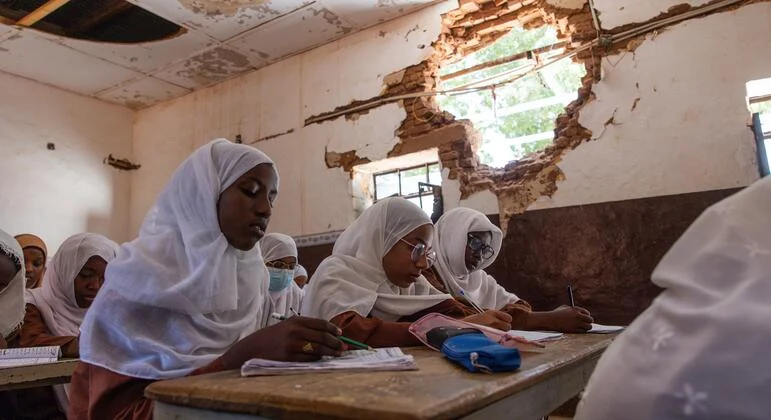
Introduction: The Erosion of Safe Havens
For generations, the schoolhouse has been viewed as a sanctuary—a neutral zone where the promise of the future is nurtured, regardless of the political or military storms raging outside. However, that fundamental global norm is rapidly disintegrating. According to Education Cannot Wait (ECW), the United Nations’ global fund for education in emergencies, we are witnessing an unprecedented assault on the right to learn.
As the world marks the International Day to Protect Education from Attack, the data paints a harrowing portrait: 258 million children across 87 countries are currently facing severe learning disruptions. This is not merely a logistical failure of infrastructure; it is a systematic dismantling of childhood security. Driven by a backdrop of escalating geopolitical conflict, a dangerous decline in military restraint, and the blatant disregard for international humanitarian law, the classroom has increasingly become a target rather than a refuge.
Main Facts: A Statistical Catastrophe
The scale of the devastation is best quantified by the surge in violence over the past two years. Recent reports partnered by ECW indicate that 2024 and 2025 have witnessed record-high figures for attacks on educational institutions and the military occupation of schools.
The Numbers Behind the Tragedy:
- Total Attacks: At least 9,259 verified attacks on education were recorded, representing a staggering 50% increase compared to the 2022–2023 period.
- Direct Assaults on Schools: Of these, more than 3,600 were direct strikes against school buildings.
- Human Toll: More than 10,600 students and educators have been killed, injured, or abducted during this period.
- Military Occupation: The use of schools and universities for military purposes—turning learning centers into barracks or weapon depots—has nearly doubled, effectively stripping students of their protected status under the laws of war.
These figures represent more than just data points; they represent the systemic erasure of a generation’s potential. In the 28 countries most heavily profiled, the presence of conflict has rendered the pursuit of basic literacy and numeracy a life-threatening endeavor.
Chronology of Escalation
The decline in the safety of educational spaces has not been sudden, but rather a steady, calculated erosion of norms.
- Pre-2022: While conflict-affected regions always posed risks, international norms—such as the Safe Schools Declaration—had begun to create a framework for protecting education.
- 2022–2023: A notable rise in global instability led to a sharp uptick in school closures and the targeting of educators, particularly in regions experiencing protracted civil unrest and cross-border conflicts.
- 2024–2025: This period marks a catastrophic inflection point. The normalization of fighting in densely populated urban centers has led to the highest recorded number of grave violations against children in history.
The shift toward urban warfare has meant that schools, often located in the heart of civilian populations, are increasingly caught in the crossfire of airstrikes, artillery, and the use of explosive drones. The "Laws of War," which mandate the protection of civilian infrastructure, are being ignored with impunity, as government forces have, for the first time, been identified as the primary perpetrators of these grave violations.
Supporting Data: The Geography of Vulnerability
The UN Secretary-General’s Annual Report on Children and Armed Conflict provides a grim spatial analysis of where children are most at risk. In 2025, over 38,500 verified violations against children were recorded, impacting 24,174 individual minors.
The Epicenters of Violence
The report identifies a hierarchy of suffering, with the highest concentration of grave violations occurring in:
- Israel and the Occupied Palestinian Territory
- The Democratic Republic of the Congo
- Nigeria
- Myanmar
- Somalia
In these regions, the violation of education rights is often part of a wider pattern of abuse, including the recruitment of child soldiers, abduction, and the denial of humanitarian aid.
The Demographic Gap
The crisis is not distributed equally. According to UNESCO, approximately 74 million out-of-school children living in crisis-affected areas are concentrated in just 20 countries. Within these environments, the most vulnerable suffer the most:
- 74% of refugee children are currently out of school.
- 52% of internally displaced children lack access to formal education.
- 45% of children with disabilities in conflict zones are entirely excluded from learning systems.
Official Responses and Ethical Imperatives
The international community, led by agencies like UNESCO and Education Cannot Wait, is sounding the alarm with increasing urgency. The consensus is clear: education is not a luxury that can be deferred until "after" a conflict ends; it is a critical life-saving intervention.
The Perspective of Education Cannot Wait
Maysa Jalbout, Director of ECW, has been vocal about the long-term implications of these attacks. "When a child is denied schooling for years, the consequences are immediate and profound," Jalbout stated. "It means forgotten literacy, lost routines, and a future dictated by recruiters or traffickers, rather than teachers."
For Jalbout, the school environment provides more than just an academic curriculum; it offers "safety, stability, a sense of normalcy, and a path toward a future beyond crisis." The organization’s "Hope Starts Here" campaign is currently seeking $600 million in funding to provide safe, quality education to 10 million children trapped in the world’s most dangerous regions.
The Role of International Law
UNESCO has issued a stern reminder to all parties involved in active conflict: education is a protected human right. The agency stresses that the laws of war, specifically those prohibiting the targeting of civilian infrastructure, must be strictly enforced. The shift toward government forces being the primary aggressors in 2025 creates a new diplomatic challenge, as traditional pressure tactics are often less effective against sovereign states than against non-state armed groups.
Implications: The Lost Generation
The implications of this crisis extend far beyond the individual child. When a generation is denied education, the prospects for national stability, economic development, and peace-building evaporate.
1. The Security Vacuum
When schools close, children do not simply stop learning; they become easy prey for criminal networks, insurgent recruiters, and human traffickers. By failing to provide education, the global community is effectively leaving the door open for these children to be radicalized or exploited, creating a cycle of violence that will haunt the next 50 years.
2. The Loss of Human Capital
Education is the engine of post-conflict recovery. A nation that has lost its teachers, its engineers, its doctors, and its civic leaders to the chaos of war is a nation that cannot rebuild. The current crisis is ensuring that the "post-war" future in many countries will be defined by a massive deficit in skilled labor and intellectual leadership.
3. The Normalization of Atrocity
Perhaps most chilling is the implication of the rising statistics: we are becoming accustomed to the destruction of schools. The nearly 100% increase in the military use of schools suggests that schools are no longer being viewed as "protected." This normalization poses a long-term threat to global humanitarian norms. If schools are not sacred, what is?
Conclusion: A Call to Action
The data is incontrovertible. We are in the midst of an emergency that requires more than just rhetoric. The targeting of education is a strategic choice made by those who wish to destabilize communities and erase futures.
To reverse this trend, the international community must move beyond the current levels of funding and enforcement. This requires:
- Increased Accountability: Implementing mechanisms to track and penalize both state and non-state actors who utilize schools for military purposes.
- Prioritized Funding: Supporting initiatives like "Hope Starts Here" to provide the immediate resources necessary to keep schools open in active conflict zones.
- Diplomatic Pressure: Ensuring that the protection of education is a non-negotiable pillar in every peace negotiation and ceasefire agreement.
The children of the world’s "toughest places" are waiting. They are not waiting for more reports or more days of commemoration—they are waiting for the safety and the dignity that only a functioning school can provide. If the world fails to act, the future of these millions of children will not be written in textbooks, but in the annals of the conflicts that stole their childhoods.
 Lina Hope
 Asro
Asro
 Layla Zulfa
