

By Olivia McEwan
The recent passing of David Hockney at age 88 has left a void in the art world, triggering a global retrospective of a career defined by its restless innovation. Yet, the final chapter of this prolific life, currently on display at London’s Serpentine North Gallery, presents a complex, often polarizing legacy. Titled A Year in Normandie and Some Other Thoughts About Painting, the exhibition invites a rigorous debate: does the digital medium—specifically the iPad—serve as a legitimate evolution of Hockney’s masterful hand, or does it represent a dilution of the tactile urgency that once defined his work?
Main Facts: A Digital Tapestry in Hyde Park
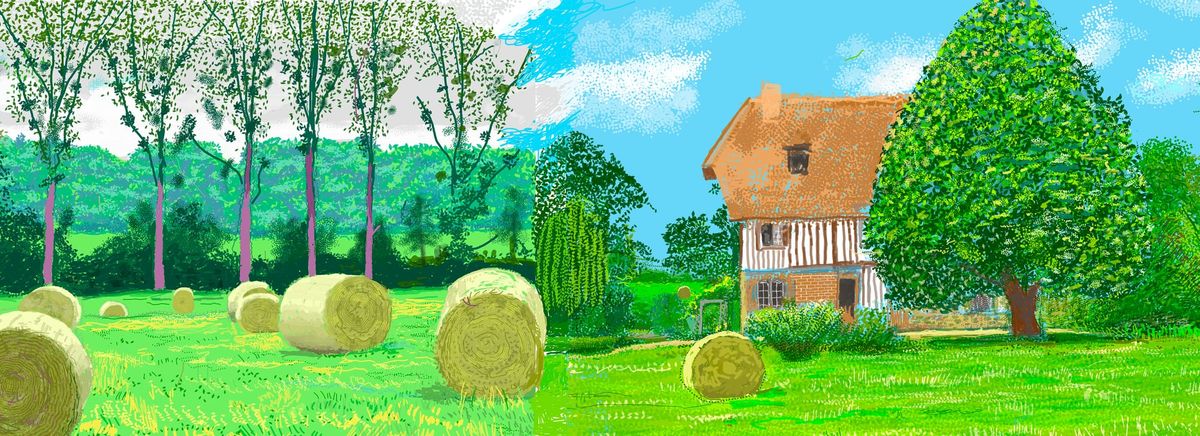
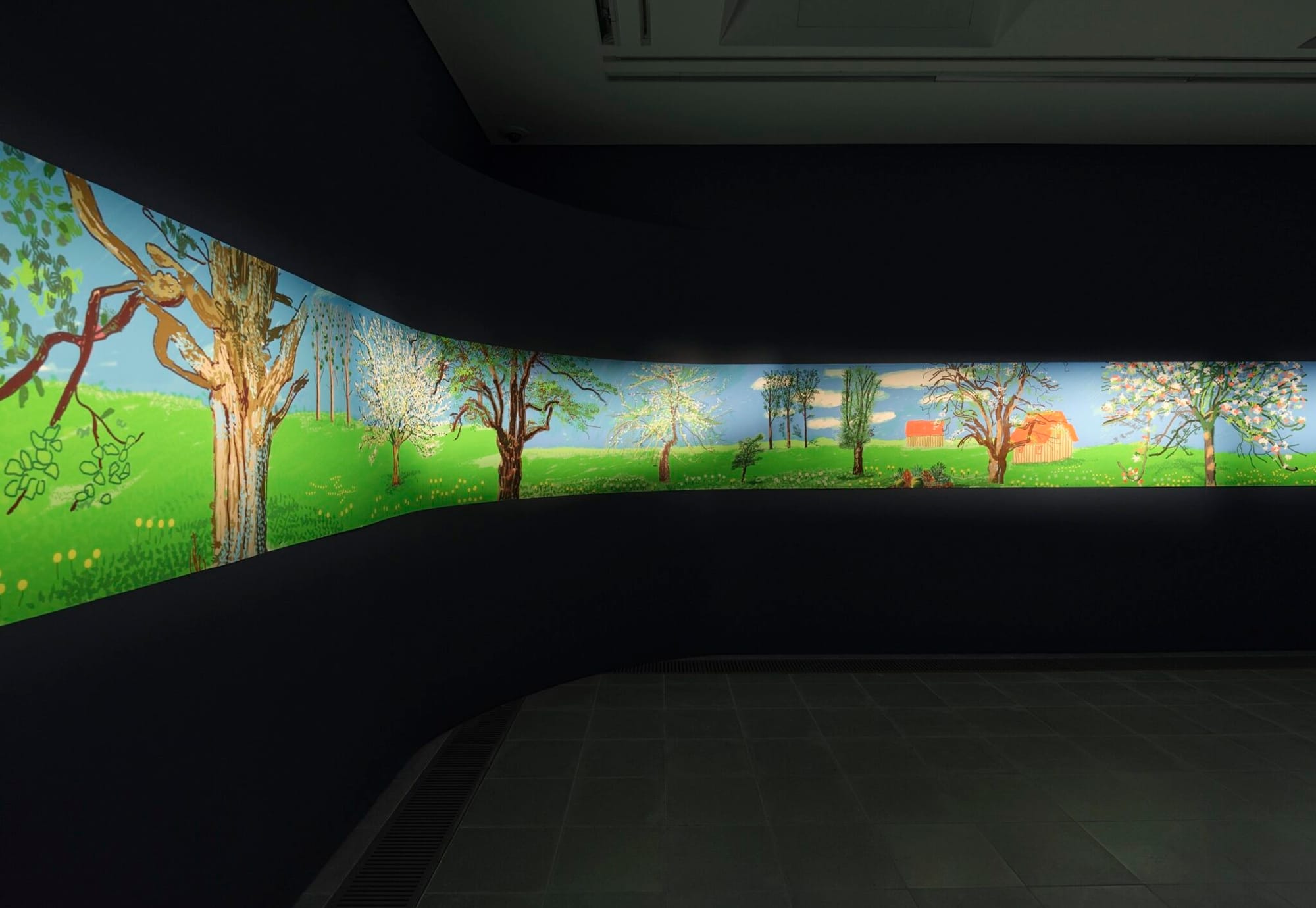
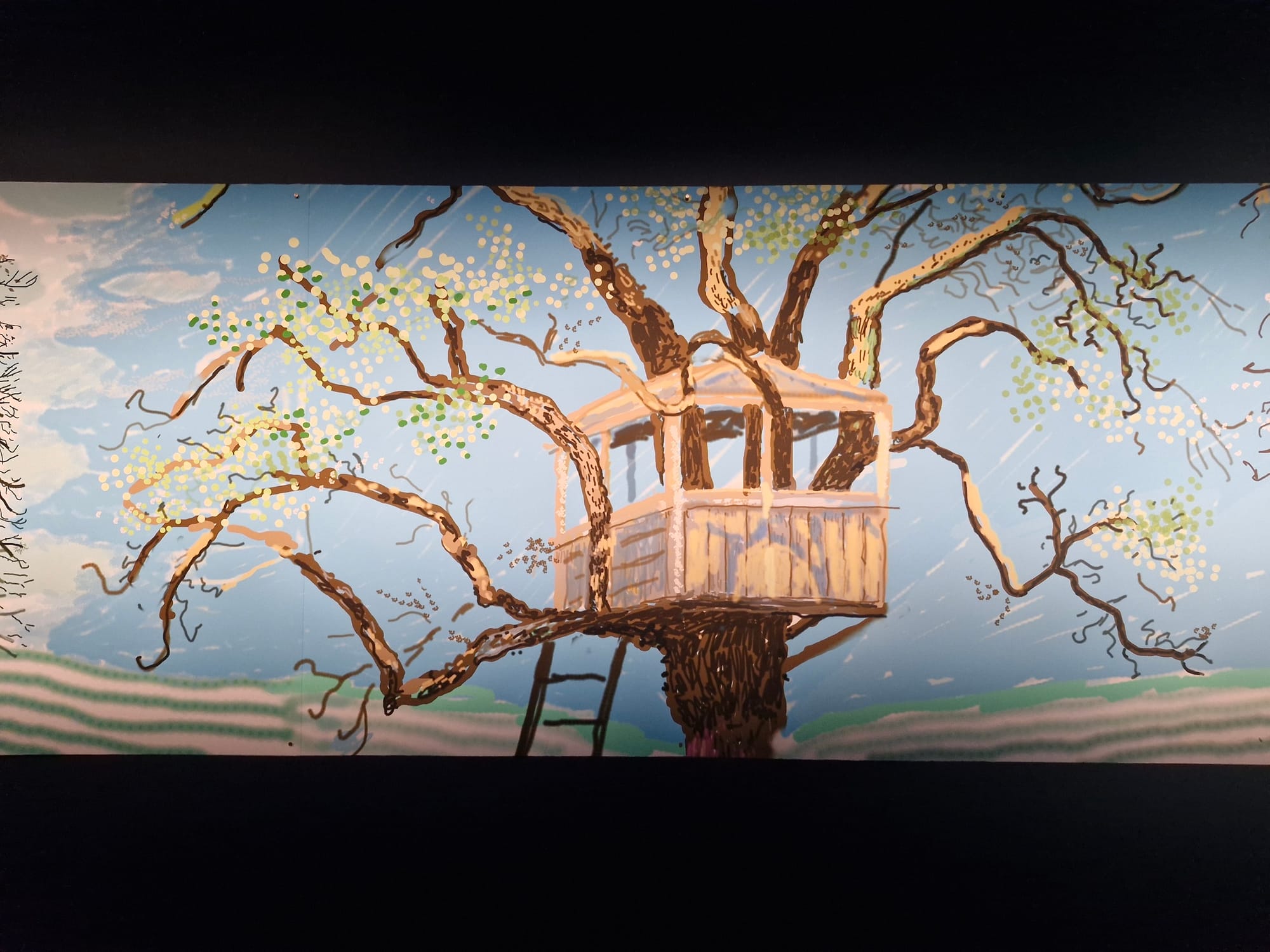
The centerpiece of the Serpentine exhibition is a staggering 295-foot-long composite digital "painting" titled A Year in Normandie (2020–21). The work, which encircles the gallery’s interior, consists of over 100 printed iPad panels digitally "stitched" together to create a continuous panoramic vista of the changing seasons in the French countryside.
The scale of the work is intentionally provocative. By creating a digital frieze that surpasses the length of the famed 11th-century Bayeux Tapestry—which measures approximately 230 feet—Hockney entered into an implicit, perhaps even cheeky, dialogue with art history. While the Bayeux Tapestry is a singular masterpiece of narrative embroidery, Hockney’s work relies on the infinite replicability of the digital file. The exhibition, curated by Hans Ulrich Obrist, Claude Adjil, and Liz Stumpf, frames this massive undertaking as a fusion of "ancient traditions" and "digital tools," drawing comparisons to 14th-century Chinese scroll paintings.
Chronology of a Late-Career Pivot
Hockney’s relationship with technology was never a sudden pivot; it was a decades-long fascination with the intersection of optics and medium. However, his final years were dominated by the glow of the tablet.
- 2020–2021: Hockney produces A Year in Normandie during the height of the global pandemic, utilizing the iPad as his primary tool to document the landscape from his Normandy home.
- March 2026: The exhibition opens at the Serpentine Galleries, coinciding with a period of intense public interest in the Bayeux Tapestry, which had recently returned to England for a loan at the British Museum.
- May 2026: David Hockney passes away at the age of 88, transforming the Serpentine exhibition from a new creative project into an unintentional valedictory statement.
- Present Day: The exhibition continues through August 23, serving as a focal point for critics and fans attempting to reconcile the artist’s legacy with his final digital experiments.
Supporting Data: The Limitations of the Screen
Despite the immense curatorial effort to position these digital prints as a revolutionary leap, the visceral experience of the work tells a different story. The exhibition’s wall text emphasizes "encouraging movement and close looking," but the digital medium imposes a rigid aesthetic uniformity.

The iPad, as a tool for "painting," is inherently constrained by the software developers who write its code. Unlike the organic unpredictability of oil on canvas, the digital mark is defined by algorithmic precision. When examined closely, the vistas in A Year in Normandie appear curiously flat. Flowers, which in Hockney’s early works were rendered with complex brushwork and color theory, are reduced to repetitive, uniform yellow circles.
The "stitched" nature of the work—a result of piecing together disparate screen captures—creates a dissonance in perspective that the exhibition’s notes attempt to explain away as a call to shift one’s viewpoint. Yet, for the seasoned observer of Hockney’s work, the result feels less like an invitation to gaze and more like a triumph of technical convenience over artistic depth. The inkjet prints, which require specific lighting conditions—intense spotlights and dark walls—to gain any semblance of emotional weight, suffer when compared to the physical presence of paint on canvas.
Official Responses and Curatorial Intent
The Serpentine Galleries have stood by the exhibition as a testament to Hockney’s "endless invention." The curation is designed to provide a comprehensive look at how the artist reconciled his love for traditional representational norms with the digital tools of the 21st century.
Hans Ulrich Obrist and his team have framed the show as a continuation of Hockney’s lifelong motto: "Look with both eyes." This slogan, which appears on merchandise throughout the museum gift shop, serves as the thematic anchor for the exhibition. The curators argue that by using the iPad, Hockney was not abandoning tradition but rather extending it into a new, contemporary vernacular. They highlight the "fusing" of ancient Chinese scroll techniques with modern technology as proof of his intellectual curiosity.
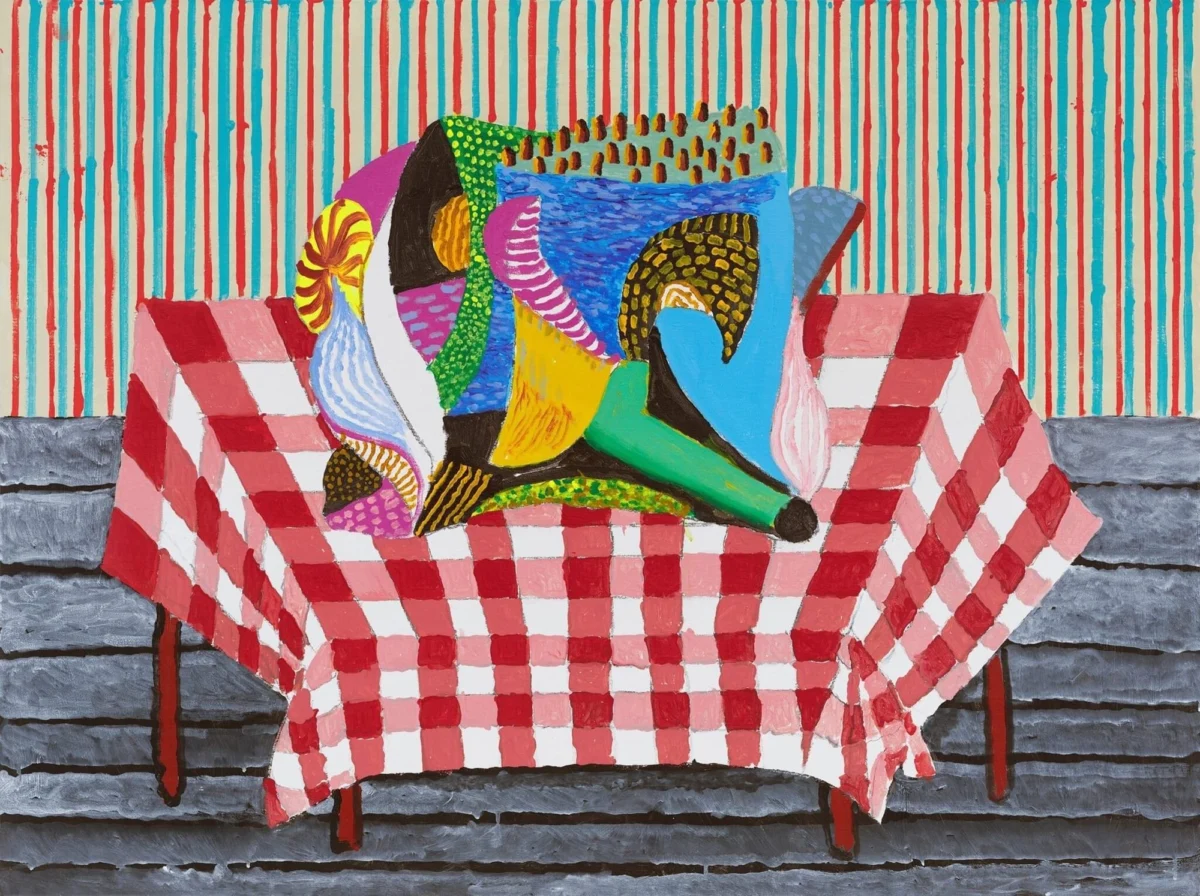
However, this narrative of "invention" is countered by the very paintings that sit in the gallery’s "inner sanctum." In these final acrylic works from late 2025, Hockney demonstrates that his traditional prowess remained sharp until the very end.
Implications: A Legacy Re-Examined
The implications of this exhibition reach far beyond the walls of the Serpentine. As the art world prepares for a major retrospective at Tate Britain next year, the question of how we value the "late style" of an artist becomes critical.
The contrast between the iPad prints and the physical canvases in the exhibition is stark. In the latter, Hockney explores the "paint-and-drag" techniques of Gerhard Richter and experiments with reversed perspectives in a way that feels daring and alive. These acrylic paintings, which feature sitters and references to the Tower of Babel, possess a tactile luminosity that the digital work lacks.
There is a danger, perhaps, in the industry’s desire to "wring as much as possible" from an aging master. In our haste to celebrate every output of a prolific legend, we risk conflating the ease of a digital tool with the depth of true artistic innovation.
Does the iPad matter? If it allowed Hockney to continue creating when his physical mobility was waning, then its utility is undeniable. Yet, to position these digital doodles as the pinnacle of his achievement is a disservice to the man who once changed the way we perceived light, color, and space. Hockney’s legacy is secure, built on a lifetime of rigorous observation and manual skill. The digital experiments may prove to be a footnote—a curious, perhaps even contradictory, coda to a life that spent 80 years proving that the most profound insights are found not on a screen, but in the messy, human, and physical act of putting implement to surface.
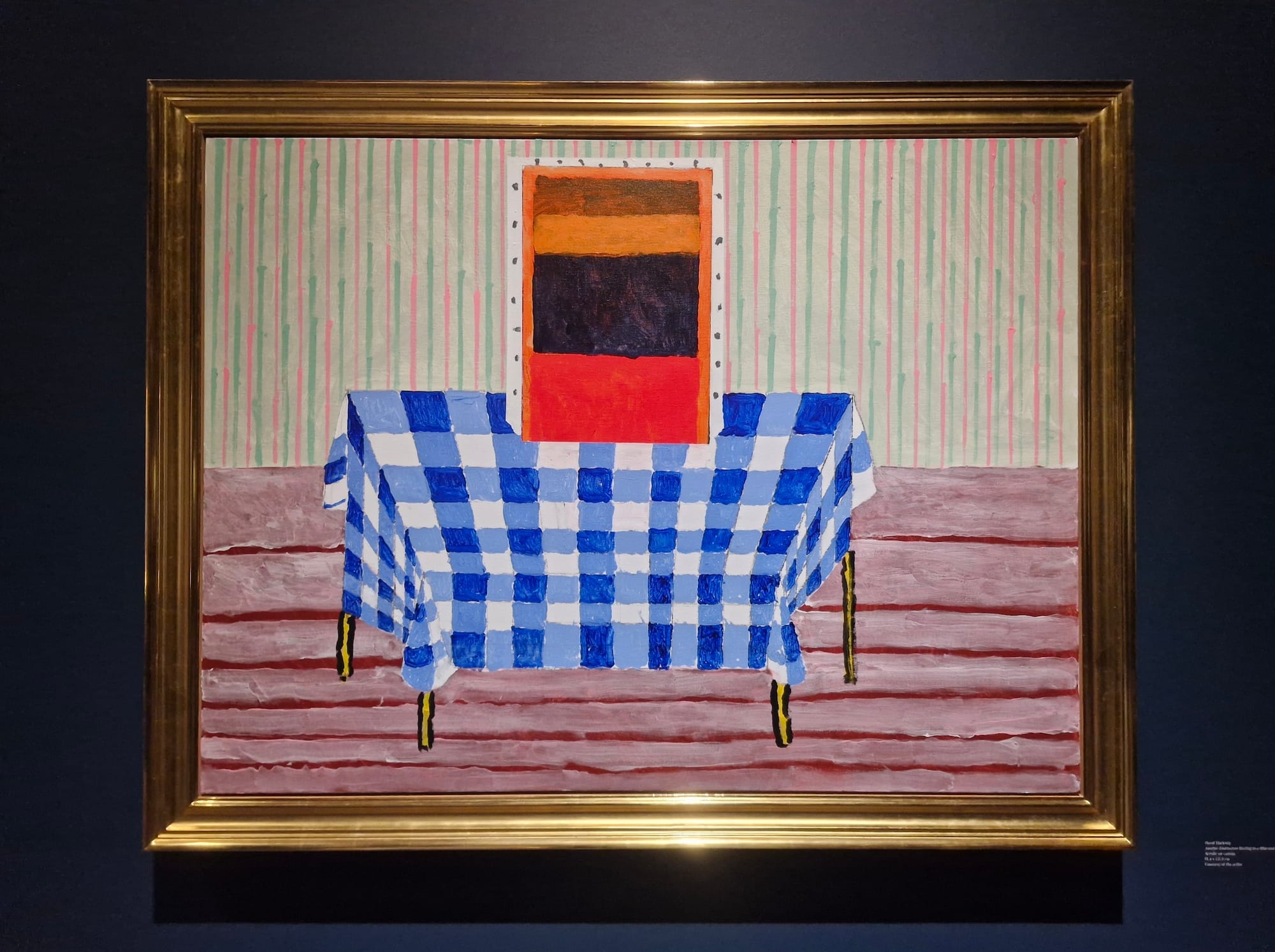
As we look toward the Tate retrospective, we must be careful to distinguish between the artist’s enduring mastery and the limitations of his final, electronically mediated efforts. We can love David Hockney and still acknowledge that, in his final reach for the future, he may have lost some of the tactile magic that made him a titan of the 20th century.
 Basiran
 Muslim
 Evan Lee Salim
