

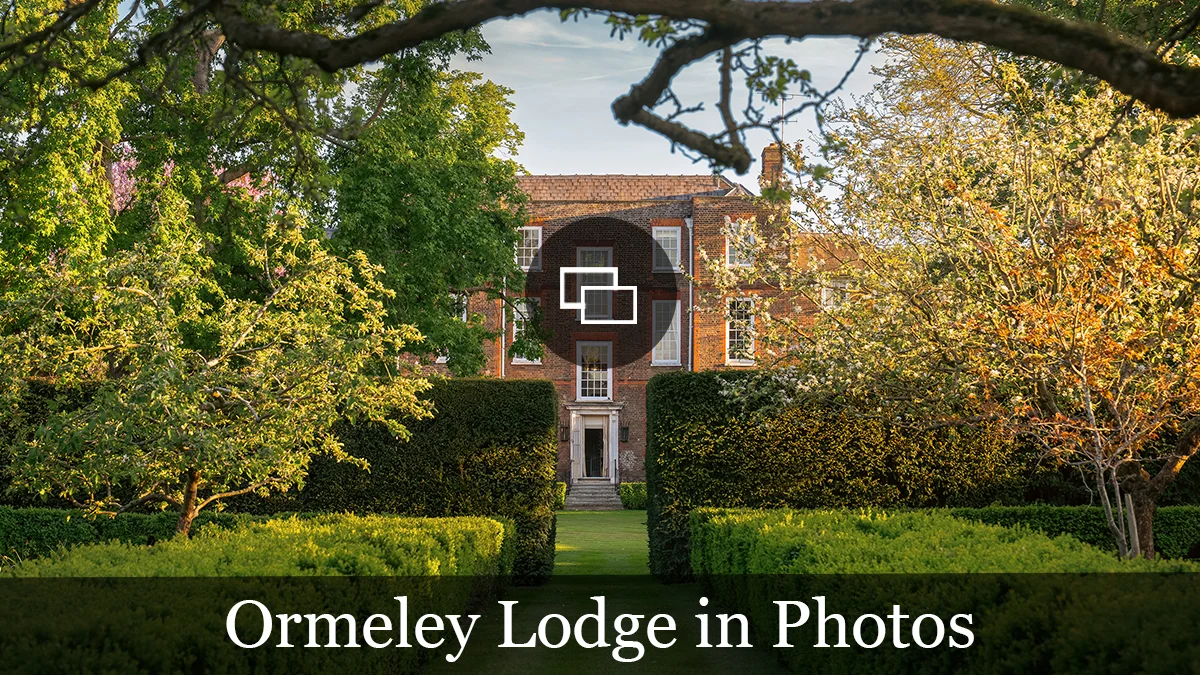
For over half a century, the heavy iron gates of Ormeley Lodge in Ham, Surrey, did more than just secure a private residence; they acted as a gateway to one of the most vibrant and exclusive social circles in British history. The late Lady Annabel Goldsmith—the legendary hostess and socialite for whom the world-famous private members’ club Annabel’s was named—turned this Georgian estate into a sanctuary for the global elite. Now, following her passing at age 91, the property has officially hit the market, inviting a new generation to step into a piece of living history for £25 million ($33.5 million).
A Bastion of British History
Listed with both Knight Frank and UK Sotheby’s International Realty, Ormeley Lodge is not merely a home; it is a cultural monument. Situated in one of London’s most idyllic and protected enclaves, the estate represents a rare synthesis of architectural grandeur and intimate, lived-in luxury.

The house, which dates back to the early 1700s, stands as a Grade II-listed testament to Queen Anne and early Georgian architectural mastery. Spanning an impressive 15,800 square feet, the residence manages to maintain a sense of warmth despite its scale. This balance is largely attributed to the legendary design firm Colefax & Fowler, who curated interiors that emphasize a "lived-in" elegance, softening the formality of 11-foot ceilings, intricate plasterwork, and oversized, light-drenched sash windows.
The Social Tapestry: A Chronology of Influence
To understand the significance of Ormeley Lodge, one must look at the guest list that defined its tenure under Lady Annabel Goldsmith. For decades, the house was a revolving door of the era’s most influential figures. Royalty, A-list Hollywood actors, titans of industry, and the most incisive journalists of the 20th century found common ground within these walls.

The 1970s and 80s: The Golden Age of the Lodge
During the 1970s and 1980s, Lady Annabel—married to the financier Sir James Goldsmith—cultivated an atmosphere that was famously egalitarian among the elite. It was a place where social boundaries dissolved. Guests were invited to participate in a lifestyle that prized wit, intellectual debate, and discretion.
The 1989 Royal Pivot
Perhaps the most indelible moment in the estate’s history occurred in 1989. As the media landscape shifted and the scrutiny on the British Royal Family intensified, Ormeley Lodge became the silent witness to a pivotal shift in modern history. It was here, during a birthday celebration, that Princess Diana famously confronted Camilla Parker Bowles. This incident, often cited by historians and biographers as a turning point in the breakdown of the Prince and Princess of Wales’s marriage, solidified the estate’s place in the annals of royal lore. The house served not just as a backdrop, but as a silent participant in the drama that would define the British monarchy for the remainder of the century.

Architectural and Botanical Splendor
Beyond the house’s interior lies a 2.3-acre botanical masterpiece. The grounds of Ormeley Lodge have been meticulously curated over the decades, functioning as a series of distinct outdoor rooms that offer both structure and wild beauty.
The Gardens
The formal knot garden, designed by the renowned landscape architect Arabella Lennox-Boyd, provides a geometric anchor to the estate. Complementing this, borders planted by the celebrated Mary Keen add a lush, seasonal vibrancy. The gardens have frequently been opened to the public via the National Gardens Scheme, reflecting Lady Annabel’s long-standing commitment to community and shared appreciation for horticultural excellence.

Beyond the formal gardens, the estate features:
- A productive kitchen garden and orchard, providing a self-sustaining touch to the estate.
- Wildflower meadows, which blend seamlessly into the surrounding Ham Common Woods Nature Reserve.
- Leisure amenities, including an all-weather tennis court, a pristine swimming pool, and an historic aviary.
- The Mews Buildings, a collection of structures across the courtyard that house staff/guest cottages, extensive garaging, and storage, ensuring the estate remains fully operational and self-contained.
A Rare Oasis in the Capital
One of the most compelling aspects of the £25 million listing is its geographical paradox. Despite being situated less than 10 miles from the heart of Buckingham Palace, Ormeley Lodge feels like a remote country estate. It is bordered by the Ham Common Woods Nature Reserve and sits on the very threshold of Richmond Park, the largest of London’s Royal Parks.

In this setting, the new owners will inherit more than just a home; they will inherit a lifestyle defined by the proximity of 2,500 acres of protected parkland, where herds of deer roam freely and the noise of the city is entirely muted. It is a rare "rural" experience located within the M25, a commodity that is increasingly scarce in the modern property market.
Official Perspectives: The Market’s Reaction
The scale and provenance of the property have garnered significant attention from the global real estate community. Paddy Dring, the global head of prime sales and joint head of Knight Frank’s Private Office, underscored the rarity of this offering.

"The sale of Ormeley Lodge represents a rare chance to acquire not only a remarkable residence, but also a part of British cultural heritage," Dring noted in an official statement. "Opportunities to secure a house of this size and character, surrounded by such established, picturesque and expansive gardens in a London setting, are very uncommon. It is a property that defies the standard market metrics because it captures an intangible history that cannot be replicated."
Implications for the Future
The listing of Ormeley Lodge marks the end of a specific chapter in London’s social history. As the property transitions to its next owner, the market is watching closely to see who will step into the role of steward for this iconic estate.

For the buyer, the property offers 10 bedrooms, seven bathrooms, and a legacy that few other homes in England can claim. However, the true value lies in its preservation. Any future development or renovation will likely be dictated by its Grade II-listed status, ensuring that the integrity of the architecture remains intact for future generations.
The sale is also a reflection of a broader trend in the high-end property market: the flight to "trophy" estates. As the global ultra-high-net-worth demographic looks for properties that offer both security and historical pedigree, homes like Ormeley Lodge—which combine privacy, heritage, and prime location—are seeing renewed interest.

Conclusion: A Living Legacy
As the sun sets on the era of Lady Annabel Goldsmith at Ormeley Lodge, the house stands ready for its next incarnation. Whether it continues as a private family residence or transforms into a new hub for cultural life, the estate remains an anchor point in the story of London’s elite.
The price tag of £25 million serves as a benchmark for the prestige attached to the address. For those with the means, it is more than a transaction; it is an invitation to inhabit a space where history was made, secrets were shared, and the very fabric of British society was woven. As the market processes this rare listing, one thing remains certain: there is only one Ormeley Lodge, and its future is as intriguing as its storied past.

For those interested in exploring the details of the estate further, official documentation and photographic archives of the property are available through Knight Frank and UK Sotheby’s International Realty.
 Evan Lee Salim
 Asep Darmawan
 Laily UPN
