

Santa Fe, New Mexico, is often described by the moniker “The City Different”—a title that, for those who have walked its winding, dust-hued streets, feels less like a marketing slogan and more like a profound understatement. As the oldest state capital in the United States, Santa Fe serves as a living museum, a high-desert sanctuary where Indigenous heritage, Spanish colonial history, and a radical, avant-garde artistic spirit converge under the vast, turquoise skies of the Sangre de Cristo Mountains.
For three decades, travelers have sought refuge in this high-altitude enclave. Whether they are drawn by the meditative silence of the desert, the intoxicating aroma of piñon smoke drifting from kiva fireplaces, or the world-class culinary landscape that elevates green chile to a high art form, Santa Fe continues to command a central role in the American travel consciousness.
The Evolution of a Cultural Landmark: A Chronology
To understand the magnetic pull of Santa Fe, one must look at the layers of history that define its geography and identity.
- Pre-1610 (Indigenous Roots): Long before European arrival, the area was settled by Tewa-speaking Indigenous peoples. The ancestral Puebloan connection remains the bedrock of Santa Fe’s cultural authenticity, visible today in the thriving pueblos that surround the city.
- 1610 (Founding): Santa Fe was established as the capital of the Kingdom of New Mexico by Don Pedro de Peralta. It remains the oldest state capital in the U.S., possessing an architectural soul that has been fiercely protected for over four centuries.
- Early 20th Century (The Artistic Boom): Following the arrival of the railroad, the city became a magnet for painters, poets, and writers fleeing the industrial malaise of the East Coast. Figures like Georgia O’Keeffe found in the stark, rhythmic landscapes of the high desert a visual language that would define American Modernism.
- 1970s–1990s (Cultural Preservation): During this period, the city implemented strict architectural ordinances, ensuring that the “Pueblo-Revival” style—defined by flat roofs, adobe construction, and earth-toned stucco—would become the permanent visual signature of the city.
- 2000–Present (The Modern Renaissance): With the rise of the digital nomad era and the mainstreaming of immersive art (notably through the meteoric success of Meow Wolf), Santa Fe has transitioned from a quiet artist’s retreat into a premier global destination, balancing tradition with a forward-thinking, contemporary edge.
Architecture as Narrative: The Staying Power of Adobe
Santa Fe’s architecture is not merely a style; it is an environmental response. The signature adobe walls, with their rounded edges and thick, thermal-mass construction, provide a cooling sanctuary during the scorching summer days and retain heat during the crisp mountain winters.
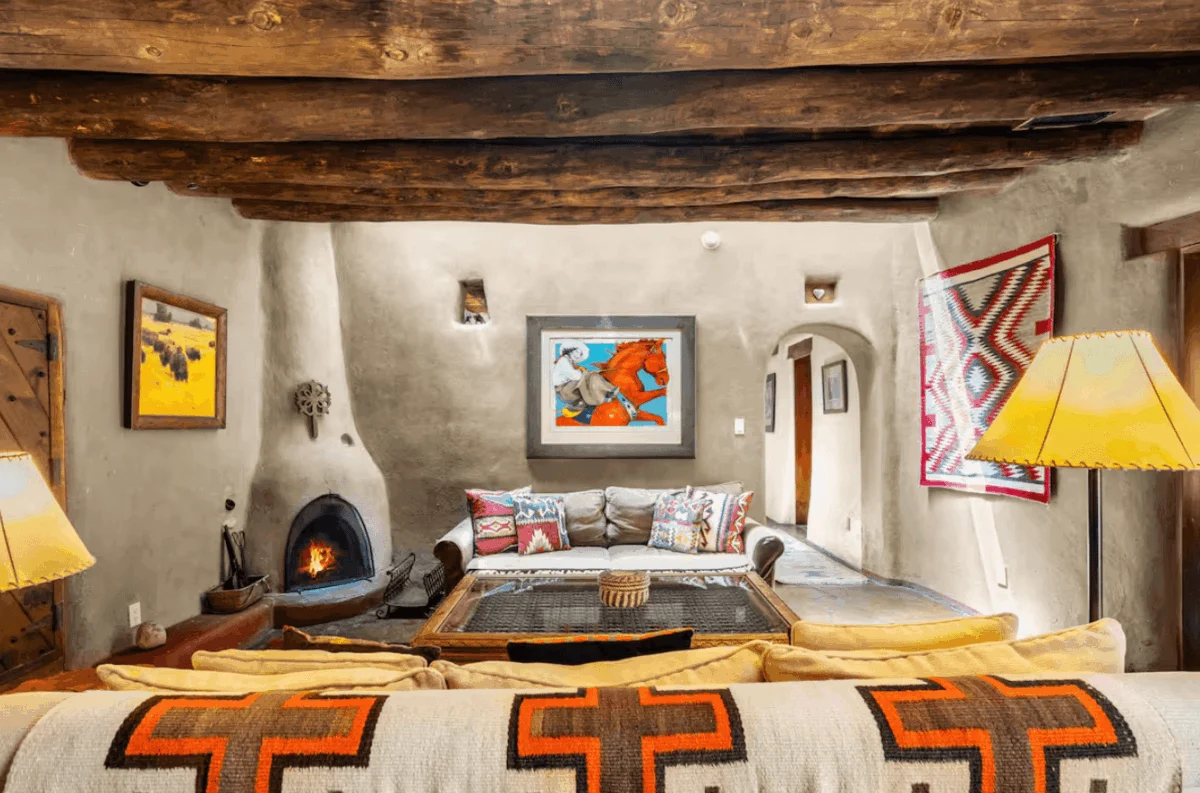
For the modern traveler, the traditional hotel experience often feels disconnected from this narrative. This is where the rise of short-term rentals has fundamentally altered the visitor experience. By opting for an Airbnb, travelers are no longer guests in a corporate lobby; they are residents of history. Staying in a restored casita allows one to experience the structural poetry of a home featuring original vigas (exposed ceiling beams) and latillas (small branches placed between beams).
These dwellings are often curated with the same attention to detail found in the city’s 250+ galleries, featuring woven Navajo textiles, hand-hammered copper, and turquoise accents that pay homage to the deep-rooted artisan traditions of the Southwest.
Supporting Data: The Economic and Cultural Impact
The influence of Santa Fe’s art scene cannot be overstated. According to recent tourism and economic reports, Santa Fe boasts one of the highest concentrations of galleries per capita in the United States.
- Gallery Density: With over 250 galleries, the city’s art market generates hundreds of millions in annual revenue, supporting a vast ecosystem of local painters, sculptors, and jewelers.
- The "Meow Wolf" Effect: Since its inception, the immersive art collective Meow Wolf has turned the city into a pilgrimage site for younger demographics, leading to a 20% increase in tourism interest among the 18–34 age bracket over the last five years.
- Hospitality Trends: Data indicates that travelers are increasingly shifting away from big-box hotels. In Santa Fe, the “home-stay” segment has seen a 15% year-over-year growth, driven by guests seeking “authentic, experiential travel” that features local design elements like kiva fireplaces and desert-scaped courtyards.
Official Perspectives and Local Stewardship
The preservation of Santa Fe’s character is not accidental. Local government officials and cultural stewards have worked diligently to balance the surge in tourism with the need to protect the city’s fragile, historic integrity.
"Santa Fe is not just a place you visit; it is a place you inhabit," says a spokesperson for the local tourism board. "The challenge we face is managing growth while ensuring that the very elements that make us ‘The City Different’—our quietude, our history, and our respect for Indigenous land—are not eroded by the volume of visitors."
There is an ongoing, sophisticated dialogue regarding "responsible tourism." Visitors are encouraged to engage with the city’s history by supporting local vendors at the Santa Fe Plaza, visiting the Museum of International Folk Art, and participating in the seasonal markets that showcase the work of Indigenous artisans. This, officials argue, ensures that the tourism dollar directly supports the preservation of local traditions rather than diluting them.
The Implications of the "Airbnb" Shift
The shift toward residential-style lodging has profound implications for the future of tourism in Santa Fe.
1. Decentralization of Tourism
Traditionally, tourism was concentrated around the downtown Plaza. Today, by staying in neighborhoods like the Railyard District, Canyon Road, or the South Capitol area, visitors are engaging with the "real" Santa Fe. They are shopping at local grocers, walking through residential neighborhoods, and interacting with the community in a way that provides a more holistic, grounded experience.
2. Architectural Preservation
Many of the city’s most desirable rentals are historic properties that have been painstakingly restored by their owners. The income generated from short-term hosting often provides the financial capital required to maintain these aging adobe structures, preventing them from falling into disrepair or being demolished for modern, uncharacteristic developments.
3. A Curated Cultural Immersion
Travelers are now looking for an “all-senses” experience. They want to wake up, open a window to the scent of high-desert sage, brew a cup of local coffee, and look out over a landscape that hasn’t changed significantly in a century. The best Airbnbs in Santa Fe act as a bridge between the guest and the local lifestyle, providing a level of intimacy that a standard hotel room simply cannot replicate.
Final Considerations: How to Experience Santa Fe Like a Local
If you are planning your inaugural trip—or your fiftieth—to Santa Fe, the following considerations will ensure your visit is as meaningful as it is memorable:
- Seek Out Authenticity: When booking, prioritize hosts who highlight local history. Look for listings that mention proximity to Canyon Road (the city’s premier gallery district) or those located in historic districts where the architecture remains untouched by modern trends.
- Respect the Landscape: Santa Fe sits at an elevation of 7,000 feet. Hydration and a respect for the sun are not just tips—they are essential to your health. Hiking the nearby trails, such as those in the Dale Ball Trails network, requires preparation and a "leave no trace" mindset.
- Engage with the Cuisine: Santa Fe’s food scene is a distinct fusion of Pueblo, Spanish, and Mexican influences. Whether you are sampling a breakfast burrito smothered in red and green chile or dining at a James Beard-nominated establishment, prioritize local ingredients. The city’s culinary identity is as much a part of its heritage as its art.
- Slow Down: Santa Fe operates on a different frequency. The light here is different, the shadows are longer, and the pace of life is intentionally slower. To truly understand the "City Different," you must allow yourself to disconnect from the frantic rhythm of urban life and tune into the quiet, rhythmic pulse of the high desert.
Conclusion
Santa Fe remains an anomaly in the modern American landscape. In a world that is increasingly homogenized, where cities look and feel the same, Santa Fe stands as a proud, stubborn, and beautiful outlier. It is a place where the past is not just remembered—it is lived. Whether you are a solo traveler seeking the solitude of the high desert, a family looking to immerse yourselves in a rich tapestry of history, or an art lover wandering the galleries of Canyon Road, Santa Fe offers a profound connection to a world that feels both ancient and eternally new.
As you plan your next visit, look beyond the traditional hospitality options. Seek out the homes that tell the story of the high desert. By immersing yourself in the architecture, the art, and the local rhythm of "The City Different," you aren’t just taking a vacation—you are becoming a small, significant part of a story that has been unfolding for centuries.
 Sagoh
Sagoh
 Asro
Asro
