

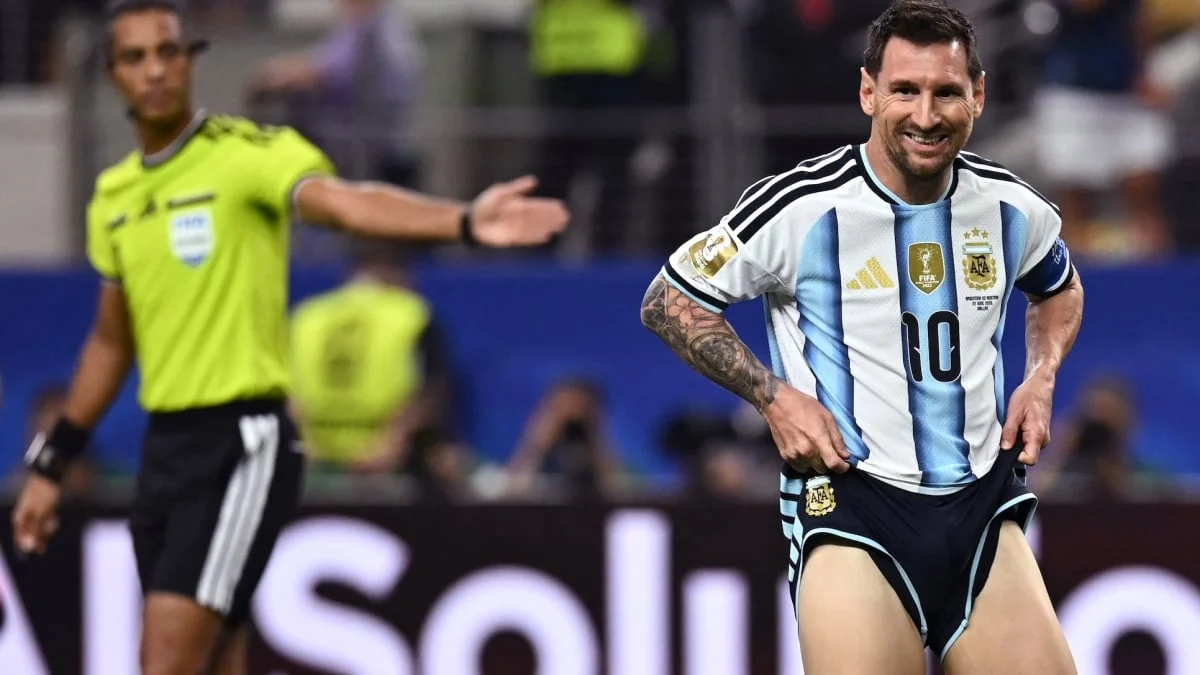
In a career defined by the pursuit of the impossible, Lionel Messi has once again redefined the boundaries of footballing greatness. Just days before his 39th birthday, the Argentine maestro delivered what many are calling the ultimate birthday gift to his global legion of supporters: he has officially ascended to the throne as the highest goalscorer in the history of the FIFA World Cup.
In a high-stakes clash against Austria, Messi entered the pitch with 16 career World Cup goals, trailing the legendary German striker Miroslav Klose by a single strike. By the final whistle, the narrative of the sport had shifted permanently. Messi not only leveled the record but eclipsed it, netting two clinical goals—the second arriving in the dying embers of stoppage time—to push his tally to 18. This historic achievement solidifies his status not merely as a player of his generation, but as the most prolific marksman in the history of the world’s most prestigious tournament.
A Chronology of a Record-Breaking Night
The match against Austria began with an atmosphere of palpable tension. Every touch Messi made was met with an anticipatory roar from the crowd, aware that they were witnessing a potential coronation.
The first half was a masterclass in tactical patience. Austria, disciplined and physically imposing, sought to neutralize the Argentine captain by crowding the midfield. However, Messi’s movement—an art form he has spent two decades refining—eventually dismantled their defensive structure. His first goal, a precise strike that threaded through a forest of legs, equalized the record.
The game’s climax, however, occurred in the final moments of added time. With the score tied and the match seemingly destined for a stalemate, Messi orchestrated one final surge. Receiving the ball on the edge of the box, he navigated through a tight marking scheme before finding the back of the net, marking his 18th World Cup goal and sending the stadium into a frenzy.
The Penalty Paradox
The match was not without its moments of vulnerability. During the encounter, Messi missed a penalty kick—a development that sparked intense discourse. This miss marked a peculiar milestone: Messi is now the first player in history to miss a penalty in three separate World Cup tournaments.
Critics and analysts were quick to debate the psychological weight of the moment. Some argued that Messi, in his pursuit of perfection, perhaps felt the pressure of the impending record too acutely during the spot-kick. Others, however, viewed the miss as a testament to his human side. On social media, fans rallied behind the captain, with many suggesting that Messi refused to accept a "cheap" record, preferring to secure his legacy through open play. As one viral post noted, the miss only served to deepen the legend, highlighting the resilience required to overcome failure in the highest-stakes environments.
The Digital Echo: A Global Celebration
The impact of the record-breaking night extended far beyond the confines of the stadium. Digital platforms became the epicenter of the celebration, with search giant Google taking a rare step to honor the athlete.
Fans across the globe reported that searching for "Messi" on the platform triggered a digital spectacle: a shower of virtual confetti cascaded down the screen, an Easter egg that captured the internet’s imagination. This gesture by Google highlighted the intersection of sports culture and modern digital life, illustrating how figures like Messi have transcended the pitch to become icons of popular culture.
Social media discourse, specifically on X (formerly Twitter), reflected the diverse ways in which fans process such history. From debates over his height—a frequent, wry topic of conversation—to comparisons of his "trademark" goals that he has seemingly perfected over the last twenty years, the conversation was relentless. One particular highlight involved a fan who had allegedly been "preparing for this moment since 1926," a humorous nod to the sheer scale of time the record has stood.
Statistical Context: The Weight of 18 Goals
To understand the magnitude of Messi’s 18th goal, one must look at the historical timeline. Miroslav Klose held the record at 17 goals since his final appearance in the 2014 World Cup. For a decade, the footballing world had wondered if any player possessed the longevity, skill, and consistency to surpass the German marksman.
Messi’s path to 18 has been a slow, steady, and inevitable burn. While some strikers rely on bursts of scoring across one or two tournaments, Messi’s record is a byproduct of sustained excellence across five World Cup cycles.
Comparison with the Next Generation
While the spotlight is firmly on Messi, the conversation has already pivoted to the future. Kylian Mbappé, the French phenom, currently sits at 14 World Cup goals. Given his age and his prolific output, many analysts view Mbappé as the most likely candidate to challenge Messi’s new record in the coming decade.
Interestingly, the relationship between the two is one of mutual respect rather than hostility. In recent public statements, Mbappé has been vocal about his admiration for the Argentine, famously declaring Messi the superior player—a sentiment that speaks volumes about the impact Messi has had on his peers. The prospect of a "Messi vs. Mbappé" final is the dream scenario for FIFA, representing a passing of the torch between the greatest of the past and the standard-bearer of the future.
Implications for the "GOAT" Debate
The question of who constitutes the "Greatest of All Time" (GOAT) has long been a source of division in football bars and social media threads alike. With this latest record, the statistical argument for Messi has become increasingly difficult to dispute.
However, the implications go deeper than just the numbers. The match against Austria reinforced the idea that greatness is not merely the absence of failure, but the ability to persist through it. By missing a penalty and then scoring the record-breaking goal later in the same match, Messi provided a microcosm of his entire career: a narrative of setbacks followed by inevitable triumph.
For the sport of football, Messi’s longevity is a boon. He has become a bridge between eras, playing against defenders who grew up idolizing him, and maintaining a level of technical output that defies biological norms for a 39-year-old athlete.
The Road Ahead
As the dust settles on this historic achievement, the focus shifts to the remainder of the tournament. Messi’s record of 18 goals is now the benchmark, a mountain that future generations will spend years attempting to climb.
Yet, for the man himself, the record is likely secondary to the collective ambition of the Argentine national team. His teammates and coaches have often noted that Messi’s focus remains anchored in the team’s success rather than personal accolades. The confetti on Google may have faded, and the social media buzz will eventually quiet, but the record will remain etched in the annals of FIFA history.
The narrative of this World Cup has shifted from a question of "if" to a celebration of "when." Messi has proven, once again, that in the grand theatre of international football, he remains the lead actor. Whether he continues to extend this record in the remaining fixtures or steps aside to let the next generation chase his shadow, one thing is certain: we are living in the age of Messi, and his legacy is now cemented in the most permanent way possible.
As the world looks toward the final rounds of the tournament, all eyes remain on the 5-foot-7-inch icon who continues to stand taller than anyone else in the history of the beautiful game.
 Ali Ikhwan
 Siti Muinah
 Suro Senen
