

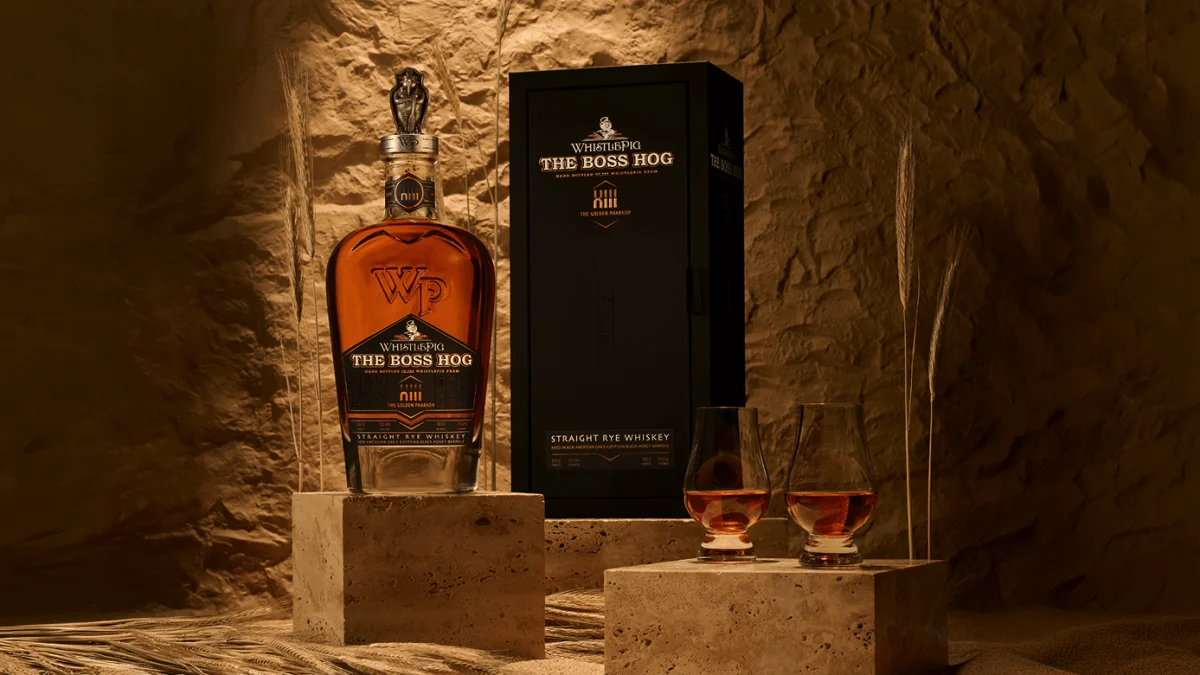
Welcome to Taste Test, where every week our critic Jonah Flicker explores the most buzzworthy and interesting whiskeys in the world. Check back each Sunday for his latest whiskey review.
In the high-stakes arena of premium American whiskey, few labels command the same level of anticipatory frenzy as WhistlePig’s “The Boss Hog.” Based on a 500-acre farm in the rolling hills of Vermont, just outside of Burlington, the distillery has carved out a niche as the industry’s mad scientist. Every year, the release of a new Boss Hog iteration promises something transformative, something avant-garde, and—occasionally—something downright bizarre.
Historically, the series has leaned into cask finishes that push the boundaries of what consumers define as “rye whiskey.” While some purists argue that these flights of fancy occasionally veer into the overboard, the 13th installment, dubbed "The Golden Pharaoh," represents a masterclass in restraint. It is a whiskey that leans into the strange, yet remains firmly anchored to its core identity.
The Evolution of the Boss Hog
To understand the significance of The Golden Pharaoh, one must look at the trajectory of the series. Since its inception, The Boss Hog has functioned as a laboratory for Head Blender Meghan Ireland and her team. The series is defined by its refusal to stick to traditional maturation profiles.
Last year’s Feather & Flame set a high bar for experimental intensity, utilizing casks seasoned with a Mexican pulque-style spirit—a bold, vegetal, and funky choice that polarized the whiskey community. In contrast, other releases have sought inspiration from the classic rum-cask school of finishing. The philosophy at the Vermont farm is fluid: sometimes they source existing casks from around the globe, and other times, they function as a full-scale production facility, recreating historical spirits onsite to season their own barrels.
The Golden Pharaoh represents the latter approach, drawing inspiration from a source material that predates the modern distilling era by three millennia.
A Chronology of Inspiration: From Tomb to Tank
The genesis of The Golden Pharaoh is perhaps the most unconventional in the distillery’s history. During a deep dive into historical gastronomy, Meghan Ireland discovered a recipe for a tiger nut cake, preserved in the hieroglyphics of an ancient Egyptian tomb.
The recipe—estimated to be roughly 3,000 years old—highlighted two distinct ingredients: Egyptian black honey (a dense, rich sugarcane molasses) and tiger nuts (edible tubers prized for their earthy, nutty profile, reminiscent of almond and coconut).
The technical challenge was clear: how to translate a solid, ancient cake recipe into a liquid medium capable of seasoning a premium American oak barrel. The WhistlePig team embarked on a multi-stage process:
- Extraction: The team developed a custom liqueur by soaking ground tiger nuts in mature rye whiskey.
- Sweetening: The mixture was balanced with the addition of Egyptian black honey, providing the deep, dark molasses notes required to mimic the profile of the ancient dessert.
- Seasoning: Ex-rye casks were filled with this bespoke tiger nut and honey liqueur and allowed to rest for four weeks, imbuing the wood with the essence of the ancient recipe.
- Final Maturation: Once the barrels were seasoned, the rye whiskey was transferred into these vessels for an eight-week secondary finish, carefully monitored to ensure the flavor profile didn’t become cloying.
Supporting Data: The Anatomy of the Spirit
The result of this eight-week marriage is a study in subtlety. Despite the exotic nature of the finish, the whiskey remains remarkably disciplined.
The palate opens with a sophisticated interplay of brown sugar, rich molasses, and the distinct, toasted nuttiness of the tiger nut. This is immediately followed by a robust cabinet of baking spices—cinnamon, nutmeg, and cloves—that provide a structural backbone to the liquid.

Crucially, these additions serve as a veil that enhances, rather than hides, the foundational profile of the rye. Enthusiasts will still find the quintessential WhistlePig DNA: deep vanilla, cooling maple, a sharp black pepper bite, and the drying, tannic influence of charred oak.
As a single-barrel release, the proof fluctuates between 102.6 and 105.6. This range is the “sweet spot” for a whiskey of this complexity; it is high enough to carry the depth of the finish, yet approachable enough to be enjoyed neat without the need for dilution.
Official Perspectives: The Philosophy of the Blend
Meghan Ireland’s approach with The Golden Pharaoh reflects a shift in the current luxury spirits market. Consumers are increasingly fatigued by “gimmick” whiskies that mask poor-quality base spirits with aggressive, syrupy finishes.
By opting for a shorter finish period (eight weeks), Ireland has ensured that the secondary maturation acts as an accent mark rather than a rewrite. The goal, according to the distillery, was not to turn the whiskey into a dessert liqueur, but to honor the ancient ingredients by weaving them into the existing tapestry of the rye. This balanced perspective is exactly why The Golden Pharaoh stands as one of the most successful experiments in the Boss Hog series to date.
Implications for the Collector’s Market
The release of The Golden Pharaoh brings with it the inevitable conversation regarding value and accessibility. With a suggested retail price of $600, it is, by any objective metric, an ultra-premium product.
For the dedicated collector, the allure is compounded by the aesthetic presentation. A limited subset of the production run features a special gold topper, intricately designed to evoke the likeness of King Tut. While these bottles will undoubtedly become the centerpieces of high-end back bars and private collections, there is a distinct argument for the pragmatic drinker.
If you are fortunate enough to secure a bottle, the recommendation is clear: open it. While the gold topper is a conversation piece, the liquid inside is a prime example of the heights the experimental rye category can reach when led by intent and restraint. For those with the means, procuring two bottles—one to preserve and one to experience—is the most prudent path.
Conclusion: A Masterful Synthesis
WhistlePig has, for years, walked a precarious tightrope between innovative genius and chaotic indulgence. With The Golden Pharaoh, they have found perfect equilibrium. By reaching back into the annals of ancient Egypt and filtering that history through the lens of modern Vermont craftsmanship, they have produced a rye whiskey that feels both timeless and entirely new.
It is a rare feat to take a 3,000-year-old recipe, adapt it to a modern rye framework, and end up with something that feels coherent rather than experimental. The Golden Pharaoh is not merely a gimmick for the shelf; it is a nuanced, thoughtful, and expertly balanced spirit that demands to be tasted.
Score: 95
For more information on the latest releases in the world of fine spirits, subscribe to the Taste Test newsletter and join our community of enthusiasts as we continue to explore the evolving landscape of global whiskey.
 Ali Ikhwan
 Laily UPN
 Raul Delapena Setiawan
