

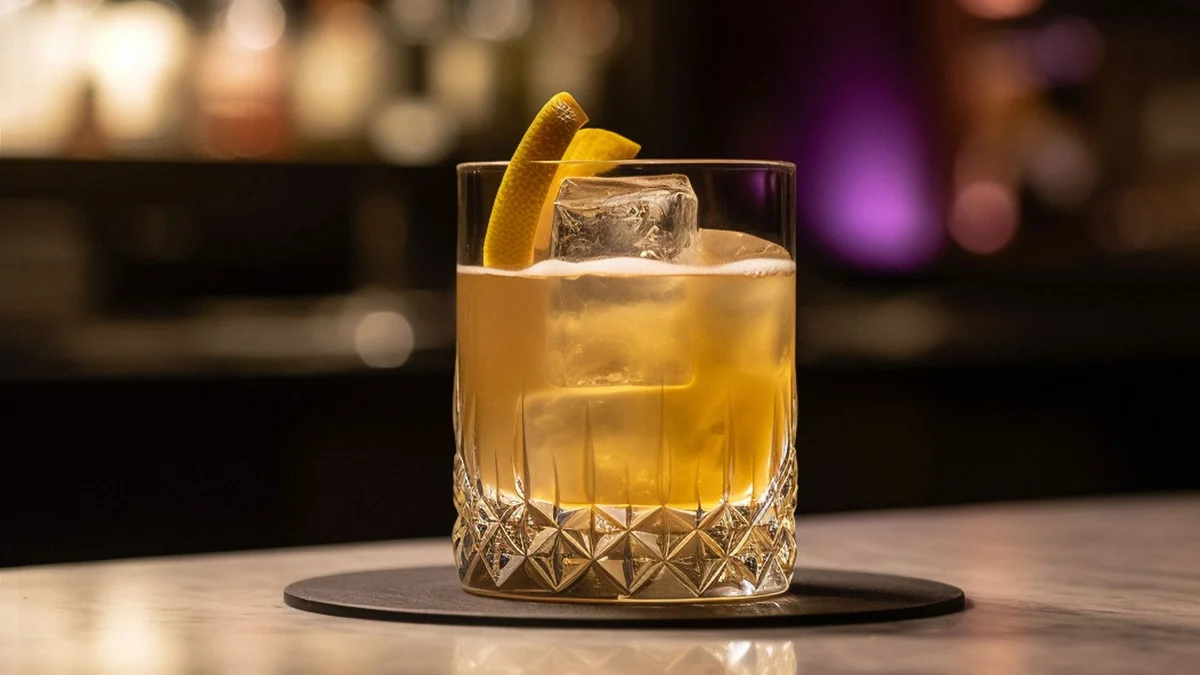
In the ever-evolving landscape of modern mixology, few creations manage to balance the tightrope between absurdity and genius as effectively as The Guillotine. At first glance, its ingredient list reads like a game of “Cocktail Mad Libs”—a seemingly haphazard assembly of Scotch whisky, mezcal, honey, and banana liqueur. Yet, in the hands of its creator, the drink transforms into a masterclass in composition, a sophisticated study in the push-and-pull of flavor profiles that challenges the drinker’s palate while offering an eerily elegant experience.
The Guillotine is not merely a drink; it is a testament to the "bizarre magic" of mixology. To the uninitiated, the inclusion of banana liqueur—a spirit often relegated to the kitsch of the 1980s—might seem like a misstep. But when deployed with the surgical precision found in this recipe, the banana acts as a spectral bridge, emerging from a smoky, vegetal fog to deliver a finish that is both haunting and deeply satisfying.
The Architect: Franky Marshall and the Spirit of Le Boudoir
To understand the Guillotine, one must understand its architect, Franky Marshall. A towering figure in the beverage industry, Marshall has moved far beyond the traditional role of a bartender, evolving into a veritable “cocktail personality.” Her career trajectory reads like a syllabus for the modern drink professional: from cutting her teeth at New York City’s most revered watering holes to serving as an educator for the prestigious Beverage Alcohol Resource (BAR).
Her influence spans the entire ecosystem of the industry. As a judge for the Tales of the Cocktail Spirited Awards and an emcee for the North American 50 Best Bars, Marshall has established herself as a leading voice in the conversation about what constitutes excellence in a glass.
In 2016, when Brooklyn’s Le Boudoir—a lavish, Marie Antoinette-themed speakeasy—sought a lead to command its bar program, Marshall was the inevitable choice. Her background as a fluent French speaker and her penchant for the theatrical (she was famously known for cosplaying as the doomed Queen of France herself) provided the perfect narrative backdrop for a menu that demanded historical wit. The Guillotine was born from this environment: a dark, playful nod to the final chapter of Antoinette’s life.

Chronology: From Concept to Cult Classic
The evolution of the Guillotine mirrors the trajectory of the modern craft cocktail movement. It began in the subterranean, velvet-draped confines of Le Boudoir, where the objective was to create a menu that felt both regal and subversive.
- The Inspiration (2016): Marshall sought a drink that embodied the duality of the French Revolution—something opulent yet dangerous. She turned to the Old Fashioned, the quintessential cocktail skeleton, and began an act of structural deconstruction.
- The Experimentation: The "split-base" technique was the breakthrough. By combining the earthy, raw, and smoky notes of artisanal mezcal with the malty, structured backbone of a blended Scotch, Marshall created a tension that felt entirely new.
- The Refinement: The final, defining variable was the banana. Initially, it was a risky inclusion, but it served as the "funhouse mirror" effect for the Old Fashioned. It provided a whisper of sweetness that rounded out the aggressive smoke of the mezcal, turning the drink from a harsh experiment into a cohesive, nuanced narrative.
- The Legacy: Since its inception, the Guillotine has migrated from the Brooklyn speakeasy to the repertoire of home bartenders and professional mixologists worldwide, cementing its status as a modern classic that defies simple categorization.
Supporting Data: The Science of the "Split-Base"
The success of the Guillotine rests on a specific chemical interplay between its four primary components.
The Mezcal-Scotch Nexus
The choice of mezcal is critical. Unlike tequila, which is often distilled to a neutral proof, artisanal mezcals maintain a vegetal, "wild" character. When mixed with a blended Scotch, the result is a bridge between the old world (the malty, grain-forward notes of Scotland) and the ancient world (the agave-forward, smoky notes of Mexico). The Scotch provides the "weight" on the palate, while the mezcal provides the "top notes" of smoke and salinity.
The Banana Paradox
The inclusion of exactly 0.25 ounces of banana liqueur serves as a structural fixative. In sensory analysis, the banana flavor in the Guillotine functions in three distinct stages:
- The Onset: The flavor is absent, allowing the drinker to register the initial shock of the mezcal-Scotch collision.
- The Mid-palate: A subtle, fruity sweetness begins to emerge, muting the harsh edges of the alcohol.
- The Finish: The banana blossoms, combining with the vegetal notes of the mezcal to create a lingering, complex aftertaste that prevents the drink from becoming cloying.
Official Guidelines: Preparing the Guillotine at Home
While the drink carries the weight of a high-concept speakeasy, it is surprisingly accessible for the home enthusiast. The key, as with all "simple" cocktails, lies in the quality of the ingredients.

The Recipe
- Mezcal: 1 oz (Artisanal, 42–50% ABV)
- Blended Scotch: 1 oz (Non-peated)
- Banana Liqueur: 0.25 oz (High-quality, such as Giffard Banane du Brésil)
- Honey Syrup (3:1 ratio): 0.25–0.5 oz (To taste)
- Lemon Peels: 2 (One for stirring, one for garnish)
Instructions:
- Combine the mezcal, scotch, banana liqueur, and honey syrup into a mixing glass.
- Add a lemon peel to the mixing glass to infuse the oils during the stir.
- Add ice and stir consistently for 15 to 20 seconds to achieve the perfect dilution and temperature.
- Strain into a rocks glass over a single large ice cube.
- Express a second lemon peel over the top and drop it in as a garnish.
Implications for the Industry
The enduring appeal of the Guillotine suggests a shift in how drinkers perceive "bizarre" flavor combinations. For years, the cocktail industry operated under the assumption that ingredients should be classic, recognizable, and "safe." However, the success of this cocktail proves that the modern consumer is looking for intellectual engagement in their glass.
The Guillotine represents a movement away from the "purity" of spirits and toward the "artistry" of the blend. It challenges the bartender to act as a chemist, using modifiers like banana liqueur not to sweeten, but to shift the perspective of the base spirits.
Furthermore, the drink highlights the importance of ingredient sourcing. The explicit warning against "trashy" banana schnapps serves as a reminder that in a recipe with so few ingredients, the quality of the weakest link will inevitably dictate the quality of the whole. It is a lesson in minimalism: when you have only four components, there is nowhere for low-quality products to hide.
Conclusion
The Guillotine remains a triumph of creative mixology. It is a drink that refuses to be defined—it is a banana drink, yet an Old Fashioned; a mezcal experience, yet a Scotch cocktail. It is a reminder that the best drinks are not those that follow the rules of history, but those that understand the rules well enough to break them with intention. Whether you are a professional bartender or a home enthusiast, the Guillotine offers a masterclass in the bizarre, refined magic of the craft. It is, quite simply, a cocktail that demands to be tasted.
 Evan Lee Salim
 Asep Darmawan
 Laily UPN
