

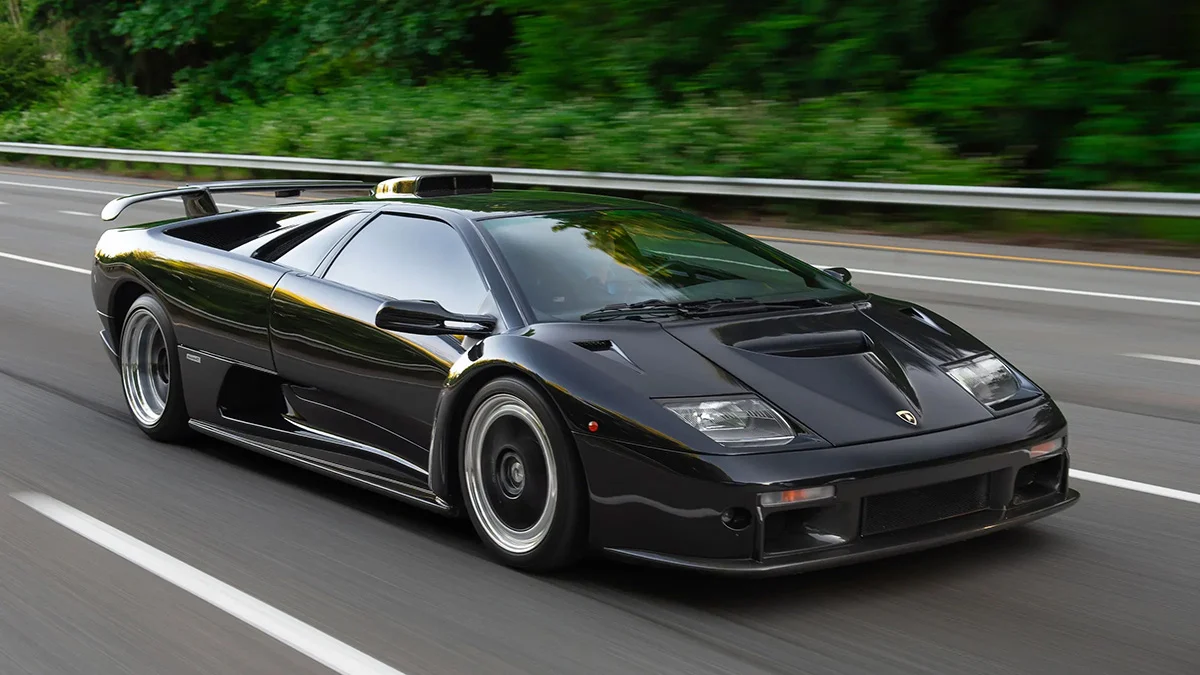
In the pantheon of automotive history, few names command the reverence of Lamborghini. Among the Sant’Agata Bolognese firm’s storied roster, the Diablo occupies a pivotal position—a bridge between the raw, unrefined mechanical fury of the 1980s and the sophisticated, high-tech hypercars of the modern era. Next month, collectors will have a rare opportunity to secure the ultimate iteration of this lineage: a 2000 Lamborghini Diablo GT, set to cross the auction block at Bonhams’ prestigious Laguna Seca sale.
This specific vehicle, chassis number 74 of only 80 ever produced, represents the pinnacle of the Diablo’s evolution. It is a machine that prioritizes mechanical purity, aerodynamic aggression, and a visceral driving experience that has become increasingly scarce in an age dominated by dual-clutch transmissions and driver-assistance software.
The Context: A Legacy Defined by Excess
The Diablo was never intended to be a subtle machine. Following the departure of the iconic Countach, the Diablo had the monumental task of redefining the Lamborghini brand for the 1990s. Marcello Gandini’s design, characterized by its sharp, wedge-like silhouette and scissor doors, set the standard for what a supercar should look like.
Beyond its aesthetic impact, the Diablo was a technological trailblazer for the brand. It was the first production Lamborghini capable of exceeding the 200-mph barrier, and later iterations introduced all-wheel drive, moving away from the rear-wheel-drive purity of its predecessors. However, as the turn of the millennium approached, Lamborghini sought to create something that returned to its roots—a "track-focused" street-legal monster that would serve as the final, definitive send-off for the model. The result was the Diablo GT.

Chronology: The Evolution of the Diablo
To understand the significance of the GT, one must appreciate the timeline of the Diablo’s life. Launched in 1990, the standard Diablo was a rear-wheel-drive beast powered by a 5.7-liter V-12. By 1993, the introduction of the VT (Viscous Traction) brought all-wheel drive to the lineup, making the car significantly more stable—and perhaps slightly more approachable—for the average driver.
By the late 90s, the design was aging. Lamborghini, now under the stewardship of Audi, looked to refresh the platform while simultaneously honoring its heritage. The Diablo GT was unveiled in 1999 as a limited-run special. Unlike the standard models, the GT was a focused, stripped-down, and highly aggressive machine. It was designed with a single purpose: to be the fastest, most engaging Diablo ever built. It was a rare, uncompromising vision of a road-legal race car that stood in stark contrast to the increasingly refined grand tourers of the era.
Technical Specifications: The Anatomy of a Beast
The 2000 Diablo GT is a masterclass in performance-oriented engineering. While the standard Diablo was a formidable machine, the GT took that foundation and elevated it in every conceivable way.
The Engine
At the heart of the GT sits a naturally aspirated 6.0-liter V-12, a significant displacement increase over the standard 5.7-liter unit found in earlier variants. This engine produces a staggering 567 horsepower and 465 ft-lbs of torque. By optimizing the intake, exhaust, and engine management systems, Lamborghini’s engineers managed to unlock a level of throttle response that remains the gold standard for naturally aspirated V-12s.

Weight and Transmission
In a deliberate move to prioritize driver engagement and reduce mass, the factory omitted the standard all-wheel-drive system, returning the GT to a rear-wheel-drive configuration. This, combined with extensive use of carbon fiber for the bodywork—including the front bumper, hood, and rear diffuser—resulted in a vehicle that was significantly lighter than the standard Diablo. Power is channeled to the road via a traditional five-speed manual gated shifter, a mechanical tactile experience that has become a "holy grail" for purist collectors.
Aerodynamics and Handling
The GT features a wider track, significantly more aggressive cooling ducts, and an aerodynamic profile designed for downforce rather than just style. The front hood is uniquely sculpted, and the rear diffuser is a functional piece of engineering that keeps the car planted at high speeds. This is not a car for the faint of heart; it is a machine that demands total focus from its operator.
Supporting Data: Why This Chassis Matters
The vehicle presented at the Bonhams auction is chassis number 74 of 80. Its provenance is impeccable, and its condition is reflective of a machine that has been treated as a piece of rolling art. Finished in "Black Rage" paint with an interior swathed in matching Nero leather, the car retains its racing-harness-equipped sport seats, underscoring its track-ready origins.
Furthermore, the inclusion of the original, rare factory tan leather briefcase adds a layer of completeness that is highly coveted by serious collectors. With less than 9,000 miles on the odometer, this is not merely a piece of history; it is a well-preserved example that retains the integrity of the factory build. Because it is now over 25 years old, this model—which was never officially imported to the United States in large numbers—is exempt from federal safety and emission standards, making it a viable acquisition for American collectors who wish to register it for road use.

Official Perspective and Market Sentiment
Auction houses like Bonhams often view the Diablo GT as a "blue-chip" asset in the supercar market. While they have not provided a specific estimate for the August 13th sale at WeatherTech Raceway Laguna Seca, the market for limited-production, analog supercars has been on a meteoric rise.
Experts in the field note that as modern supercars become increasingly digitized, the demand for analog masterpieces—those with gated manuals, naturally aspirated engines, and a lack of electronic interference—has reached an all-time high. A Diablo GT, being the most exclusive and "hardcore" version of a marquee model, is naturally positioned to command a premium. It is widely expected that the winning bid will comfortably settle in the seven-figure range, reflecting both the rarity of the car and the increasing scarcity of such raw, mechanical experiences.
The Implications: A Shift in Collector Focus
The sale of this Diablo GT signals a broader shift in the collector car market. For years, the focus was primarily on classic 1960s and 70s exotics. However, the "Youngtimer" era—specifically the supercars of the 1990s and early 2000s—has now firmly established itself as the new frontier of investment-grade collecting.
The Diablo GT is emblematic of this trend. It represents the last of the "Analog Bulls," a time when Lamborghini built cars that were difficult to drive, physically demanding, and entirely unapologetic about their excess. For the next owner, this car represents more than just an investment; it is a time capsule of a bygone era of engineering, where the human-machine connection was not mediated by algorithms or adaptive suspension, but by a heavy clutch, a gated shifter, and twelve screaming cylinders.

As the gavel falls at Laguna Seca, the sale will likely serve as a benchmark for the appreciation of the Diablo. Whether it finds its way into a climate-controlled private museum or back onto the open road, one thing is certain: the Lamborghini Diablo GT will continue to hold its place as a cornerstone of supercar history, a testament to a time when speed was achieved through sheer displacement and the indomitable spirit of Italian design.
 Evan Lee Salim
 Asep Darmawan
 Laily UPN
