

By Joel Christensen
Christopher Nolan’s highly anticipated 2026 adaptation of The Odyssey has arrived in theaters, draped in the prestige of a blockbuster epic and the weight of three millennia of literary history. For the casual viewer, it is a spectacle of grand proportions. For the scholar of Homeric tradition, however, it is a confounding, albeit technically masterful, exercise in omission. As a Homerist, I found myself repeatedly grappling with a central tension: How does one compress the foundational text of Western literature into a three-hour runtime without losing the very soul of the narrative? The result is a film that offers visceral, horrifying beauty, yet suffers from a protagonist who feels curiously untouched by the very trauma he is meant to endure.
The Architecture of Omission: From 12,000 Lines to Three Hours
To understand the scope of Nolan’s The Odyssey, one must first acknowledge the impossibility of the task. Homer’s original epic spans roughly 12,000 lines, a sprawling, non-linear tapestry of homecoming, divine interference, and existential reflection. Nolan’s screenplay, by necessity, functions as an act of ruthless reduction.
The most jarring adjustments occur in the narrative structure. In the source material, the Phaeacian episode—the bridge between the hero’s isolation and his homecoming—is essential to the pacing and thematic weight of the story. In Nolan’s version, this entire sequence is excised. Similarly, the emotional gravity of the homecoming is diminished by the film’s lopsided structure: two hours are dedicated to the journey and the psychological toll of the flashbacks, while the actual return to Ithaca is compressed into a frantic, hurried final act of less than sixty minutes.
Most notably for the purists, the film omits the reunion between Odysseus (played with stoic, perhaps overly rigid, restraint by Matt Damon) and his father, Laertes. In Homer, this reunion serves as the final, necessary healing of the generational trauma that defines the hero’s identity. Without it, Damon’s Odysseus feels untethered, a man wandering through a void rather than a king struggling to reclaim his throne.
Chronology of a Hero’s Descent
The narrative arc of the film is divided into three distinct psychological segments, each reflecting a different aspect of Nolan’s directorial style:
- The Exile (The Flashbacks): The film opens in media res, with Odysseus adrift in the Mediterranean. Through a series of nonlinear memory sequences, we see the destruction of Troy, a sequence rendered with a grim, monochromatic aesthetic that emphasizes the futility of war.
- The Trial of Appetite (The Island of Aeaea): This represents the film’s emotional zenith. The encounter with Circe (Samantha Morton) is treated not as a whimsical mythic event, but as a body-horror meditation on human nature.
- The Return (Ithaca): The final act abandons the mythological grandeur for a gritty, almost claustrophobic thriller pace. The slaughter of the suitors is handled with the clinical precision of a heist film, lacking the cathartic, moralizing weight found in the original text.
Visceral Realism: The Circe Sequence
If the film has a singular triumph, it is the portrayal of Circe’s island. In a scene that will undoubtedly be studied in film schools for years to come, Nolan uses practical effects and subtle CGI to depict the transformation of Odysseus’s men.
As Circe serves her feast, the camera tracks the crew’s transformation from men to swine with a sickening, slow-motion intimacy. We see the skin bloom and distend, the frantic slurping turning into guttural, animalistic grunts. It is here that Nolan updates the myth for a modern audience: his Circe is not merely a sorceress, but a woman who has been consistently abused by travelers, using her magic as a mechanism of self-defense. The animals that populate her island are not random beasts; they are the ghosts of men who met their deserved fate. This interpretation shifts the moral center of the myth, suggesting that the "monsters" of the odyssey are often the product of the hubris of the travelers themselves.
Supporting Data and Production Context
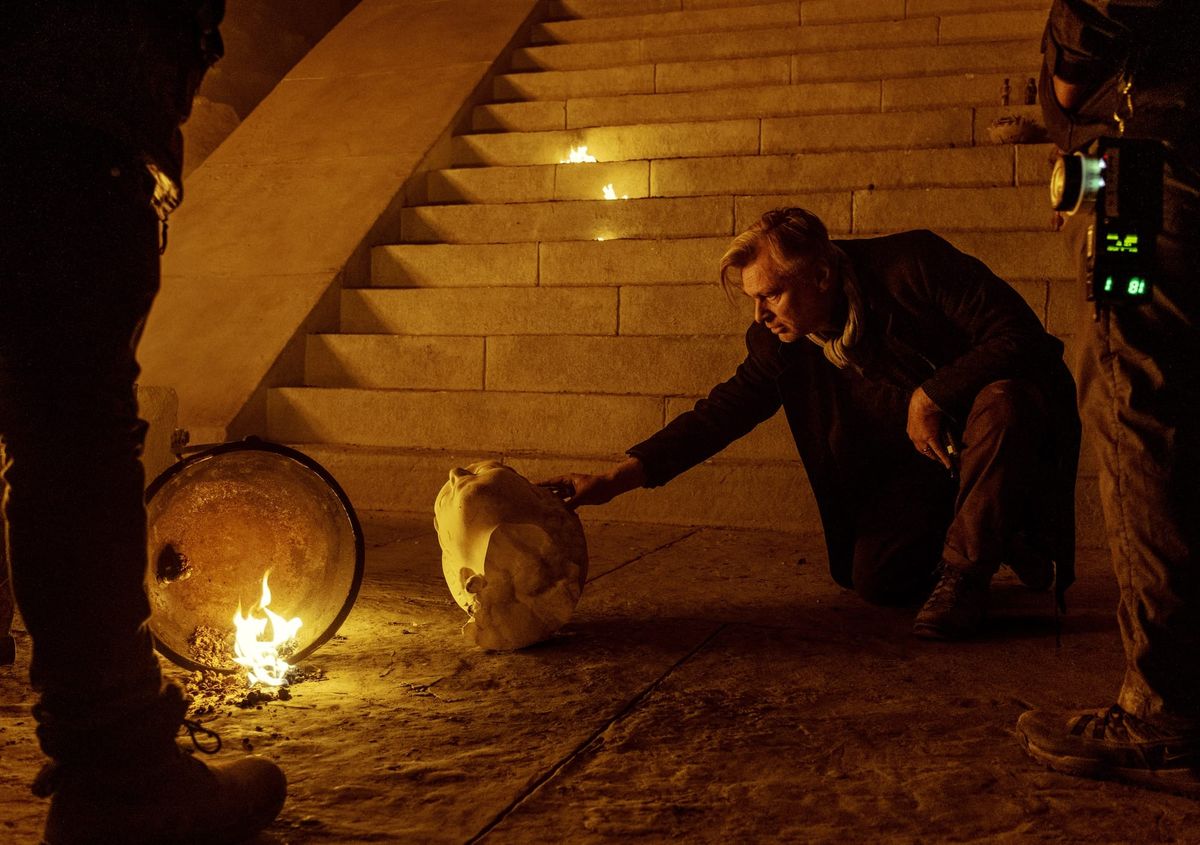
Produced by Universal with a budget estimated at over $300 million, the film represents the peak of modern blockbuster filmmaking. Nolan’s insistence on using 70mm film stock gives the Mediterranean landscapes an expansive, almost overwhelming scale.
However, the technical brilliance does little to address the characterization issues. In our contemporary discourse, we are obsessed with "the journey" as a vehicle for transformation. Yet, in this iteration, Odysseus is a static figure. He is a man affected by trauma—the war, the loss of his men, the distance from his family—but there is no sense that these experiences have changed his fundamental nature. He enters the story as a man of cunning and iron, and he exits it exactly the same. In the context of ancient Greek pathos, this is a radical choice, but in the context of modern character-driven cinema, it leaves a hollow center that the audience must work hard to fill.
Official Responses and Creative Intent
In a recent press junket, Christopher Nolan addressed the criticisms regarding the film’s narrative omissions. "The Odyssey is not a book; it is a cultural force," Nolan stated. "To adapt it is to curate it. I was not interested in a faithful adaptation of the poem, but in an exploration of the feeling of being lost—the feeling of the ‘nostos’ (homecoming) as a destination that might not exist."
Samantha Morton, when asked about her portrayal of Circe, emphasized the shift in perspective. "We looked at the original text and asked, ‘Why does she transform them?’" Morton said. "It’s a reaction to the violation of her space. It’s a very modern, very necessary perspective on a character who has been traditionally villainized."
The Implications of a "Static" Hero
The most profound implication of this film is what it reveals about our current cultural relationship with trauma. We often treat trauma as a transformative narrative device: the "hero’s journey" requires the hero to be broken and then remade. By refusing this arc, Nolan posits a darker, more cynical possibility: perhaps some men are incapable of change.
For the Homerist, this is a betrayal of the Odyssey’s core, which is fundamentally about the hero’s reintegration into a community and his evolution from a warrior to a king. By keeping Odysseus in a state of perpetual, hardened detachment, the film suggests that the scars of war are not lessons, but permanent erasures of the self.
Conclusion
Christopher Nolan’s The Odyssey is a technical marvel that succeeds in making the ancient world feel immediate, terrifying, and physically present. It is a bold, challenging piece of cinema that demands to be seen on the largest screen possible. However, it is ultimately a film of fragments. By stripping away the supporting characters and the intricate moral tapestry of the Homeric poems, it creates a vacuum where the human heart of the story should be.
It is a tale of a man affected by trauma, but one that leaves us wondering if the man who returns to Ithaca is truly the same man who left for Troy, or if, like his men on the island of Aeaea, he has been transformed into something else entirely—something less human, and perhaps, more enduringly tragic. As a Homerist, I am left conflicted: I admire the craft, but I mourn the loss of the soul. The film is a spectacular success as a piece of visceral art, but a cautionary tale of what happens when we prioritize the "look" of an epic over the evolution of its hero.
 Muslim
 Evan Lee Salim
 Jia Lissa
