

By Olivia Tauber
July 8, 2026
Christopher Nolan has never been a filmmaker interested in the small-scale. From the mind-bending architecture of Inception to the atomic weight of Oppenheimer, his career has been a relentless pursuit of cinematic maximalism. Yet, with his latest endeavor, The Odyssey—a gargantuan, $250 million adaptation of Homer’s foundational epic—Nolan has pushed his technical ambition into uncharted waters. Following its thunderous world premiere in London this week, the film has emerged as both a critical triumph and the epicenter of a fierce, polarized cultural debate.
As the July 17 theatrical release approaches, one thing is certain: The Odyssey is not a film to be consumed on a handheld device. It is a sensory, IMAX-exclusive experience designed to swallow the audience whole. But while critics are praising its technical mastery, the digital landscape has become a battleground, fueled by intense scrutiny over casting, historical fidelity, and the ever-present shadow of "culture war" discourse.
A Technical Odyssey: The IMAX Revolution
The primary narrative emerging from the early press screenings is one of unprecedented technical scope. The Odyssey holds the distinction of being the first feature film captured entirely with IMAX cameras. While Nolan has long been the medium’s most vocal advocate, this production represents the culmination of his technical philosophy.
Spanning six countries—including the rugged coasts of Greece, the vast deserts of Morocco, and the volcanic terrain of Iceland—the film eschews digital artifice in favor of practical spectacle. Real, full-scale ships were constructed to navigate open waters, and the film’s massive crowd sequences rely on thousands of extras rather than CGI replications.
Matt Damon, who anchors the film in the titular role of the weary, battle-hardened King of Ithaca, described the production as a transformative physical ordeal. "It was much harder than anything I’ve ever done," Damon told reporters at the premiere. "Nolan doesn’t just ask you to perform; he asks you to exist in an environment that is as dangerous and imposing as the one Homer described."
Chronology of a Cultural Lightning Rod
The path to The Odyssey’s release has been anything but smooth. The project was announced in early 2025, immediately generating massive anticipation given Nolan’s post-Oppenheimer cachet. However, as production details leaked and casting announcements were made, the film began to attract significant, often hostile, attention.

- Early 2025: Production begins in Morocco. Initial set photos, depicting a highly stylized, multicultural aesthetic, spark early whispers of "anachronism" among online forums.
- Late 2025: Casting details are finalized. The inclusion of a diverse, high-profile ensemble—including Lupita Nyong’o as Helen of Troy and Himesh Patel as Eurylochus—triggers a wave of commentary on social media.
- Spring 2026: A marketing push focusing on the film’s "modernized" approach to Greek mythology begins. Critics and fans notice the influence of Emily Wilson’s 2017 translation, which sought to strip away centuries of accumulated, archaic interpretations of the text.
- July 6, 2026: The World Premiere in London. While the audience inside the theater responds with a standing ovation, the social media fallout begins immediately as attendees post their initial reactions.
- July 8, 2026: The "Twitter/X" discourse reaches a fever pitch as high-profile figures, including Elon Musk, engage in public critiques of the film’s creative direction.
Supporting Data: The Scale of Ambition
The financial and logistical stakes for The Odyssey are staggering. With a reported production budget of $250 million, the film is a high-stakes gamble in an era where mid-budget films struggle to find theatrical footing. Box office analysts are currently projecting an opening weekend domestic haul between $80 million and $130 million.
The film’s run-time, clocking in just shy of three hours, serves as a test of the modern audience’s endurance and appetite for "event cinema." Unlike many recent blockbusters, The Odyssey has effectively marketed its scarcity; select IMAX tickets were available for pre-purchase over a year in advance, creating a "must-see-now" atmosphere that mirrors the Barbenheimer phenomenon of 2023.
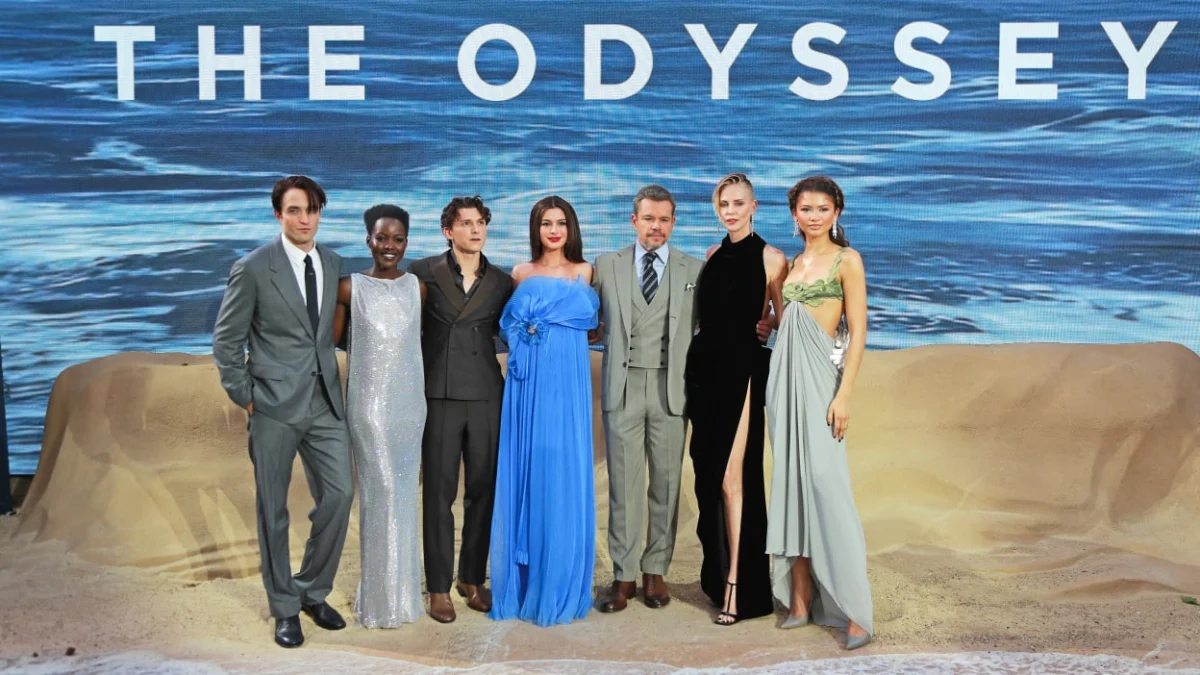
The ensemble cast reads like a "who’s who" of modern acting talent, including Anne Hathaway as Penelope, Tom Holland as Telemachus, Robert Pattinson, Charlize Theron, and a surprise appearance by Travis Scott as a mythic bard. The sheer volume of star power has been both a marketing boon and a lightning rod for those who prefer their historical adaptations to adhere to traditionalist aesthetic standards.
Official Responses and the "Historian’s" Feud
Perhaps the most peculiar aspect of the Odyssey discourse has been the intervention of non-film voices. The criticism regarding the film’s casting and "modern" tone caught the attention of Elon Musk, who has used his platform to label the film a "desecration" of the original Greek text.
This drew a sharp retort from the renowned historian Tom Holland (the author, not the actor appearing in the film), who has spent his career contextualizing the ancient world. Holland argued that the original Odyssey was a living, breathing oral tradition that changed with every teller. By framing the casting and linguistic choices as "modernization," critics are ignoring the fact that the Homeric epics were never static relics; they were designed to reflect the humanity of the audience hearing them.
Lupita Nyong’o, who portrays the pivotal role of Helen of Troy, has been a stoic defender of Nolan’s vision. "We aren’t making a museum piece," Nyong’o stated in a recent interview. "We are telling a story about human nature, about the agony of return, and the cost of war. This cast is representative of the world, and that is how it should be."
The Implications of the "Nolan Brand"
What does the backlash against The Odyssey tell us about the current state of film criticism? We are seeing a distinct shift where the value of a film is being judged less by its craft and more by its alignment with pre-existing cultural anxieties.

Nolan’s previous work, Oppenheimer, was largely spared this treatment because the subject matter was treated with a reverent, biographical gravity. The Odyssey, however, touches upon the "canon"—a concept that many internet commentators feel protective of. When Nolan adapts a text as foundational as Homer, he is not just competing with other movies; he is competing with the personal, idealized versions of the story that millions of people have held in their minds since high school literature class.
Furthermore, the film’s reliance on IMAX, practical effects, and a non-linear, epic structure cements Nolan’s status as a director who refuses to bow to the constraints of streaming or "snackable" content. The implication for the industry is clear: if The Odyssey succeeds, it will prove that there is still a massive, hungry audience for "Big Cinema." If it falters, it may signal that the audience’s appetite for complex, three-hour epics is waning in favor of more digestible, controversy-free entertainment.
Conclusion: A Voyage Toward the Screen
As the opening date of July 17 approaches, the noise surrounding the film seems destined to quiet down, replaced by the hushed, reverent silence of the IMAX auditorium. Whether or not one agrees with Nolan’s creative choices regarding his ensemble cast or his pacing, the sheer audacity of the production remains undeniable.
Critics who have seen the film describe it as a "visceral, haunting, and technically perfect" adaptation. For those who can look past the manufactured outrage of the digital discourse, The Odyssey promises a return to a style of filmmaking that is increasingly endangered: the kind that demands your full attention, your full time, and the full capability of the giant screen.
Odysseus may have spent ten years trying to get home to Ithaca, but for the average cinephile in 2026, the journey is much shorter—it’s just a trip to the nearest IMAX. Whether the film stands the test of time remains to be seen, but one thing is certain: Christopher Nolan has once again ensured that we are all, for better or worse, talking about the movies.
 Nana Wu
 Neng Nana
 Reynand Wu
