

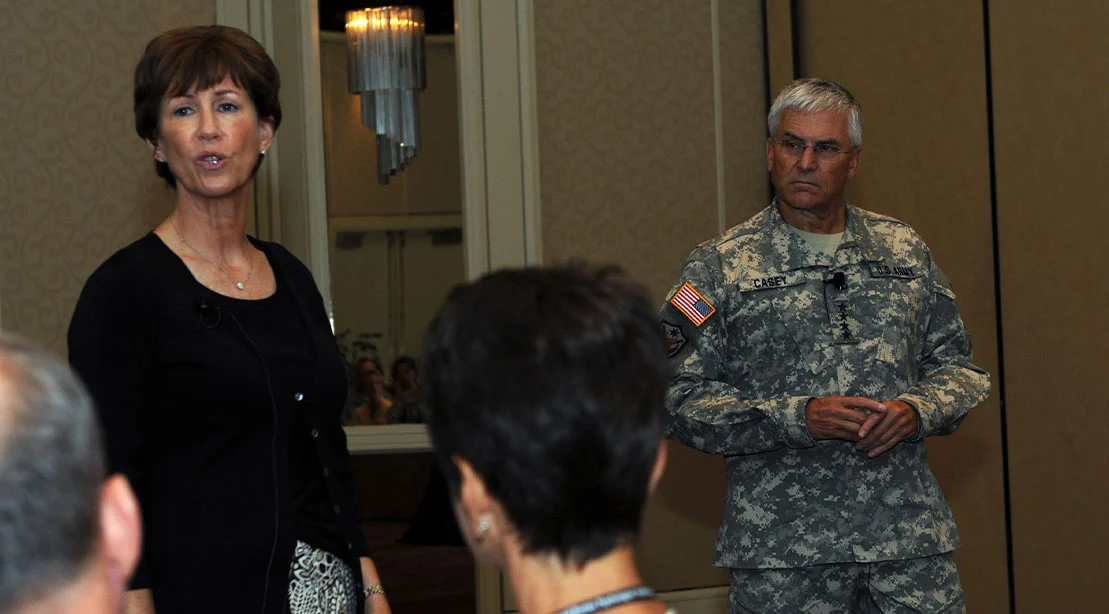
For the nearly two million men and women serving in the United States Armed Forces, the call to duty is a defining commitment. Yet, behind every uniform stands a silent engine of support: the military family. While the bravery of the service member is often the focal point of national pride, the selfless dedication of the spouses who anchor the household is an equally vital component of our national security infrastructure.
Among those who have navigated the complexities of military life with grace and advocacy is Sheila Casey, wife of retired four-star General and 36th Army Chief of Staff George Casey Jr. Her journey from the life of a peripatetic military spouse to a prominent government leader and advocate for military families offers a masterclass in resilience, self-actualization, and the essential nature of personal well-being.
The Foundations of a Life in Service: A Chronology
Sheila Casey’s life has been defined by transition. Over the course of 41 years of marriage to a high-ranking officer, she moved 25 times. These relocations were not merely changes of address; they were systemic overhauls of her life, requiring her to manage the logistics of new housing, integrate into unfamiliar communities, and ensure the stability of her two sons while her husband fulfilled his demanding duties.
Her athletic background, rooted in 12 years of competitive swimming, served as an early indicator of the discipline that would eventually define her character. Even before the term "work-life balance" was a household phrase, Casey understood that to be a pillar for others, she had to build a strong foundation within herself.
Key Milestones:
- The Early Years: Balancing the rigors of frequent military relocations with motherhood, Casey began to seek professional outlets outside the military sphere, establishing an identity distinct from her husband’s rank.
- The Professional Pivot: Breaking the mold of the "traditional" military spouse, she embarked on a distinguished career, most notably serving for 20 years as the Chief Operating Officer of The Hill.
- Public Service: She transitioned into the heart of Washington D.C., serving as Special Assistant to President Biden and Director of Joining Forces, a mission dedicated to supporting military and veteran families.
- Modern Advocacy: Today, she serves as a Senior Advisory Partner for American Corporate Partners (ACP), working to bridge the gap in veteran and spouse underemployment.
The Reality of the "Hidden" Service
The military lifestyle demands a unique form of endurance. The Department of Defense reported in 2017 that 92 percent of military spouses are women—a demographic that often absorbs the full weight of household management, emotional labor, and crisis mitigation.
Casey emphasizes that this role, while noble, often comes at the cost of personal identity. She recalls the exact moment she realized the severity of this lifestyle: when her own son deployed to a war zone. "I thought I understood what it would be like to send a child to a war zone," she reflects. "I quickly realized once that happened, I didn’t have a clue until I actually experienced it myself."
This realization became a cornerstone of her advocacy. She argues that the "selfless service" narrative can sometimes be a trap if it leads to the total abandonment of one’s own health and professional aspirations. By advocating for careers and personal health, she is not suggesting that spouses put themselves above their families, but rather that they cannot pour from an empty cup.
Data and Implications: The Fight Against Underemployment
The challenges faced by military spouses are supported by sobering data. High turnover rates, frequent moves, and the unpredictable nature of military schedules contribute to a chronic underemployment crisis within the military community.
As a Senior Advisory Partner for American Corporate Partners (ACP), Casey works to address these structural barriers. The organization’s one-to-one mentorship model is designed to help veterans and spouses navigate the civilian job market, which often fails to account for the unique, non-linear resumes of those who have moved every 18 months.
The implication is clear: when military spouses thrive professionally, the entire military family is more resilient. Financial stability reduces the stress on the service member, which in turn improves retention and operational readiness. Casey’s work with Hiring Our Heroes and ACP acts as a bridge, transforming the "military spouse" label from a perceived liability into a badge of adaptability, leadership, and crisis management.
Empowerment Through Physical and Mental Resilience
For Casey, the secret to sustaining a decades-long career while managing a high-stakes family life has been a non-negotiable commitment to fitness. "If you didn’t take care of yourself, then you would not have the ability to take care of your family and anything else that was important," she asserts.
This philosophy was put to the ultimate test when she and her family climbed the grueling trails of Machu Picchu. Reaching an elevation of 13,500 feet, camping in sub-freezing temperatures, and navigating rugged terrain was, in her words, "really hard." Yet, it served as a metaphor for her life: a climb that required preparation, endurance, and the willingness to lean on others.
Why Self-Care is a Strategic Asset:
- Preventative Health: By maintaining a fitness regimen, Casey avoids the common health pitfalls associated with high-stress environments, such as hypertension and cholesterol issues.
- Psychological Durability: Regular exercise provides a 30-minute window of mental clarity, essential for the "constant-on" lifestyle of a military family.
- Modeling Behavior: By prioritizing her own health, she sets a standard for her children and the spouses she mentors, proving that "self-care" is a tool for survival, not a luxury.
Official Perspectives and The "Permission" Paradigm
One of the most profound observations Casey shares is the feedback she receives from younger military spouses. Many have approached her, thanking her for giving them "permission" to work. Her response is characteristically firm and empowering: "You don’t need my permission. You need to do what is important for you and your family."
This shift in perspective is essential for the future of the armed forces. As the military looks to improve the quality of life for its personnel, the focus must remain on the agency of the spouse. When a spouse feels empowered to build a career, their connection to their community strengthens, their mental health improves, and they become more effective partners to their service members.
Conclusion: A Blueprint for the Future
Sheila Casey’s story is not merely one of a spouse who "supported her husband." It is the story of an individual who navigated one of the most challenging environments in American life and emerged as a leader in her own right. Her accolades—including the Defense Distinguished Civilian Service Medal—are secondary to the impact she has had on thousands of families who now see themselves as more than just a support system.
The "Fit to Serve" mindset that Casey advocates for is a call to action for every military family. It is a reminder that while the mission of the military is the defense of the nation, the mission of the family is the preservation of the individual. By prioritizing health, professional growth, and personal autonomy, military spouses can ensure that they are not just waiting for their loved ones to return, but are building a legacy that is just as significant as the service provided by those in uniform.
As she prepares for her next challenge, a trek to Mount Fuji, Casey remains a beacon for those who feel the mountain of military life is too steep to climb. Her message remains constant: stay active, stay ambitious, and remember that you are the architect of your own life. Everything else, she suggests, will fall into line.
 Lina Hope
 rifanmuazin
 Laily UPN
