

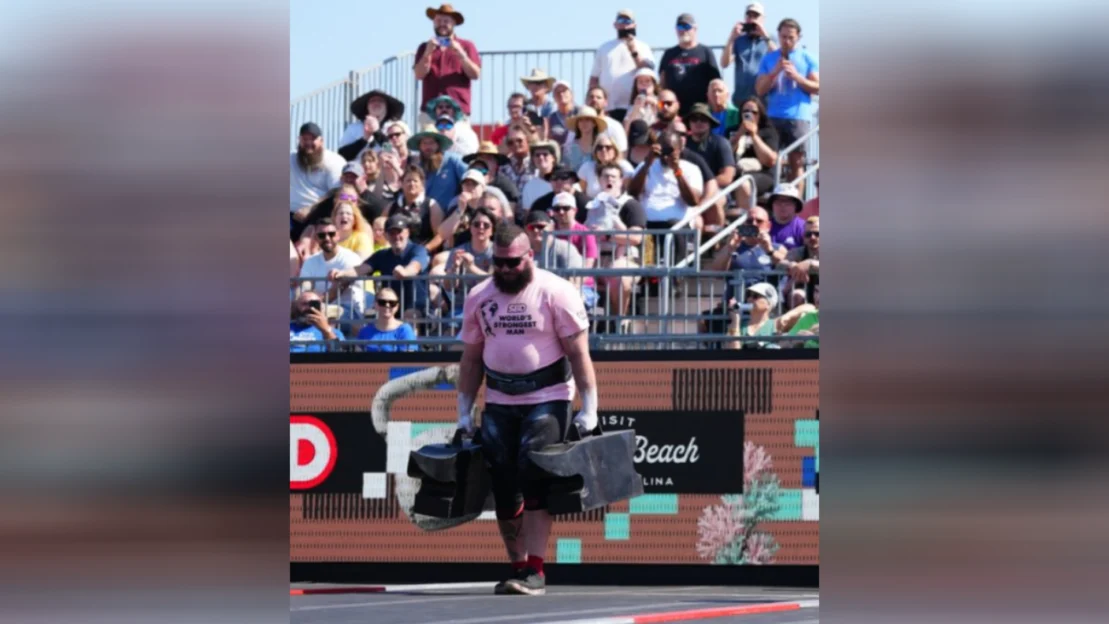
The World’s Strongest Man (WSM) competition is, by definition, the pinnacle of human brute force. Every year, the event serves as a crucible where legends are solidified and history is forged. The 2026 edition of the WSM was no exception, headlined by the triumphant return of Mitchell Hooper, who reclaimed his title in a display of tactical brilliance and physical dominance. However, beneath the shadow of the main podium, a different kind of history was being written—one that signaled the emergence of a new geographical powerhouse in the sport: Mississippi.
Enter Levi Strong. Standing at a formidable 6’8” and weighing in at over 370 pounds, the man with the aptly descriptive surname made his debut at the 2026 WSM, becoming the first athlete from the state of Mississippi to compete on the sport’s greatest stage. His presence in Myrtle Beach was not merely a participation trophy; it was the culmination of a grueling, unconventional journey that bridged the gap between blue-collar manual labor and professional athletic excellence.
A Legacy Forged in Iron: The Chronology of Levi Strong
Levi Strong’s entry into the professional strongman circuit is a testament to the idea that greatness often starts in the most unassuming places. His journey began not in a state-of-the-art training facility, but on a job site in New Orleans. While working as a professional lineman, Strong crossed paths with a bodybuilder who introduced him to the rigors of disciplined physical training.
However, the spark truly ignited when Strong stumbled upon the documentary featuring British strongman icon Eddie Hall. Watching the absolute mastery of heavy implements resonated with the Mississippi native. "I thought that looked cool," Strong recalls of that pivotal moment. "So, I found a competition, entered it, and I did well. So, I just kept doing it."
That decision set off a chain reaction. Strong quickly realized that his frame—perfectly suited for the high-impact demands of being a lineman—was tailor-made for the demands of the log press, atlas stones, and the yoke walk. Following his debut, he committed himself fully to the sport, navigating the complexities of transitioning from a hobbyist to a professional.
His path to the 2026 WSM was defined by resilience. In 2024, while preparing for America’s Strongest Man, Strong was pulled away for two weeks of intensive storm recovery efforts in Florida. The grueling nature of the work, coupled with the difficulty of maintaining a specialized training regimen on the road, took its toll. He arrived in Las Vegas for the contest having shed 25 pounds, a deficit that proved insurmountable at the highest level of competition.
Refusing to be deterred, Strong pivoted. He spent the remainder of 2024 and 2025 honing his craft, eventually finding his rhythm on the international stage. His victories at the 2025 Magnus Ver Magnusson Classic in Gimli, Canada, and the Magnus Classic in Iceland provided the necessary points and momentum to secure his invitation to the 2026 World’s Strongest Man.
The Supporting Architecture: Family and Coaching
One of the most compelling aspects of Levi Strong’s rise is the domestic support system that fuels his training. In an era where professional athletes often have access to high-end recovery teams and specialized dietitians, Strong has built a localized powerhouse at home.
His wife, Rebecca Strong, is not just a partner; she is a trailblazer in her own right. Under Levi’s coaching, Rebecca became the first professional strongwoman from Mississippi. This unique dynamic provides Levi with an unparalleled advantage: he shares his life with someone who intimately understands the physical and mental toll of the sport.
"She definitely knows about it, including the time to set up and take down the events for training, which is sometimes the hardest part," Strong notes. "She is a strong asset for that, and she takes care of our two kids when I work out." This collaborative approach to training, where both spouses operate at the professional level, has become a cornerstone of their success. It allows for a level of empathy and shared sacrifice that is rarely seen in the solitary, individualistic world of elite strength sports.
The 2026 WSM Experience: Lessons from the Deep End
The 2026 WSM competition served as a baptism by fire for the Mississippi native. Placed in a qualifying group that featured three-time world champion Tom Stoltman, alongside seasoned veterans Austin Andrade and Matthew Ragg, the deck was stacked against the rookie.
While Strong did not advance to the finals, his performance was viewed by scouts and spectators alike as a clear "proof of concept." He demonstrated the raw power necessary to hang with the best in the world, even if his technical efficiency with specific implements still required refinement.
The experience provided more than just a ranking; it provided a blueprint. Strong left Myrtle Beach with a clear understanding of the gap between the mid-tier professional circuit and the elite level. His stated intention is to return to the 2027 WSM, not as a participant, but as a contender.
The Implications: Growing the Sport in the South
Levi Strong’s rise holds significant implications for the future of strongman in the United States. Historically, the sport has been concentrated in specific hubs, often leaving regions like the Deep South without clear pathways for aspiring athletes. By establishing himself as the first pro from Mississippi and actively coaching the next generation—including his wife—Strong is effectively creating a blueprint for regional growth.
His transition between his career as a lineman and his role as a professional athlete serves as a narrative for the "everyman" strength athlete. He emphasizes that the sport does not belong exclusively to those who have the luxury of training in perfect conditions. His ability to maintain a high-intensity career in storm recovery while training for international competitions challenges the current paradigm of athlete development.
Insights for the Aspiring Titan: Strong’s Training Methodology
For those looking to follow in his footsteps, Strong provides a pragmatic approach to training that favors adaptability and mental toughness over expensive equipment.
1. Adaptability as a Core Skill
Strong’s career is a case study in rolling with the punches. He recounts a chaotic period earlier this year when he received a late-notice invitation to a contest in Siberia. Five weeks out, he began training specifically for a max deadlift, only for the event to be canceled due to visa issues. Two days later, he received the call for the WSM.
"I had to put on weight and build up for a max deadlift, but our visas didn’t get approved," Strong explains. "Two days later, I found out I was going to be invited to Worlds. So, I just rolled over into training for that." The lesson for beginners is clear: in a sport where external variables (injury, work, scheduling) are constant, the ability to pivot is just as important as the ability to lift.
2. Cultivating Mental Fortitude
Strong is adamant that strongman is a psychological game as much as a physical one. "There are events that are grueling and make you want to give up, but you must shut those thoughts out," he advises. This involves a deliberate practice of pushing past the threshold of pain, particularly during conditioning-heavy events like the Farmer’s Walk or the Yoke Carry. For the novice, this means training through the "burn" and refusing to drop the implement until the required distance or time is met.
3. The Power of the Sled Push
Perhaps the most actionable piece of advice Strong offers involves the use of the weighted sled. While many beginners are obsessed with acquiring expensive log presses or atlas stones, Strong argues that the sled is the most underutilized tool in the amateur’s arsenal.
"Aside from the strength it takes to move it, it will teach you the footwork you need for a pull like that and help with that mental fortitude," he says. The sled push is a full-body engagement exercise that mimics the specific strain of truck pulls and heavy carries, making it an essential component for anyone looking to build a foundation for contest-ready strength.
Conclusion: The Road to 2027
As the dust settles on the 2026 World’s Strongest Man, the landscape of the sport feels slightly shifted. Levi Strong has carved out a niche as a representative of both the grit of his home state and the blue-collar spirit of the industry. His trajectory suggests that we are witnessing the early chapters of a career defined by late-blooming potential and relentless, high-stakes adjustments.
Whether or not he finds himself on the podium in 2027 remains to be seen. However, the message he has sent to the strength community is unmistakable: Mississippi has arrived, and the "Strong" name is set to be a permanent fixture in the annals of the sport. For those who wish to follow his journey, his progress is documented through his social media channels, where he continues to demystify the path from the job site to the world stage, proving that with enough fortitude, any obstacle can be moved.
 Lina Hope
 rifanmuazin
 Laily UPN
