

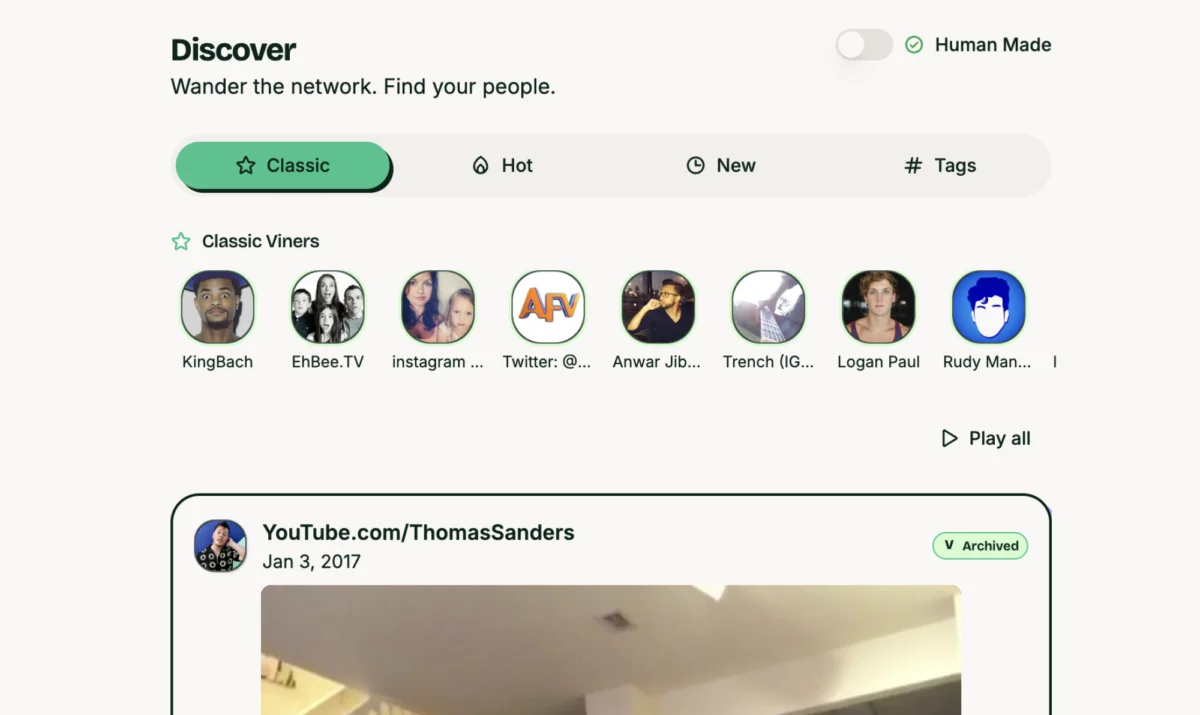
In a twist of irony that would feel at home in a digital satire, the platform that defined the early 2010s internet—and was subsequently euthanized by its own corporate parent—has returned. Vine, the short-form video app that served as the digital nursery for a generation of internet stars, is back in 2026. However, it arrives under a new moniker: Divine.
The revival of this cultural artifact is a complex tale of nostalgia, corporate atonement, and a desperate, technology-fueled battle against the rising tide of synthetic content. Funded by Jack Dorsey, the former Twitter CEO who oversaw the original app’s demise in 2017, Divine is positioning itself not just as a successor, but as an ideological antithesis to the current social media landscape.
The Chronology of a Digital Phoenix
To understand the significance of Divine, one must first look at the turbulent history of its predecessor. Launched in 2013, Vine was an experiment in creative constraint. Its six-second looping format forced creators to distill comedy, art, and storytelling into bite-sized fragments. It was a cultural juggernaut, reaching 100 million monthly active users at its peak. Names like Logan Paul and King Bach emerged from this creative crucible, proving that six seconds was more than enough time to capture global attention.
However, Twitter, which acquired Vine before its launch, struggled to monetize the platform. By January 2017, the doors were shuttered. The decision left a void that was quickly filled by Musical.ly, which later morphed into the behemoth we know as TikTok. For nearly a decade, the "Vine era" was relegated to archives and YouTube compilations, a preserved snapshot of a simpler internet.
The path to Divine’s birth began in late 2025 with a low-profile test launch. Led by Evan Henshaw-Plath—a former Twitter veteran known in tech circles as "Rabble"—the project was initially conceived as a digital preservation effort. Henshaw-Plath sought to provide a permanent home for the 500,000 legacy videos that had survived the original Vine’s closure. With funding from "and Other Stuff," a nonprofit organization backed by Jack Dorsey focused on open-source social media, the project evolved from a museum into a living, breathing social network.
The Anti-AI Manifesto: A War on "Slop"
The most striking feature of Divine is not its nostalgia, but its hostility toward the current industry trend: generative artificial intelligence. While platforms like TikTok and Instagram are rapidly integrating AI-driven filters, content generators, and synthetic influencers, Divine has declared war on what its creators call "AI slop."
The platform’s mission is centered on the principle of human-only creation. To enforce this, Divine has implemented a two-fold verification system. Users are encouraged to record content directly within the app, ensuring the raw file originates from a camera sensor. For those who prefer to edit outside the app, Divine utilizes a sophisticated human-verification tool developed in partnership with the human rights nonprofit, the Guardian Project.
This mechanism is designed to detect synthetic patterns, ensuring that every video on the platform is, at its core, a reflection of human activity. For a digital ecosystem currently drowning in deepfakes and automated "content farms," this "human-only" verification is a high-stakes gamble. It suggests that the value of social media in 2026 may lie not in how much content can be produced, but in the proven authenticity of its origin.
Official Responses and Philosophical Shifts
Jack Dorsey’s involvement in Divine serves as both a financial backing and a public admission of previous failures. In a rare statement regarding the platform’s philosophy, Dorsey addressed the shortcomings of the original Vine. He noted that the primary flaw of the 2013 era was the centralization of power.
"The core principle of Divine is ownership," the project’s mission statement reads. Unlike the closed gardens of the early 2010s, Divine is built on the promise that creators maintain sovereignty over their content and their follower base. The platform aims to move away from the "black box" algorithms that dictate visibility on platforms like Instagram Reels and YouTube Shorts, allowing creators to build their own revenue streams without the looming threat of an algorithm change destroying their livelihood.

"The goal is to recapture an era of social media built around real people, algorithm control, and authentic content," Henshaw-Plath stated during the 2025 test phase. It is an acknowledgment that the industry took a wrong turn when it prioritized machine-optimized engagement over human connection.
Supporting Data: The Landscape of 2026
Divine enters a market that is fundamentally different from the one Vine left behind. Today’s landscape is defined by sheer scale and algorithmic dominance:
- YouTube Shorts: Currently averages over 200 billion daily views, serving as the dominant engine for quick-hit, ad-supported content.
- Instagram Reels: A massive revenue generator for Meta, leveraging the company’s vast social graph to keep users in a constant loop of "brainrot" content.
- TikTok: The entrenched king of the short-form space, which has effectively weaponized attention metrics to keep users addicted to algorithmic feeds.
Against these giants, Divine’s six-second, human-only proposition feels almost quaint. However, data from early adopters suggests a growing fatigue with AI-generated content. As platforms become saturated with generic, AI-assisted videos, the "human touch" has begun to command a premium. The challenge for Divine is not technological, but cultural: can a platform survive by intentionally restricting the volume of its content in a market that rewards infinite scrolling?
The Implications: Is Authenticity a Viable Business Model?
The implications of Divine’s success—or failure—will ripple through the tech industry. If the platform gains traction, it will provide a proof-of-concept for a "human-only" internet. It would suggest that a significant portion of the user base is willing to trade the infinite, algorithmically optimized feed for a more constrained, authentic experience.
Furthermore, it challenges the narrative that AI-driven content is the inevitable future of social media. By betting on human-made, six-second clips, Divine is attempting to create a "slow food" movement for the digital age. It is a defiant stance against the race to the bottom, where machines generate videos faster than humans can watch them.
However, the irony of the situation cannot be overstated. Elon Musk, who once toyed with the idea of reviving Vine to bolster the X platform (formerly Twitter), was beaten to the punch by the very man who killed it. While Musk’s vision for a Vine revival was likely tied to creating a competitor for TikTok, Dorsey’s vision is focused on a decentralized, human-centric alternative.
Conclusion: The Future of the Loop
Divine is now available on both the Google Play Store and the Apple App Store, inviting users to return to a format that defined a generation. It is a bold, perhaps even foolhardy, proposition. In an age of high-definition, AI-enhanced, and algorithmically perfect content, the return of the six-second, raw, human-made loop is a radical act.
Whether Divine can survive the pressures of a market dominated by multi-billion dollar giants remains to be seen. But in its very existence, it poses a question that every social media user in 2026 must answer: Do we want a feed that is perfect and automated, or do we want a feed that is messy, human, and real?
As the first generation of "Viners" returns to the app, they aren’t just looking for nostalgia. They are looking for a digital space that feels like it belongs to them again. If Divine can maintain its integrity, avoid the trap of algorithmic over-optimization, and keep its promise of human-only content, it might just prove that the best way forward is to look back.
The loop has started again. This time, it’s up to the humans to keep it going.
 Nana Wu
 Neng Nana
 Reynand Wu
