

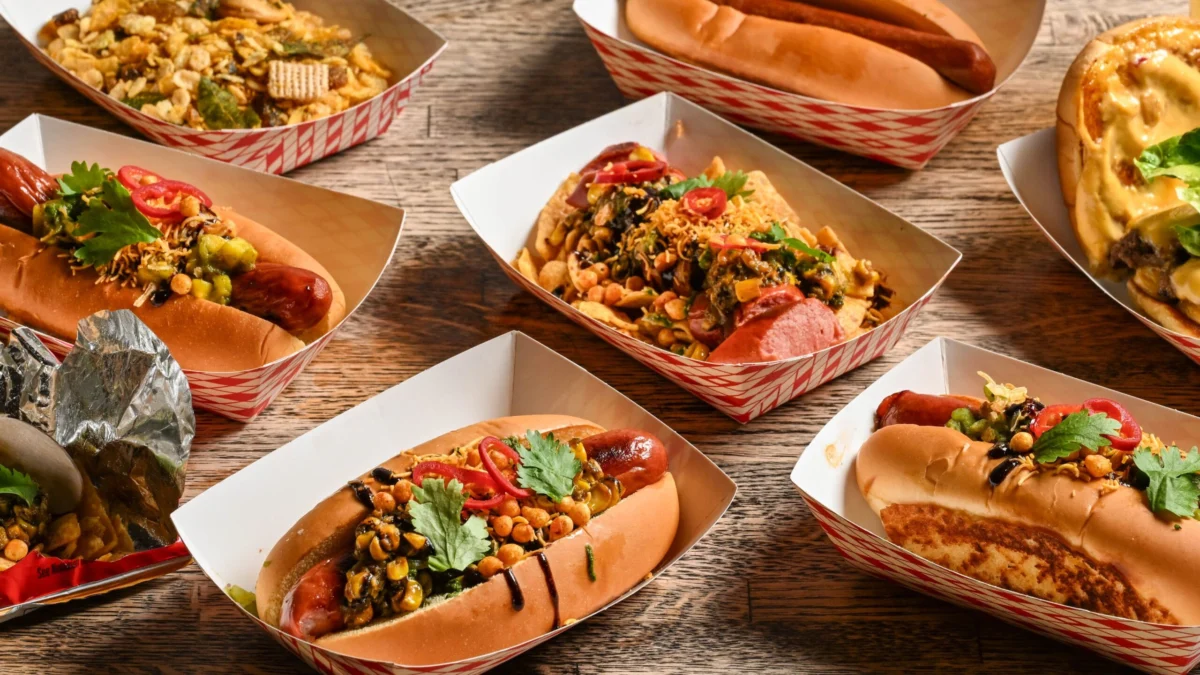
In the summer of 2017, journalist and chef Pervaiz Shallwani stood over a grill at a friend’s birthday celebration. As he prepared a hot dog—an iconic symbol of American backyard culture—he found himself reaching for an unlikely set of ingredients. Instead of the standard mustard or relish, he topped the frankfurter with bhel puri, the beloved South Asian street snack consisting of crispy puffed rice, vibrant diced red onions, tomatoes, and a complex interplay of tangy and spicy chutneys.
What began as a playful, spontaneous experiment—a fusion of Chicago-style hot dog tradition and the bustling street food culture of Karachi—was more than just a culinary curiosity. It was the spark for a movement. Today, that "happy accident" has evolved into Chaat Dog, a permanent fixture in Brooklyn’s Time Out Market. But more importantly, it serves as a microcosm of a much larger, seismic shift in the American culinary landscape: the emergence of the unapologetic, bold, and inventive Pakistani-American kitchen.
A Historical Context: From the Shadows to the Spotlight
To understand the current "Pakistani moment," one must look at the migration patterns that shaped it. The first significant wave of Pakistani immigrants began arriving in the United States in the early 1970s, establishing roots in major urban hubs like New York City, Chicago, Los Angeles, Houston, and Washington, D.C.

For decades, the culinary footprint of this diaspora was intentionally muted. During the 1980s and 90s, the few Pakistani restaurants that managed to open in these immigrant enclaves often sought refuge under the umbrella of "Indo-Pak" or simply "Indian" branding. This was a strategic move born of necessity; the American palate was already becoming familiar with staples like butter chicken and chana masala, and masking regional identities was often the quickest path to economic survival. Authentic Pakistani flavors were largely confined to tight-knit communities in places like Devon Avenue in Chicago or Hillcroft in Houston, effectively hidden from the mainstream.
However, the demographic reality has shifted dramatically. The Pakistani-American population has exploded from roughly 32,600 in 1980 to nearly 680,000 today. As the community has grown, so has the confidence of its restaurateurs. They are no longer hiding behind generic labels; they are staking their claim on the American culinary map with names that honor their heritage and menus that challenge conventional boundaries.
The Post-Pandemic Pivot: A New "Fast-Casual" Wave
The past four years have acted as a pressure cooker for this movement. While the 2010s saw a rise in the profile of West African and Filipino cuisines through sophisticated, fine-dining concepts, the current wave of Pakistani-American dining is defined by a different energy: it is scrappy, fast-casual, and relentlessly inventive.
%2520everything%2520on%2520the%2520menu%2520is%2520halal.%2520Thanks%2520yall!.jpg)
This generation of chefs is not interested in white-tablecloth gatekeeping. Instead, they are taking the "American" formats they grew up with and layering them with the complex, aromatic, and fiery profiles of home. We are seeing the birth of a hybrid lexicon: New York-style chopped cheese bolstered by the heat of chapli kabab, Nashville-style hot chicken infused with South Asian spice medleys, and buttermilk-brined fried chicken paired with mint chutney and tikka sauce.
This model is not just culturally resonant; it is operationally brilliant. By focusing on takeout-friendly, replicable menus, these entrepreneurs have successfully navigated the volatility of the post-pandemic hospitality industry.
Chronology of a Culinary Evolution
2015: The Breakthrough of BK Jani
Long before the current boom, Sibte Hassan opened BK Jani in Bushwick, Brooklyn. Moving from Lahore, one of the world’s most vibrant food cities, Hassan was struck by the lack of quality in local Pakistani offerings. His initial journey was one of trial and error; he famously struggled to attract customers for months after opening, nearly accepting a buyout. That all changed with a New York Times review that dubbed him the "Midas of Meat." Hassan proved that premium halal ingredients, when treated with reverence, could command a loyal following outside of immigrant enclaves.

2020–2022: The Rise of Namkeen and Chaat Dog
In the fall of 2020, at the height of the pandemic, Usman and Amena Chaudhry launched Namkeen in Chatham, New Jersey. With a tight, replicable menu featuring hot chicken sandwiches and tikka-spiced mac and cheese, they tapped into the demand for comfort food. The concept was so successful that it has since expanded to ten locations across the U.S. and Canada. Shortly thereafter, Pervaiz Shallwani formalized his "Chaat Dog" concept, proving that the American public was hungry for bold, cross-cultural experimentation.
2024–2025: The Rise of the Visionaries
The momentum has only accelerated. In 2024, Zeeshan Bakhrani launched Nishaan in the East Village, quickly becoming a viral sensation for his Pakistani-take on the chopped cheese. His success was bolstered by winning $50,000 on the Food Network’s The Great Food Truck Race in 2025, a victory that validated the "all-halal" concept on a national stage. Meanwhile, in Harlem, Saud Khan opened Kaafi, a café dedicated to the art of chai and Pakistani snacks, proving that there is a massive market for Pakistani-centric social spaces.
Supporting Data: By the Numbers
The success of this movement is backed by hard data:
%2520(1).JPG)
- Population Growth: The Pakistani-American diaspora has increased by over 2,000% since 1980, creating a significant domestic customer base.
- Uber Eats Dominance: Aga’s in Houston, a long-standing titan of the industry, recently recorded the highest volume of any single-location restaurant on Uber Eats, signaling that demand for these flavors is no longer niche.
- Expansion: Brands like Namkeen have demonstrated that the "fast-casual" Pakistani model is inherently scalable, moving from a single location to a cross-border franchise in under five years.
- Media and Validation: The shift from local "word of mouth" to national features in The New York Times, Texas Monthly, and Eater highlights the mainstreaming of these flavors.
Official Perspectives: The Philosophy of "Ice-Breaking"
For these chefs, the food is often a vehicle for social discourse. Zain Shafi, the pitmaster behind the food truck Sabar in Texas, emphasizes the role of food in combating prejudice. Growing up in Texas, he found that high-quality, halal barbecue was almost non-existent. By training at the renowned Goldee’s and then applying those techniques to halal meats—serving smoked tandoori turkey and seekh kebab-spiced sausages—he wasn’t just making dinner; he was dismantling barriers.
"In the midst of Islamophobia in Texas, food was a good stepping stone to introduce Pakistani culture to people," Shafi explains. "It broke the ice."
Zeeshan Bakhrani echoes this sentiment. When faced with the question of whether labeling his food "Pakistani" would hinder his chances in a competitive, mainstream market, his answer was defiant: "It won’t hurt me either." This reflects a fundamental change in mindset: the younger generation of Pakistani-Americans is no longer asking for permission to be seen; they are demanding it.
.jpeg)
The Implications: What Defines American Food?
The most profound implication of this movement is the redefinition of what "American food" actually is. Pervaiz Shallwani argues that what is happening in the Pakistani-American kitchen is not just "fusion"—a term often used to dismiss immigrant creativity—but the natural continuation of a centuries-old American tradition.
"You know what you know, you take what you can find, and you adapt it over time," Shallwani says. "Every immigrant group that comes here makes American food their own. That’s what defines American food."
The implications for the future are clear. We are entering an era where the borders between "ethnic food" and "American staples" are dissolving. When a customer walks into a bodega and orders a chopped cheese, they are now just as likely to encounter a chapli kebab iteration as they are a traditional beef patty. When someone stops for a hot dog in Brooklyn, they are increasingly expecting a dash of chaat masala.

The Pakistani-American kitchen is no longer a footnote in the story of American immigration; it is a leading character. As these chefs continue to "lock in," as Saud Khan puts it, they are not only feeding a hungry nation but are also etching a new, permanent layer into the complex, delicious, and ever-evolving tapestry of American culinary identity. The Pakistani influence is here to stay, and it is adding a much-needed, vibrant, and unapologetic spice to the American table.
 Lina Hope
 Muslim
 Asep Darmawan
