

As the crisp winds of September sweep through Lower Manhattan, the New York art world is officially back in business. Nowhere is this dynamic seasonal revival more palpable than in Tribeca, where a dense concentration of compact storefronts, historic loft spaces, and sleek contemporary galleries are punching well above their weight class. Strolling down Broadway and cutting across Walker and White Streets, visitors are immediately struck by a revitalized neighborhood pulse. The galleries opening their doors this fall are not merely displaying commodities; they are offering deeply impactful, story-driven exhibitions that spotlight both generational masters and generational breakthroughs.
From monumental explorations of artist anxiety and the often-overlooked logistics of the art market to ethereal nods to High Renaissance masterpieces and poignant Vietnamese funerary traditions, Tribeca has transformed into the epicenter of the city’s early fall cultural calendar.
The Landscape of Tribeca’s Fall Season: Main Facts
The autumn 2026 gallery season in Tribeca is characterized by a distinct shift toward narrative intimacy and conceptual risk-taking. While blue-chip galleries continue to migrate downtown, they are sharing the cobblestone streets with an influx of agile, risk-friendly spaces that give younger artists unprecedented platforms.
The current crop of exhibitions highlights a broad spectrum of human experiences. At Matthew Brown Gallery, veteran painter Carroll Dunham debuts his first body of work since switching representation, offering a surreal psychological tableau. Meanwhile, at Journal Gallery, 25-year-old rising star Mia Goldstein turns her lens toward the unglamorous, behind-the-scenes mechanics of art handling. Institutions like Bortolami, apexart, and Chapter NY round out a robust neighborhood circuit that balances international contemporary discourse with hyper-local and cross-cultural traditions.
A Walk Through the Neighborhood: Chronology of the Exhibitions
For art lovers planning an afternoon walk through the neighborhood, the current slate of exhibitions offers a cohesive journey across generations, mediums, and themes. While most of these shows opened in early September to kick off the fall season, they are staggered across the coming weeks, giving audiences ample time to absorb the breadth of what Tribeca has to offer.
- Mia Goldstein: Handle With Care at Journal Gallery (45 White Street) opened the early fall rush, running a tight schedule through October 3.
- Giuseppe Francalanza: All of My Angels Wear a Rag: I The Tuner at Chapter NY (60 Walker Street) runs through October 17.
- Carroll Dunham: Paintings at Matthew Brown Gallery (390 Broadway) remains on view through October 24.
- Christine Safa: Noces at Bortolami Gallery (39 Walker Street) runs concurrently through October 24.
- Weaving a Day, Mourning a Life: The Mother and Daughter-in-Law of Phúc Sen at apexart (291 Church Street) welcomes visitors through October 24.
Deep Dive: Supporting Data and Curatorial Breakdown
Carroll Dunham: Paintings
- Location: Matthew Brown Gallery, 390 Broadway, Tribeca, Manhattan
- Dates: Through October 24
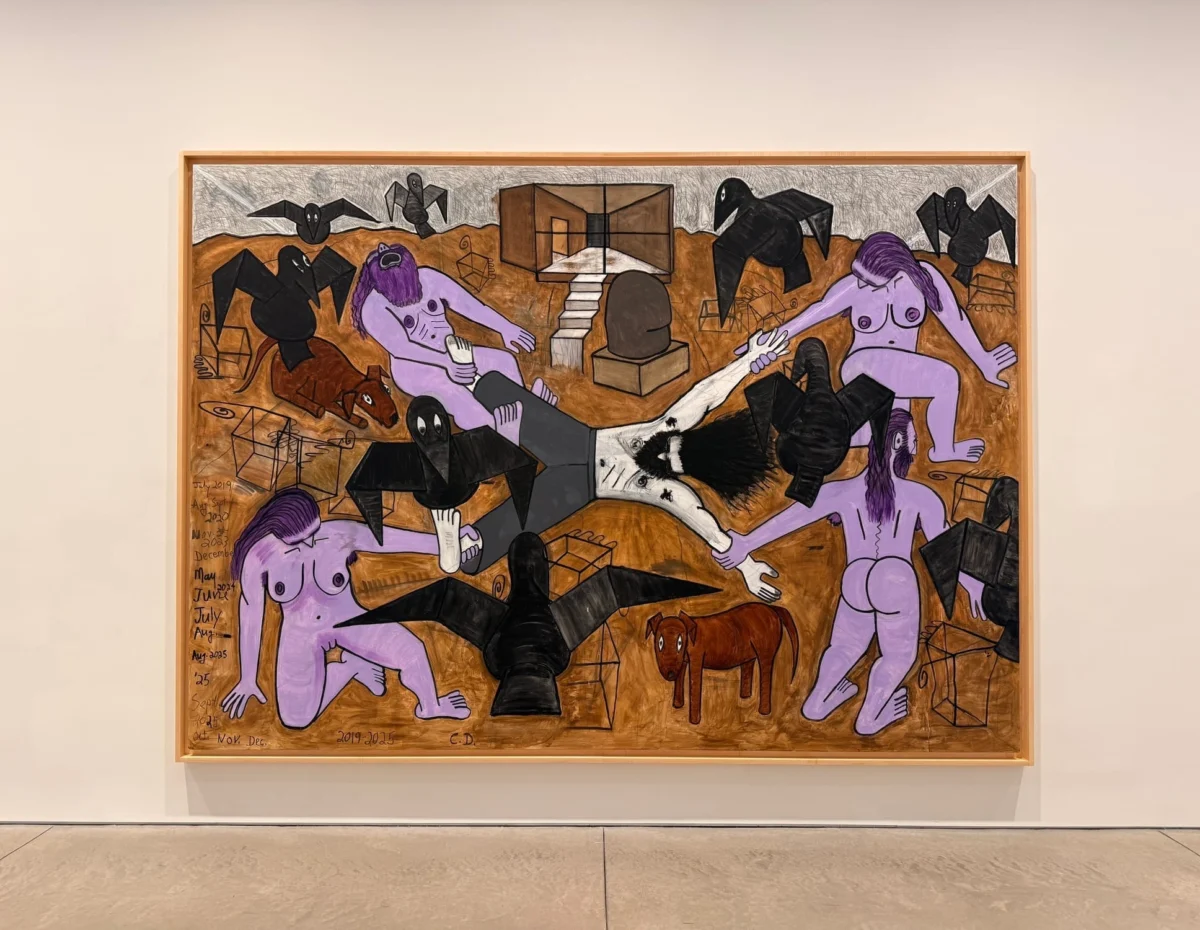
Throughout his illustrious career, Carroll Dunham has utilized sharp archetypes and cartoonish distortion to explore the complexities of human psychology and male identity. His prior "wrestler" period—notoriously populated by homoerotic pink men, aggressive posturing, and chaotic physical configurations—was a staple of contemporary painting discourse.

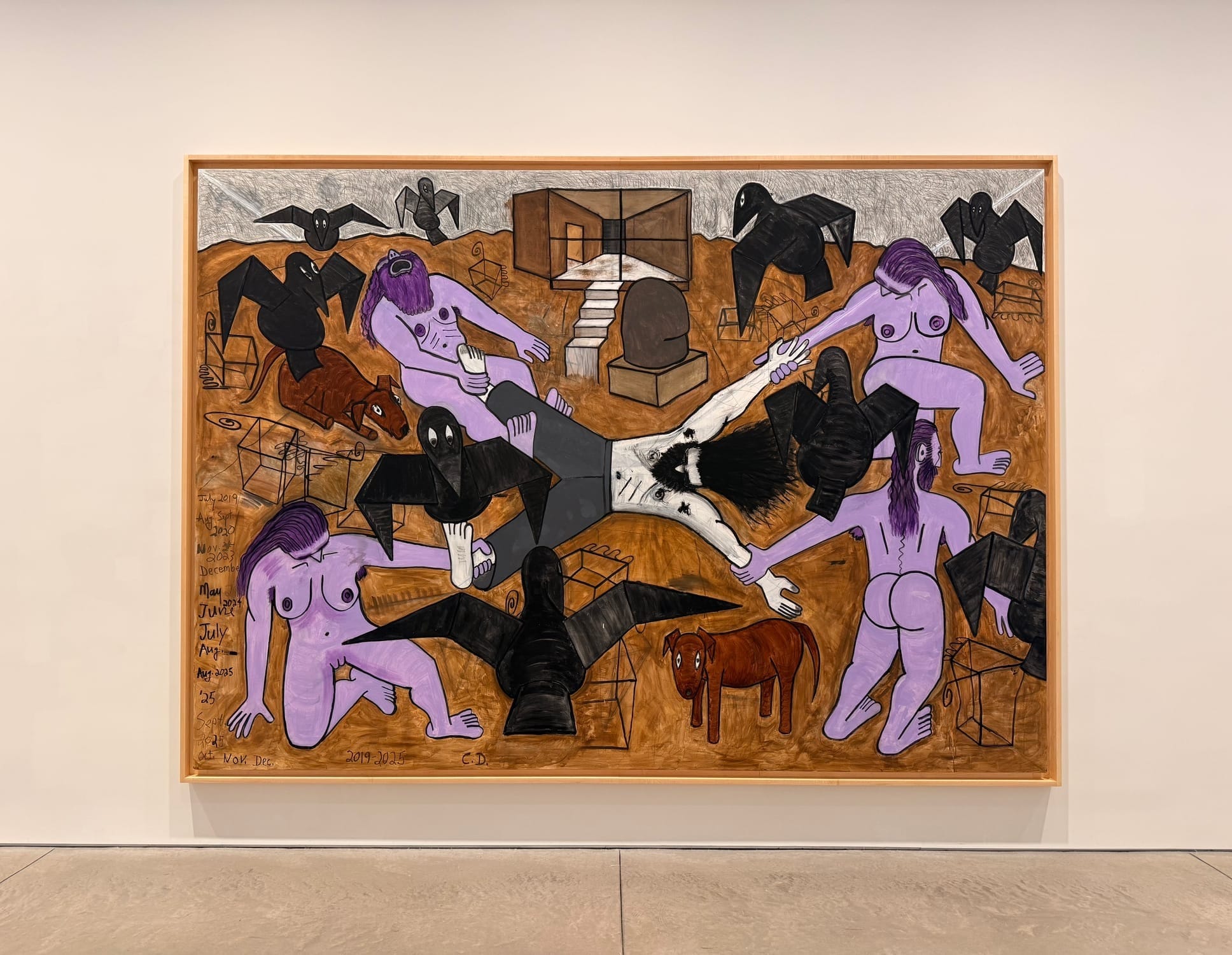
In his latest body of work at Matthew Brown Gallery—his first major presentation since joining the gallery in 2025 after a two-decade run with Gladstone Gallery—Dunham swaps his signature pinks for striking purples. The new canvases construct a surreal narrative centered on a White male sculptor stranded on an alien planet populated entirely by purple people. These figures dance, sing, and literally pull at the sculptor from every conceivable angle. In the commanding 12-foot canvas Finished (2019–2025), executed in acrylic and pencil on linen, multiple figures tug at the artist’s limbs. It reads as a visceral, darkly humorous manifestation of creative anxiety and the crushing demands placed upon the aging male creator.
Christine Safa: Noces
- Location: Bortolami Gallery, 39 Walker Street, Tribeca, Manhattan
- Dates: Through October 24
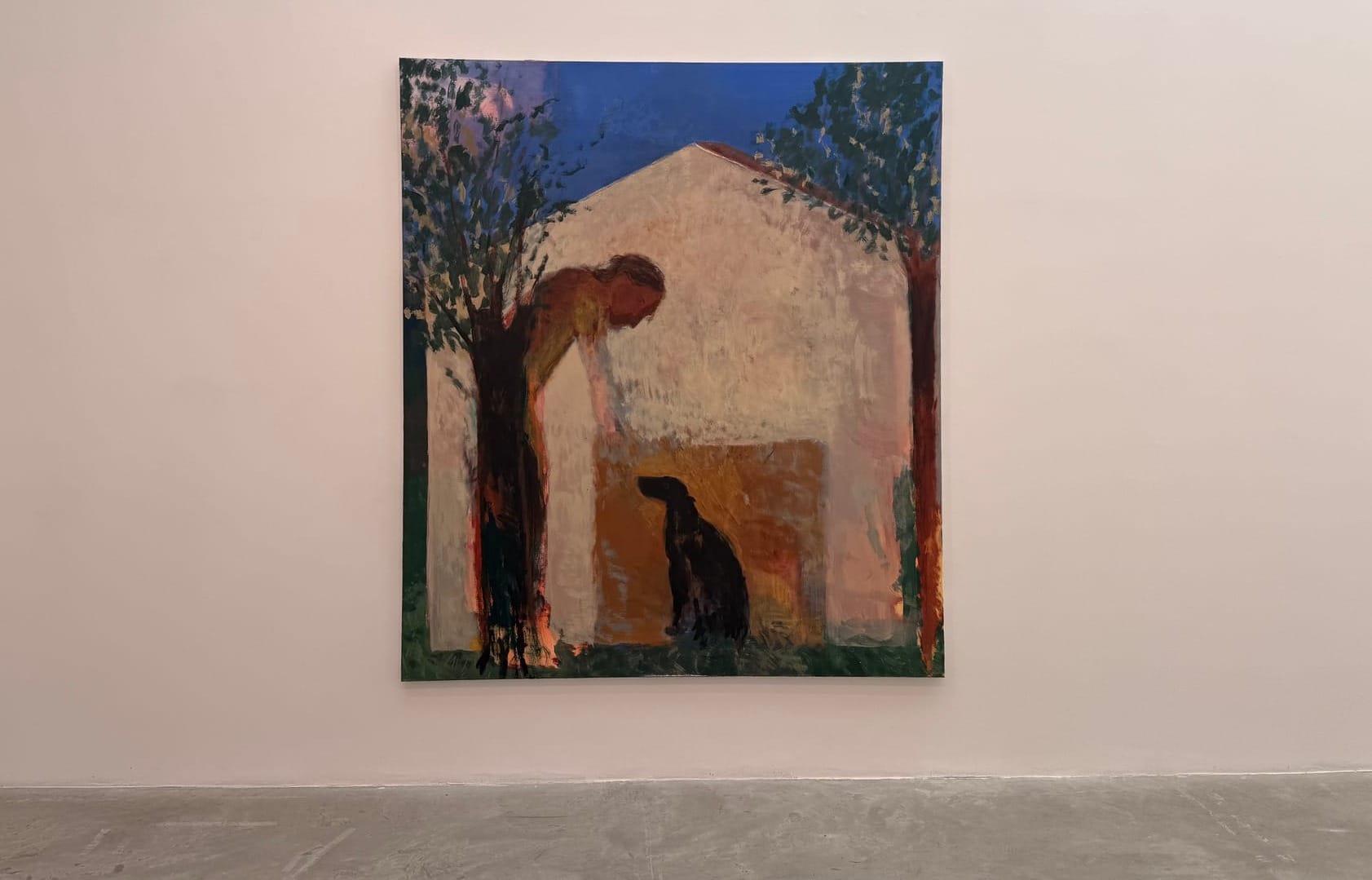
At Bortolami Gallery, French-Lebanese painter Christine Safa presents Noces, a quiet, meditative exhibition defined by a constrained and poetic palette of deep blues, warm oranges, and earthy greens. Safa’s smaller canvases—featuring miniature renderings of oceans, rainbows, and sunflowers—might initially appear modest, but when juxtaposed with her larger figurative compositions, they reveal themselves as monumental explorations of motion, emotional resonance, and memory.
Safa’s work speaks the language of temporal passage and internal peace. In one particularly relatable and tender moment within the exhibition, a lone female figure is depicted embracing her loyal brown dog. The gesture grounds the ethereal atmosphere of the paintings in everyday warmth, bridging the gap between grand art-historical traditions of landscape and intimate, lived reality.
Mia Goldstein: Handle With Care
- Location: Journal Gallery, 45 White Street, Tribeca, Manhattan
- Dates: Through October 3
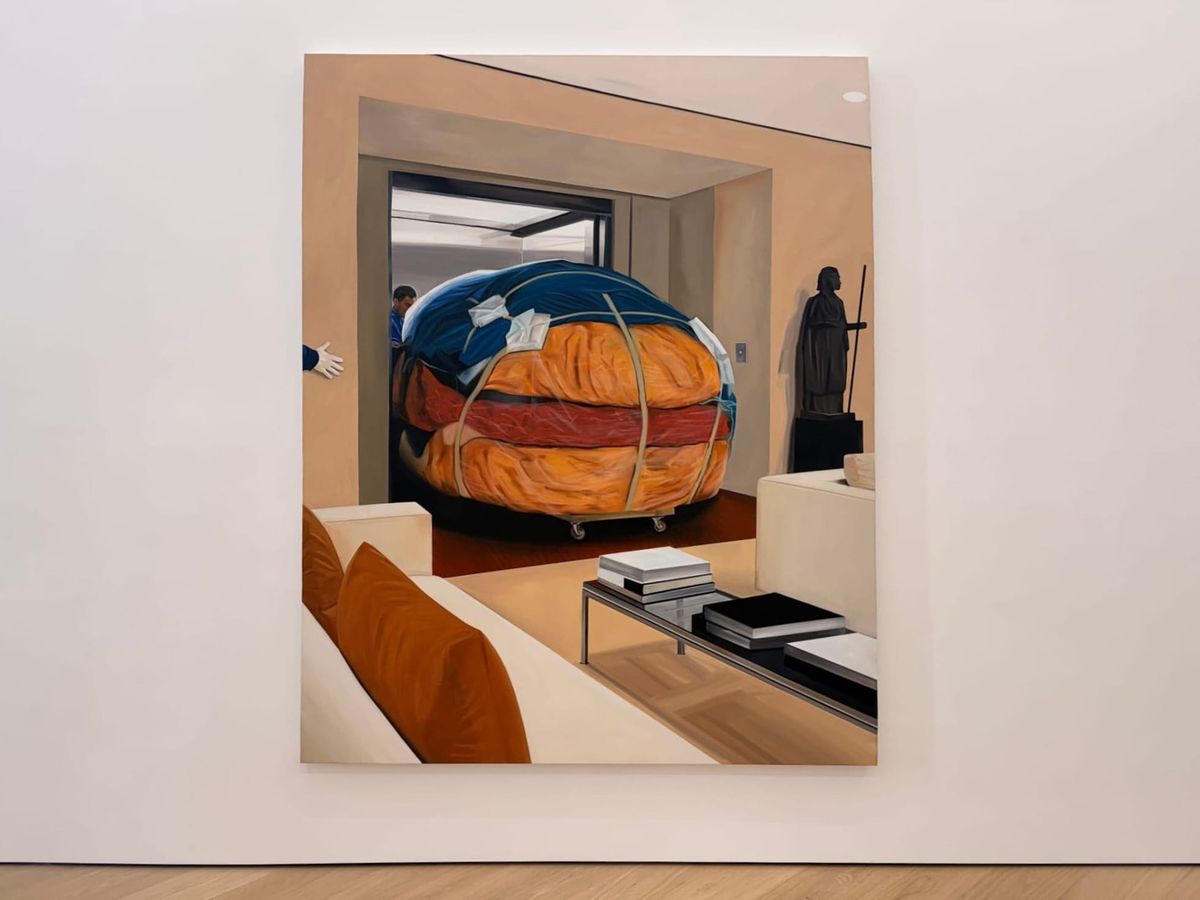
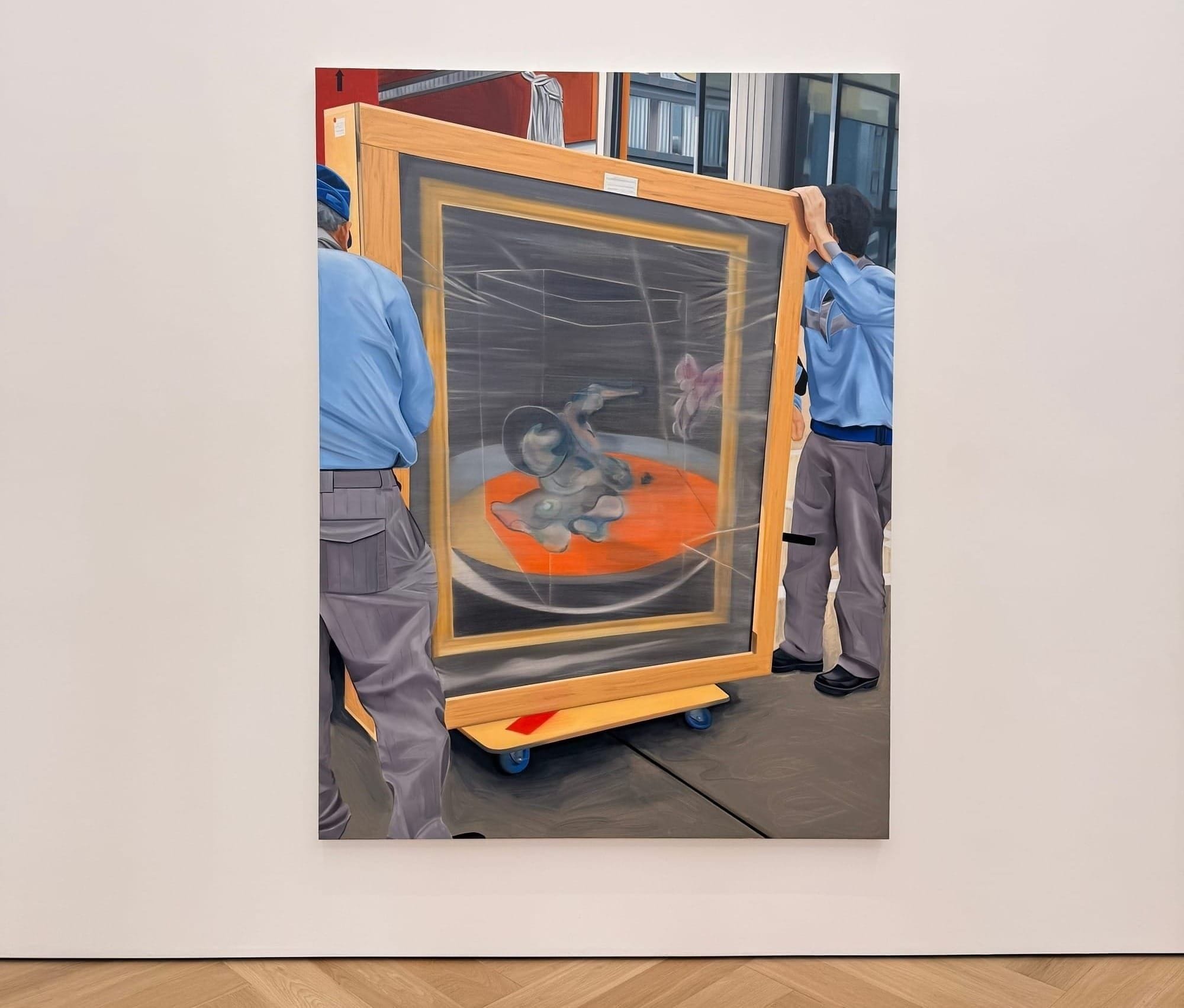
Born in 2001, Mia Goldstein is one of the youngest artists commanding serious attention in the current gallery circuit. Her exhibition Handle With Care at Journal Gallery embraces the artistic ethos of "paint what you know." For Goldstein, who has spent time embedded in the logistics of the fine art world, what she knows best is shipping, crating, and transit.
Goldstein’s hyper-realistic oil paintings shed light on the intensely unglamorous underbelly of the art market—the bubble wrap, the wooden crates, and the anonymous hands that move multi-million-dollar inventory behind closed doors. The works playfully nod to internet art-handler culture while maintaining a serious fascination with the precarious journey of cultural artifacts. Art historians and sleuths can spot veiled references to canonical pieces caught in transit: a Claes Oldenburg hamburger sculpture vacuum-sealed and jammed haphazardly into an elevator, two handlers wrestling a wrapped Francis Bacon painting onto a dolly, or the exposed back of a Piet Mondrian canvas resting casually against a scuffed sneaker. In one standout anecdote turning into reality, a collector demanded to see a René Magritte painting as-is, prompting the gallery to deliver the masterwork directly in the trunk of an SUV—a logistics coordinator’s worst nightmare.
Weaving a Day, Mourning a Life: The Mother and Daughter-in-Law of Phúc Sen
- Location: apexart, 291 Church Street, Tribeca, Manhattan
- Dates: Through October 24
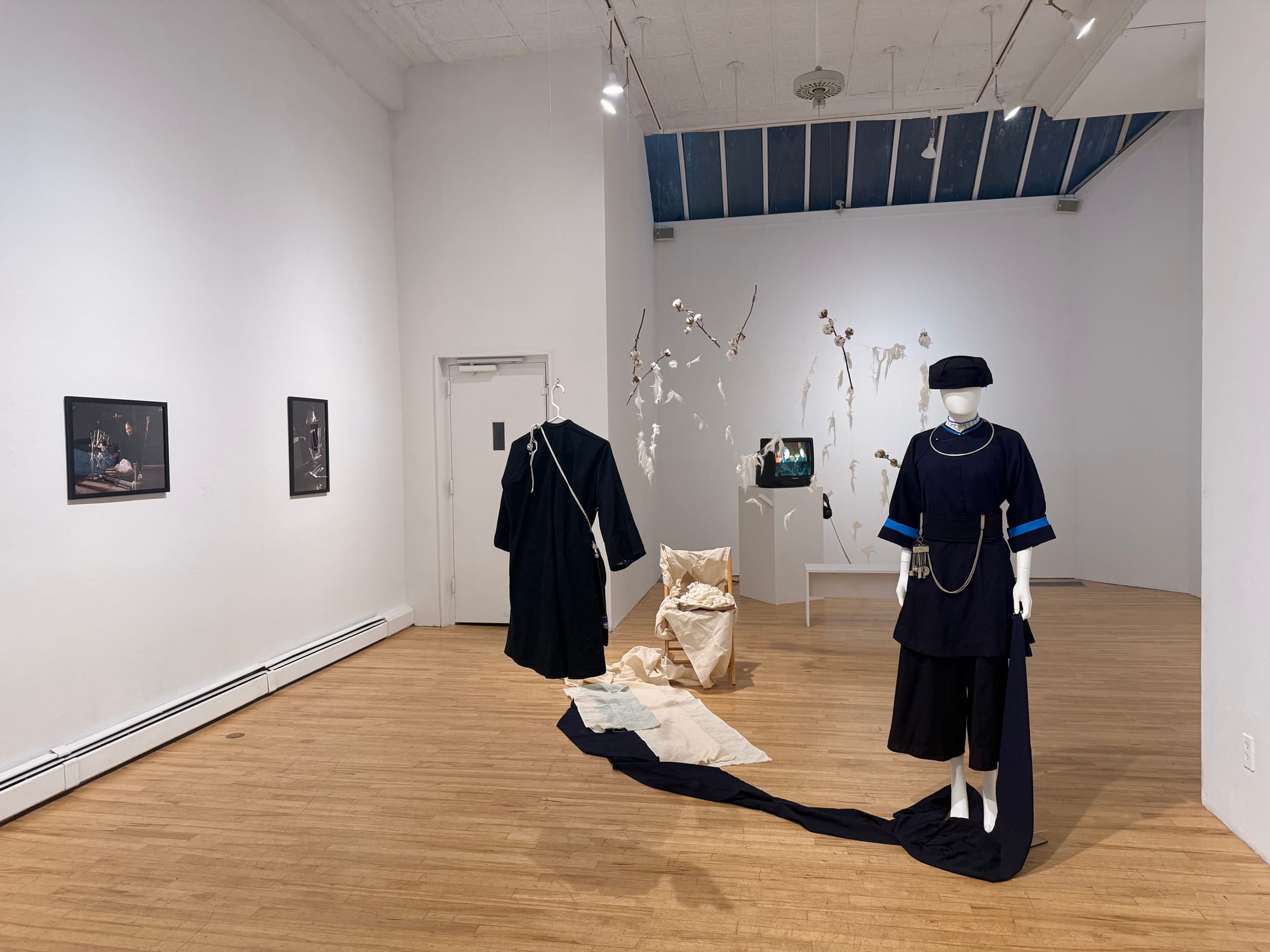
Shifting away from the Western commercial gallery system, apexart presents a deeply moving ethnographic and artistic exploration of funerary traditions in northern Vietnam. Among the Nùng An people of the village of Phúc Sen, women weave distinct patterns on handlooms day by day, accumulating scraps of fabric that are eventually sewn into funerary garments following an elder’s passing.
Once the official mourning period concludes, a daughter of the deceased repurposes the garment, wearing it to symbolize the continuous, unbroken cycle of life, death, and remembrance. The exhibition at apexart brilliantly weaves together three distinct bodies of work: intimate documentary photographs capturing the daily lives of the family, a mesmerizing video installation highlighting the rhythmic motion of the village’s looms, and a direct physical re-creation of the textile itself. It is a masterclass in cross-cultural curation, anchoring Tribeca’s commercial landscape in deep-rooted human ritual.
Giuseppe Francalanza: All of My Angels Wear a Rag: I The Tuner
- Location: Chapter NY, 60 Walker Street, Tribeca, Manhattan
- Dates: Through October 17
At just 26 years old, Sicilian-born painter Giuseppe Francalanza is making his highly anticipated United States solo exhibition debut at Chapter NY. Visitors entering the gallery must first navigate a series of provocative air conditioner sculptures graffitied with casual modern vernacular like "k." and "baby." However, pushing past this introductory installation reveals five breathtaking, ethereal paintings that anchor the entire show.
Though the gallery’s press statements cite a musical tuner as the conceptual catalyst for the series, Francalanza’s technical execution evokes the ghosts of High Renaissance masters. Direct echoes of Leonardo da Vinci, Sandro Botticelli, and Raphael live within his brushwork. Francalanza builds up heavy layers of oil, graphite, and fusain charcoal on canvas, only to aggressively wipe pigments away. The resulting figures hover in a liminal space: physically present on the canvas, yet psychologically drifting in an infinite, dreamlike void.
Official Responses and Curatorial Intent
The deliberate pairing of emerging voices with institutional stalwarts this September highlights a conscious strategy among Tribeca gallerists. Rather than relying solely on the safe name-recognition of established blue-chip artists, gallery directors are increasingly leaning into conceptual storytelling and material honesty.
Curators across the neighborhood have emphasized a collective desire to ground contemporary art in tangible human labor and emotional resonance. Whether it is Mia Goldstein demystifying the hidden physical transit of blue-chip masterpieces, or apexart elevating the ancestral hand-weaving and mourning rituals of rural Vietnamese artisans, the overarching curatorial response this fall is one of transparency and connection. Artists are stripping away the clinical sterility often associated with white-cube galleries, opting instead to reveal the sweat, anxiety, and ritual inherent in the creative process.
Broader Implications for the New York Art Market
The vibrant health of Tribeca’s September lineup carries significant implications for the broader New York City art ecosystem. As traditional gallery hubs like Chelsea face rising commercial rents and shifting neighborhood demographics, Tribeca has firmly cemented its status as the city’s premier destination for agile, high-impact programming.
The success of young, generation-defining exhibitions—such as Francalanza’s US debut and Goldstein’s market-aware realism—signals a generational turnover in the art market. Collectors and institutions are increasingly willing to invest in young artists who interrogate the very infrastructure of the art world itself. Furthermore, the juxtaposition of international commercial galleries with community-driven ethnographic projects like apexart ensures that Tribeca remains not just a marketplace for the wealthy elite, but a vibrant cultural neighborhood capable of engaging global human narratives.
Of course, rapid gentrification and neighborhood development come with their own realities—as evidenced by the neighborhood’s notorious cost of living, where even a simple latte near the galleries can easily run upwards of $10. Yet, despite the neighborhood’s upscale evolution, the sheer creative vitality on display this fall proves that Tribeca’s artistic soul remains entirely untamed.
 Dwi Wanna
 Neng Nana
 Ali Ikhwan
