

By Olivia McEwan
Art Review
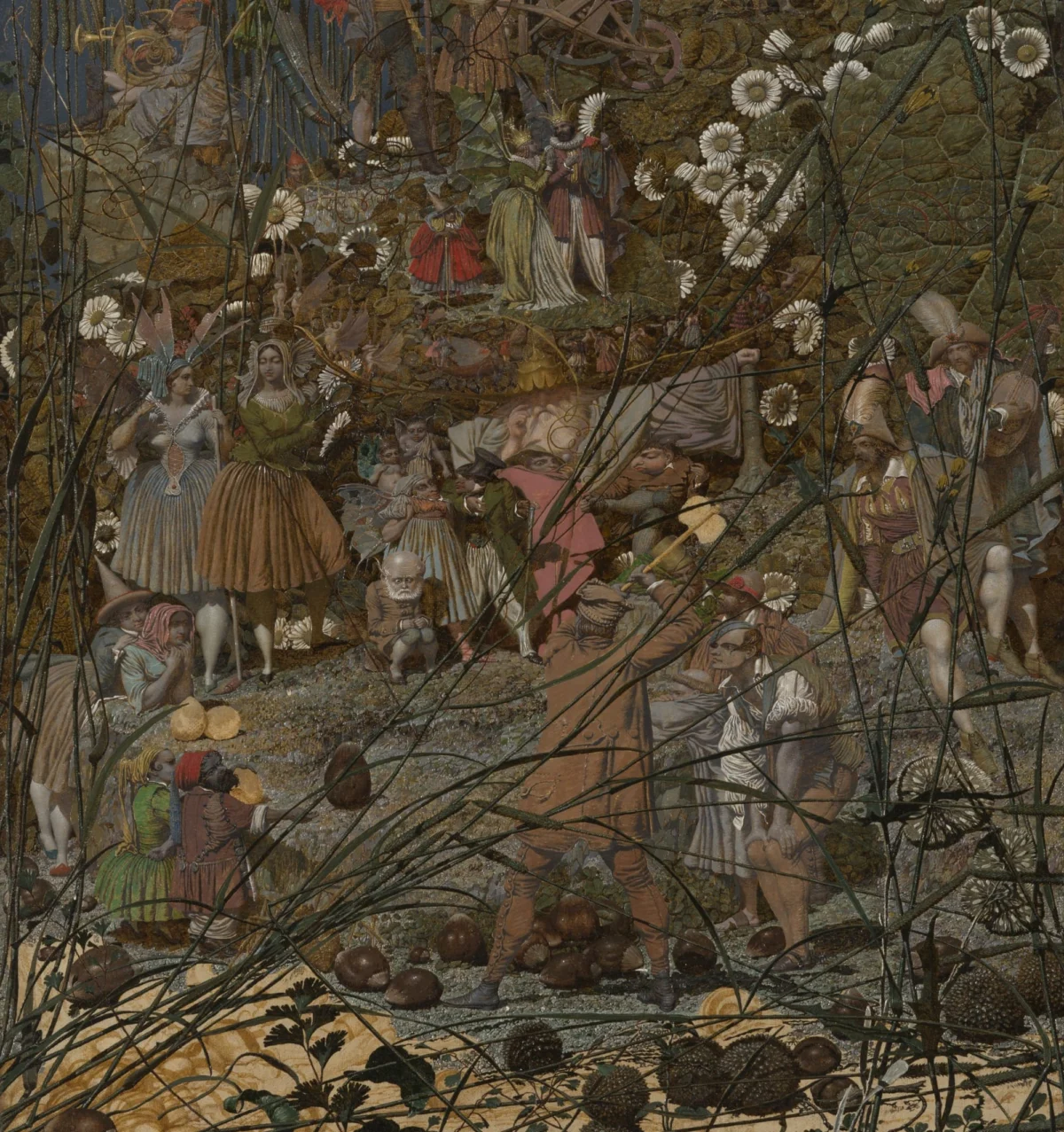
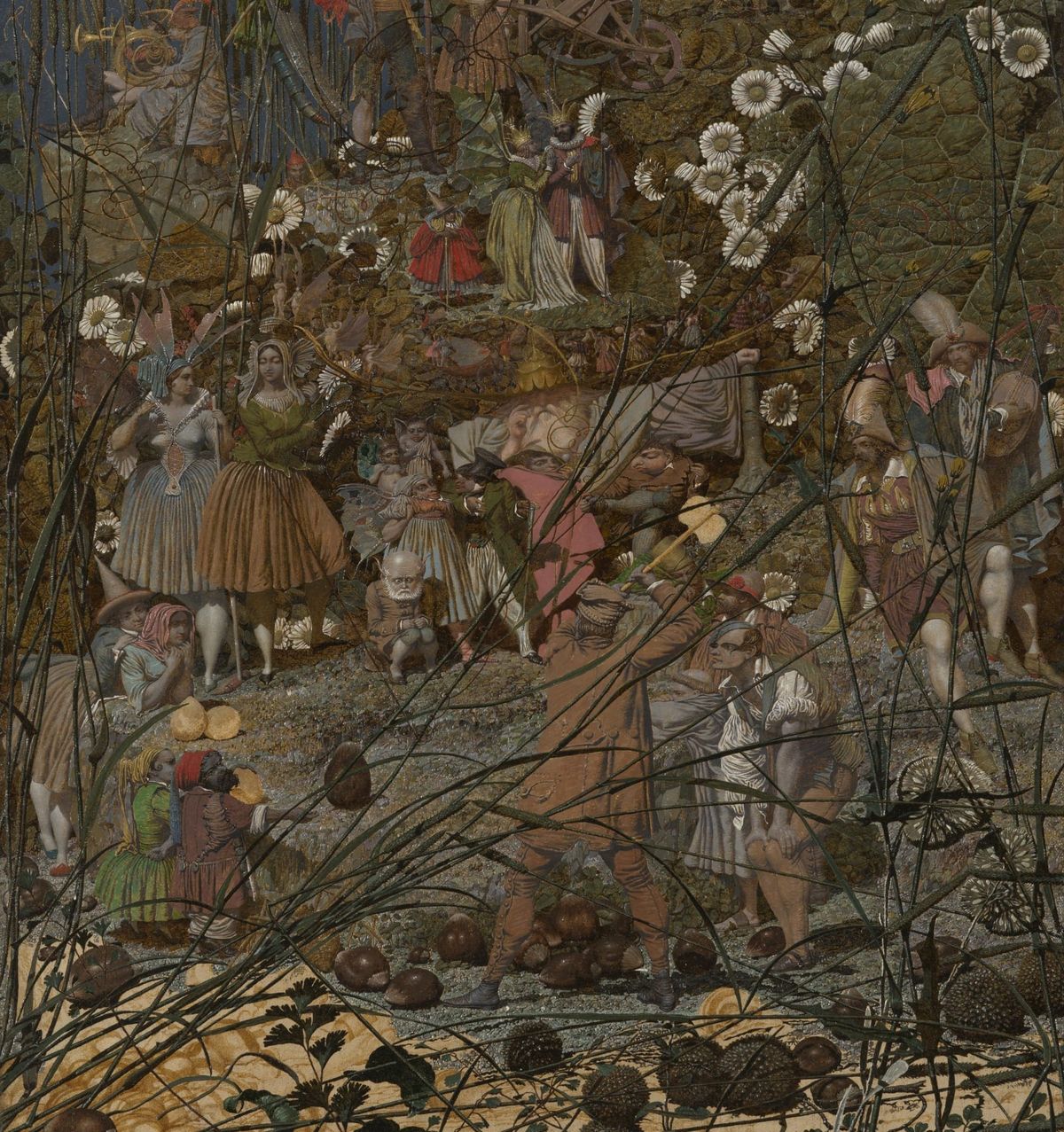
LONDON — For generations of art historians, enthusiasts, and casual museum-goers alike, the Victorian painter Richard Dadd has occupied a singular, albeit isolated, niche in the British cultural consciousness. To the broader public, he is known almost exclusively for a single, mesmerizing masterwork: The Fairy Feller’s Master-Stroke (1855–64). Housed permanently in Tate Britain and currently serving as a centerpiece in the Royal Academy of Arts’ monumental new retrospective, Richard Dadd: Beyond Bedlam, the painting is a marvel of controlled chaos. Measuring a mere 21 by 15 inches, the canvas is a dense, microscopic universe filled with minutely detailed fantastical figures, gnarled woodland creatures, and intricate fairies. The entire scene is overlaid with an obsessive web of flowers and grass blades that bisect its surface, creating a visual labyrinth that viewers can spend hours decoding.
Yet, for all its technical brilliance and enchanting subject matter, The Fairy Feller’s Master-Stroke has historically been inseparable from the tragic biography of its maker. Painted over nearly a decade while Dadd was incarcerated within the criminal department of Bethlem Royal Hospital—infamously known as "Bedlam"—the work has often been viewed through the clinical lens of its creator’s profound mental illness.
With Richard Dadd: Beyond Bedlam, the Royal Academy attempts a daring and long-overdue feat: stripping away the sensationalist myths that have long clouded Dadd’s legacy to present a comprehensive, nuanced appraisal of his entire artistic trajectory. Rather than boxing him into the reductive category of "outsider art" or leaning into amateur psychoanalysis, the exhibition honors Dadd as what he truly was—a brilliantly trained, deeply sophisticated Victorian academician whose life was tragically derailed by psychological catastrophe.
Main Facts
The retrospective brings together a remarkable collection of Dadd’s surviving oeuvre, sourced from major institutions, private collections, and significantly, the Bethlem Museum of the Mind. The exhibition maps the dualities of an artist whose life was violently cleaved in two: the bright, promising dawn of a conventional Victorian art career, followed by decades of astonishing, solitary creation behind asylum walls.
At the heart of the exhibition is Dadd’s unique methodology. Before his institutionalization, Dadd was a rising star of the British art establishment, celebrated for his academic rigor, technical precision, and luminous command of classical and literary themes. After 1843, his medium remained oil and watercolor, but his subjects shifted inward, manifesting as intensely hallucinatory landscapes, hyper-detailed Orientalist scenes recalled from his youth, and bizarre, enchanting woodland realms populated by fairies, specters, and mythological entities.
The exhibition carefully curates these works to demonstrate that Dadd’s institutionalized art was not merely a symptom of his illness, but a deliberate, highly calculated intellectual and creative endeavor. By refusing to diagnose the artist from the gallery walls, the Royal Academy shifts the focus back to where it belongs: the canvas. Visitors are thoughtfully directed to the Bethlem Museum of the Mind for those seeking a deeper historical and medical accounting of Dadd’s institutionalization, allowing the art at the Royal Academy to speak on its own uncompromising aesthetic terms.
Chronology: The Life and Trajectory of Richard Dadd
To understand the profound transformation in Dadd’s work, one must trace the tragic arc of his biography, which moved from conventional academic success to catastrophic mental collapse and, ultimately, a deeply internalized creative rebirth.
Early Promise and the Royal Academy (1817–1842)
Born in Chatham, England, in 1817, Richard Dadd showed an early, prodigious aptitude for draftsmanship. In 1837, at the age of 20, he entered the prestigious Royal Academy Schools in London. During his formative years, Dadd aligned himself with a progressive group of young English painters who called themselves The Clique. Alongside contemporaries such as Augustus Egg, William Powell Frith, Henry Nelson O’Neil, and John Phillip, Dadd rebelled against the rigid hierarchies of the traditional academic establishment, favoring genre scenes, literary narratives, and a shared camaraderie that emphasized independent artistic vision.
During this period, Dadd produced works of striking grace and classical alignment. Paintings like Titania Sleeping (1841) showcased his early fascination with fairyland and Shakespearean motifs, rendered with a delicate, luminous palette that signaled a bright future in the upper echelons of the Victorian art world.
The Grand Tour and the Turning Point (1842–1843)
In the summer of 1842, Dadd’s career received a prestigious endorsement when he was hired as a draftsman to accompany Sir Thomas Phillips, a wealthy Welsh lawyer and politician, on an ambitious, grueling expedition across Europe and the Near East. The journey took Dadd through Greece, Turkey, and parts of Syria.
The physical and psychological toll of the expedition proved catastrophic. Traveling through punishing heat, navigating unfamiliar cultures, and enduring immense physical exhaustion, Dadd began to experience severe psychological disintegration. He became increasingly paranoid, convinced that he was being pursued by ancient Egyptian deities—specifically Osiris—and that his mind was being manipulated by unseen forces.
By the time he returned to England in the spring of 1843, Dadd was a severely altered man. Though his family recognized that he was deeply unwell, the mental health infrastructure of early Victorian England was entirely unequipped to handle or treat severe psychotic breaks.
The Tragedy and Incarceration (August 1843)
The crisis reached its horrific climax in August 1843. Convinced that his father, Robert Dadd, was an incarnation of the devil or an agent of evil, Richard lured his father on a walk to Cobham Park in Kent and fatally stabbed him.
Fleeing the crime scene, Dadd crossed the English Channel to France, intending to continue his flight. However, during a coach journey near Fontainebleau, his erratic behavior and delusions caused him to attack another traveler with a razor. French authorities promptly arrested him.
Extradited back to Great Britain, Dadd was tried, but the courts readily recognized his profound insanity. Escaping the gallows, he was ordered to be detained "during Her Majesty’s pleasure." Initially confined to the criminal lunatic asylum at Bethlem Royal Hospital, Dadd would spend the rest of his life—over four decades—behind institutional walls, moving later to the newly constructed Broadmoor Hospital in Berkshire, where he died in 1886.
The Asylum Years and Late Masterworks (1844–1886)
Remarkably, rather than silencing him, incarceration became the crucible for Dadd’s most astonishing artistic output. Recognizing his extraordinary talent, sympathetic medical officers and attendants at Bethlem provided Dadd with art supplies, a makeshift studio space, and a degree of protective insulation from the harsher realities of asylum life.
It was during this long, solitary confinement that Dadd produced his masterworks. Freed from the commercial pressures of the Victorian art market and the societal expectations of The Clique, his imagination flourished in isolation. Works like Contradiction: Oberon and Titania (1854–58) and, most famously, The Fairy Feller’s Master-Stroke (painted laboriously over nine years) emerged from this period of intense, obsessive craftsmanship.
Supporting Data and Curatorial Insights
The Royal Academy’s retrospective meticulously gathers approximately 60 works, offering viewers a rare opportunity to trace the stylistic evolution of an artist whose output is famously fragmented across private and public collections.
- The Pre-Asylum Period: The exhibition features early sketches, portraits, and ambitious oil paintings that demonstrate Dadd’s mastery of academic draftsmanship. These pieces shatter the myth that Dadd was a naive or untrained creator, firmly establishing his credentials as a premier talent of his generation.
- The Orientalist Interlude: A fascinating grouping of watercolors and sketches from his 1842–43 tour reveals how deeply the landscapes of the Middle East imprinted upon his psyche. Far from being forgotten, these visual memories resurfaced years later in his asylum paintings, blended strangely with English folklore and hallucinated details.
- The Masterworks of Confinement: The centerpiece room gathers his late masterpieces, including The Fairy Feller’s Master-Stroke, Flight Out of Egypt (1849–50), and various fantastical portraits. Data provided by conservation scientists at the Tate and the Royal Academy indicates the astonishing density of Dadd’s late technique: utilizing microscopic brushstrokes, layering glazes repeatedly over years, and scratching into the paint surface to achieve tactile, jewel-like textures that reward prolonged, close-up viewing.
Institutional and Expert Perspectives
The curation of Richard Dadd: Beyond Bedlam represents a significant paradigm shift in how museums handle artists with histories of severe mental illness. For decades, institutional framing often leaned into voyeurism, treating asylum art as a psychological curiosity rather than a high point of cultural achievement.

In exhibition catalogs and introductory statements, the curators of the Royal Academy have emphasized a deliberate ethical stance:
"We have consciously avoided attempting a retroactive psychiatric diagnosis of Richard Dadd through his brushstrokes. To view his entire career merely as a symptom of schizophrenia or paranoid delusions is to rob him of his agency, his intellect, and his formidable technical mastery. Dadd was an artist working under extreme, extraordinary conditions, but he remained a master planner, a deliberate colorist, and a deeply conscious creator."
Collaborating closely with the Bethlem Museum of the Mind, the Royal Academy ensures that the historical realities of 19th-century psychiatric care are acknowledged without overshadowing the artwork itself. By sending curious visitors to the Museum of the Mind for historical context regarding Bethlem and Broadmoor, the Royal Academy successfully frees the art from the clinic, allowing Dadd’s technical brilliance to command center stage.
Wider Implications for Art History and the Canon
The staging of Richard Dadd: Beyond Bedlam carries profound implications for how the art historical canon values artists who fall outside conventional trajectories.
For much of the 20th century, Dadd was championed primarily by outsider art enthusiasts, surrealists—who were naturally drawn to his dreamlike, hallucinatory iconography—and historians of psychiatry. While this patronage kept his name alive during eras when Victorian genre painting was deeply unfashionable, it also marginalized him, ghettoizing his work as the product of madness rather than the deliberate triumph of a disciplined intellect.
By claiming Dadd as a central figure of Victorian artistic ambition, the Royal Academy’s retrospective forces a recalibration of mid-19th-century British art history. It challenges the tidy narrative that the avant-garde or academic mainstream held a monopoly on sophisticated visual experimentation. Dadd’s late works demonstrate a proto-modernist obsession with surface texture, spatial compression, and psychological interiority that anticipates the movements of the 20th century by decades.
Furthermore, the exhibition serves as a timely meditation on the intersection of trauma, creativity, and institutionalization. In an era where cultural institutions are increasingly examining the complex personal lives of historical creators, the Royal Academy offers a masterclass in how to address tragedy and mental illness with empathy, rigor, and profound respect for the artist’s autonomy.
Ultimately, Richard Dadd: Beyond Bedlam proves that great art can survive the most devastating personal cataclysms. Richard Dadd may have spent his adult life physically confined behind the walls of Victorian asylums, but through his astonishing canvases, he built boundless, intricately detailed worlds that continue to captivate, challenge, and enchant us today.
 Jia Lissa
 Iffa Jayyana
