

LOS ANGELES — For over half a century, the photographic work of Joel-Peter Witkin has occupied a singular, often contentious space within the annals of contemporary art. Revered by many as a visionary humanist and dismissed by detractors as a purveyor of the grotesque, the octogenarian photographer’s career is the subject of a sweeping, career-spanning retrospective at the Fahey/Klein Gallery in Los Angeles.
Spanning five decades of meticulous, avant-garde image-making—from the raw experiments of the 1970s up until his 2018 diagnosis with dementia—the exhibition offers a profound reassessment of an artist whose haunting tableaux vivants challenged societal boundaries. Far from mere shock value, the retrospective illuminates Witkin’s deep-rooted Catholic faith, his intellectual engagement with classical art history, and an unwavering commitment to a singular foundational thesis: that every marginalized individual is, fundamentally, a child of God.
Main Facts
The retrospective at Fahey/Klein brings together some of the most striking and debated images in modern photographic history. Witkin’s methodology is entirely distinct in an era dominated by digital immediacy. Working exclusively with traditional analog cameras, black-and-white film, and physical darkroom manipulation, Witkin operates less like a traditional photographer and more like a classical history painter or a cinematic director.
Each image is meticulously staged. He builds elaborate sets from scratch, employs live models, and incorporates unexpected props ranging from classical drapery to anatomical specimens. Crucially, the transformation does not end when the shutter clicks. Witkin frequently intervenes physically on his materials: he scratches the film negatives and treats the developing prints with chemicals, bleach, or encaustic (hot pigmented wax). This tactile process yields haunting textures, distress marks, and celestial halos of light that elevate his subjects from ordinary mortals to mythic archetypes.
Throughout his career, Witkin has trained his lens on populations historically pushed to the fringes of society. His models have frequently included people with dwarfism, amputees, transgender individuals, and intersex persons. By framing these individuals within narratives drawn from the Bible, classical mythology, and masterworks of European art history, Witkin subverts traditional standards of beauty, forcing viewers to confront their own biases regarding the human body and bodily autonomy.
Chronology: A Lifetime on the Margins of the Medium
To understand Witkin’s trajectory is to trace the evolution of taboo-breaking in American art from the post-Stonewall era through the dawn of the digital age.
- 1939: Joel-Peter Witkin is born in Brooklyn, New York, alongside his identical twin brother, the acclaimed painter Jerome Witkin. Raised in a religiously mixed household (a Jewish father and a Catholic mother), the young Witkin absorbs early exposure to disparate spiritual traditions and a sense of duality.
- 1970s: Witkin emerges in New York’s avant-garde photography scene. Works from this period, such as Ecce Homo, NYC (1975), begin to blend street-level subcultures with high-art theological references.
- 1980s: This decade marks the apex of Witkin’s international notoriety. He produces several of his most celebrated and controversial masterpieces, including The Kiss (Le Baiser) in 1982. He relocates to New Mexico, where the expansive desert landscape and regional culture heavily influence his use of dramatic, theatrical lighting and Catholic iconography.
- 1988–2016: Witkin refines his exploration of gender variance and identity through iconic reinterpretations of art history, producing works like The Three Graces, New Mexico (1988), Gods of Earth and Heaven, LA (1988), and decades later, The Soul Has No Gender, Mexico (2016).
- 2018: Witkin receives a diagnosis of dementia, effectively concluding his active decades-long practice of building sets and capturing new photographic tableaux.
- Present: The Fahey/Klein Gallery retrospective opens in Los Angeles, drawing critical acclaim and re-contextualizing his massive body of work for a contemporary audience grappling with modern questions of gender, representation, and bodily rights.
Supporting Data and Technical Mastery
Witkin’s artistic process relies heavily on physical manipulation, setting him apart in a medium that historically championed "straight" documentation.
The Darkroom as Altar
Unlike photographers who strive for pristine preservation of the negative, Witkin treats his negatives as raw, malleable canvases. By physically scratching the emulsion, he introduces scars, vignettes, and atmospheric veils. When applying bleach or encaustic wax during the printing process, he introduces deliberate imperfections that evoke the degradation of time, mirroring the physical vulnerabilities of the human subjects he portrays.
The Scale of Production
Though his final prints vary in size, the infrastructure required to produce them is monumental. A single image can require weeks of conceptualization, set design, sourcing of specialized props, and coordination with unique models who are often hesitant to trust the mainstream art establishment.
Art Historical Precedents
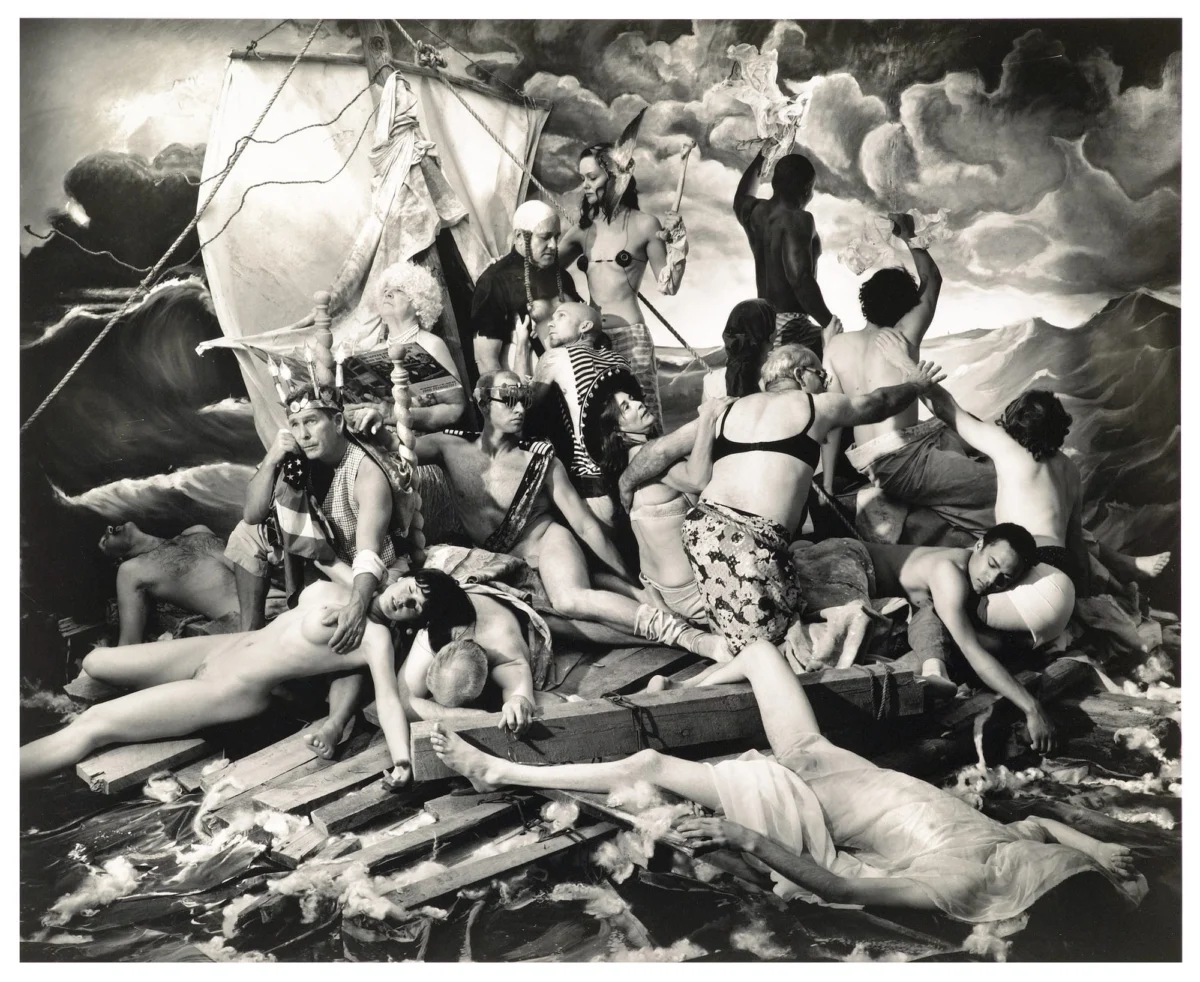
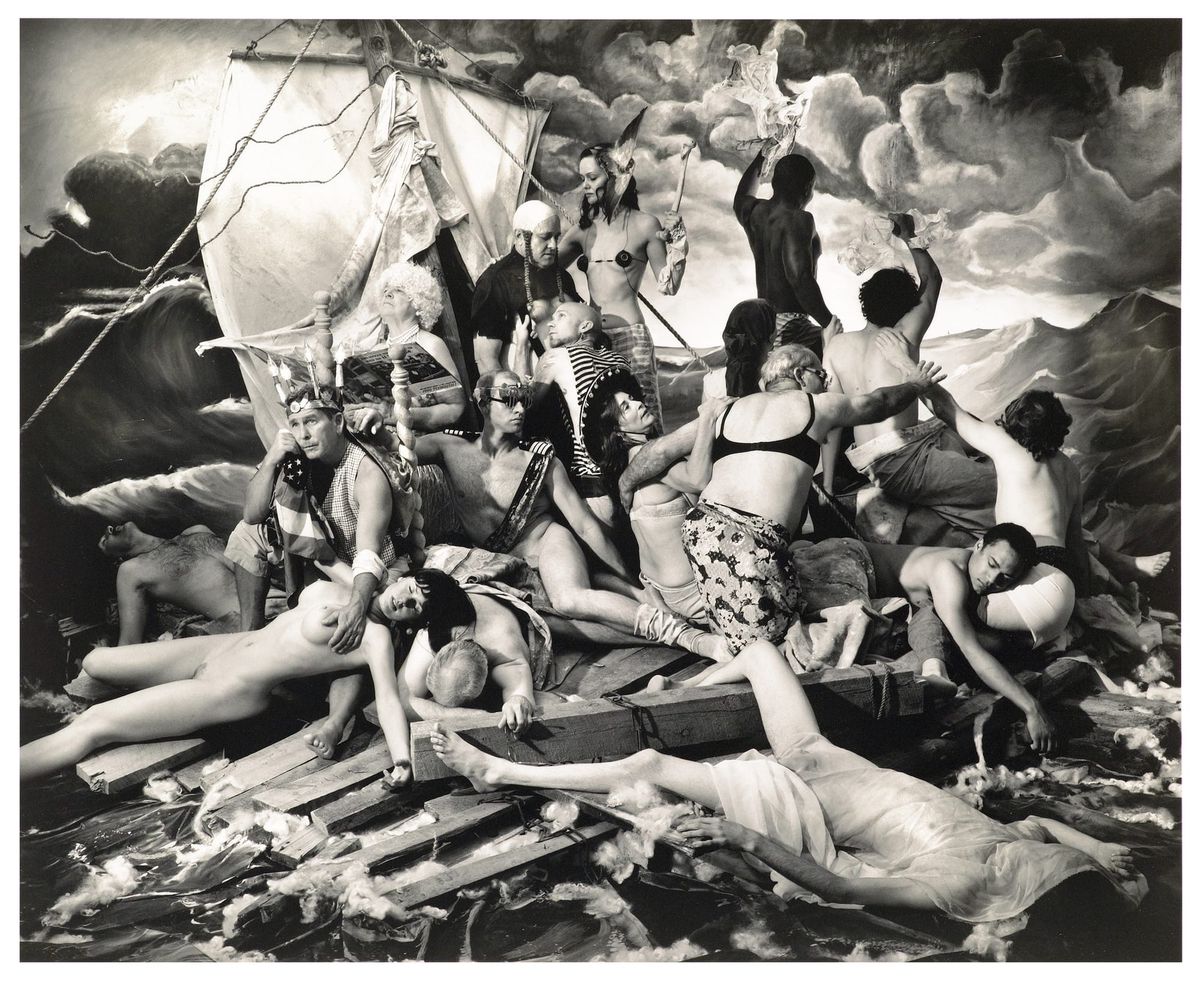
Witkin’s tableaux are deliberate dialogue partners with Western art history. His compositions frequently borrow the spatial geometry of the Renaissance and Baroque periods—echoing masters such as Caravaggio, Théodore Géricault, and Sandro Botticelli. For instance, his 2006 work The Raft of George W. Bush directly subverts Géricault’s romantic masterpiece The Raft of the Medusa (1819), transforming a historical political critique into a timeless theatrical allegory of hubris, despair, and systemic abandonment.

Official Responses and Critical Reception
Over the decades, institutional and public reactions to Witkin’s work have shifted from outright shock to profound critical appreciation, though debates regarding his methods have never entirely subsided.
When Witkin’s work first gained prominence in the 1980s, conservative commentators and morality watchdogs frequently targeted him for obscenity, pointing to his use of unconventional biological materials and explicit portrayals of non-normative bodies. Conversely, the contemporary art establishment recognized a rigorous intellectual framework beneath the macabre surface. Museums across Europe and the Americas—including the Museum of Modern Art in New York, the Centre Pompidou in Paris, and the San Francisco Museum of Modern Art—acquired his prints for their permanent collections.
In reviews of the current Fahey/Klein exhibition, critics have noted a profound shift in how modern audiences receive Witkin’s oeuvre. In an era where discussions surrounding gender fluidity, intersex rights, and physical disability are at the forefront of cultural discourse, Witkin’s models are no longer viewed merely as spectacles of otherness, but as pioneering agents of dignity. As contemporary art critic David S. Rubin observes, Witkin’s overarching mission remains rooted in a deeply compassionate, albeit unorthodox, spiritual worldview: an insistence that holiness exists precisely where society prefers to look away.
Implications: The Legacy of a Visionary Provocateur
The retrospective of Joel-Peter Witkin’s work in Los Angeles arrives at a crucial cultural crossroads, prompting a broader conversation about ethics, empathy, and the boundaries of representation in art.
Redefining the Canon of Human Dignity
By placing marginalized bodies—particularly intersex individuals and those with severe physical anomalies—at the center of grand religious and mythological narratives, Witkin inverted the traditional power dynamics of visual culture. Historically, portraiture was reserved for the powerful, the wealthy, and the conventionally beautiful. Witkin democratized the pantheon of high art, populating it with society’s most vulnerable outcasts and investing them with the gravitas of saints and classical deities.

The Intersection of Faith and Transgression
Witkin’s self-identification as a practicing Catholic has often perplexed casual observers, given the visceral nature of his imagery. Yet, his work underscores a profound theological alignment with the Gospels: a focus on the outcast, the leper, and the suffering servant. Works like Ecco Homo, NYC (1975) explicitly link the societal rejection of gender-nonconforming individuals with the Passion of Christ. In doing so, Witkin bridges the gap between sacred devotion and radical political empathy.
A Warning for the Digital Age
As photography has transitioned into an era of frictionless digital manipulation, AI generation, and synthetic perfection, Witkin’s analog, labor-intensive approach serves as a poignant reminder of the power of physical presence. His images demand that the viewer acknowledge the real, breathing human beings who stood before his lens in a dusty studio, enduring hours of staging to etch their existence permanently into photographic history.
Ultimately, the Fahey/Klein retrospective cements Joel-Peter Witkin’s legacy not as a merchant of shock, but as a master moralist of the photographic medium. Through the alchemy of chemistry, light, and unwavering empathy, he transformed the margins into a sacred space, leaving behind an indelible testament to the infinite variations of the human spirit.
 Muslim
 Evan Lee Salim
 Jia Lissa
