

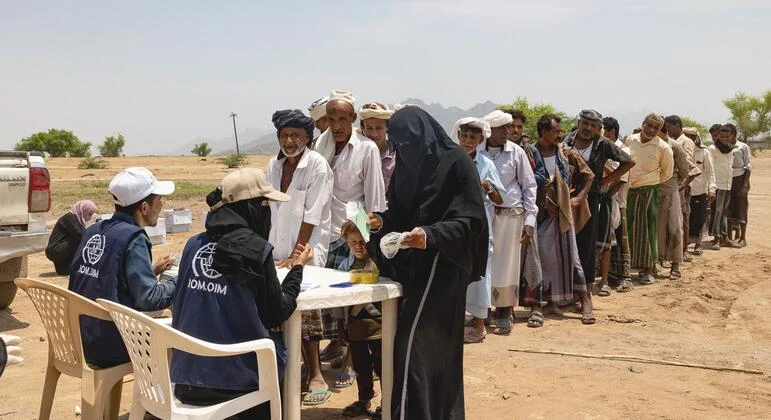
The humanitarian situation in Yemen has entered a perilous new chapter. As hostilities between Saudi-backed Yemeni government forces and Iran-backed Houthi militias escalate along the country’s western coast, the civilian population is bearing the brunt of a conflict that has already claimed hundreds of thousands of lives over the past decade. With over 112,000 people displaced in just two weeks, aid agencies are sounding the alarm: resources are exhausted, the delivery of assistance is being systematically obstructed, and the most vulnerable—women, children, and the elderly—are being pushed into a fight for survival that many are losing.
The Current Crisis: A Statistical Overview of Suffering
The rapid escalation of conflict in areas such as Aden, Hudaydah, Abyan, and Taiz has triggered a massive wave of internal displacement. This sudden spike compounds an already staggering figure: according to the United Nations High Commissioner for Refugees (UNHCR), nearly 4.8 million Yemenis have been uprooted by years of warfare, economic collapse, and environmental devastation.
The current escalation is not merely a military maneuver; it is a human rights emergency. Beyond the internal displacement, more than 3,000 individuals have risked their lives in the treacherous waters of the Bab el-Mandeb Strait, attempting to reach safety in Djibouti. These desperate journeys are often conducted on overloaded, unseaworthy vessels, with many refugees arriving in Djibouti having lost everything, some even separated from their families during the chaotic flight from bombardment.
Chronology of Escalation and Obstruction
The roots of the current crisis run deep, but the recent two-week surge in violence marks a significant departure from the relative—though fragile—periods of reduced activity seen previously.
- Early 2015 – Present: The long-standing conflict between the internationally recognized government and the Houthi de facto authorities creates a state of perpetual instability.
- Two Weeks Ago: Full-scale hostilities erupt along the western coast. Bombardment and shelling trigger mass civilian flight.
- Recent Days: The humanitarian delivery mechanism within Houthi-controlled areas is declared "untenable" by the UN. Premises are occupied, and critical personnel are detained.
- Ongoing: 73 UN personnel remain in arbitrary detention, some held captive since 2021. Dozens of NGO and civil society workers also remain behind bars, effectively paralyzing the humanitarian response in key regions.
Supporting Data: The Fragility of Life
To understand the depth of this crisis, one must look at the data provided by the Integrated Food Security Phase Classification (IPC) and the World Health Organization (WHO).
Before the current wave of violence, nearly half of Yemen’s 41 million people were already in urgent need of humanitarian assistance. In government-controlled areas alone, one in two individuals was suffering from high levels of food insecurity. The healthcare system is equally decimated: an assessment conducted prior to the recent escalation revealed that of 5,000 health service delivery units, a mere 60 were fully functional.
The health landscape is a grim convergence of multiple, concurrent risks:
- Disease Outbreaks: Cholera, measles, dengue, and diphtheria continue to spread, exacerbated by a lack of clean water and sanitation.
- Malnutrition: The core driver of long-term health decline among children.
- Trauma: Injuries caused by shelling and gunfire remain the leading cause of surgical intervention in an environment where medical supplies are virtually non-existent.
The Human Cost: Stories from the Frontline
Statistics, while alarming, often mask the individual agony of the Yemeni people. Abdusattor Esoev, Chief of Mission in Yemen for the International Organization for Migration (IOM), shared the harrowing account of a mother displaced in Taiz. Having fled under fire, she was forced to give birth in the open air, lacking medical care, shelter, or basic supplies. Her only protection from the elements was a torn piece of plastic tarpaulin.
Similarly, the United Nations Population Fund (UNFPA) has highlighted the plight of women-led households. One woman, Aziza, escaped the shelling in Mocha with her four daughters, suffering burns during her flight. Her testimony is emblematic of millions: exhausted, traumatized, and clinging to the hope that there is a future beyond the immediate struggle to keep her children alive.
Official Responses and Calls for De-escalation
The international community has been urged to act with unprecedented urgency. Shabia Mantoo, spokesperson for the Office of the UN High Commissioner for Human Rights (OHCHR), stated, "Yemen civilians are already bearing the consequences of renewed full-scale hostilities and we urge all parties and those with influence over them to act immediately to de-escalate, protect civilians, and facilitate humanitarian access."
Alessandra Vellucci, Director of the UN Information Service in Geneva, has been particularly vocal regarding the detention of UN staff. The fact that the Houthi authorities continue to hold dozens of aid workers not only hampers the current response but creates a climate of fear that prevents the international community from maintaining a presence in the country.
The IOM’s Abdusattor Esoev has issued a stark warning: "Our resources are very, very, very limited and our stocks will be depleted very soon." He has called upon the global community to provide urgent, life-saving aid, including food, shelter, and medical support, emphasizing that for many, this is their final chance at survival.
Regional Implications: The Burden on Djibouti
The exodus across the Bab el-Mandeb Strait has created a secondary humanitarian challenge for Djibouti. Sandrine Desamours, a UNHCR representative in Djibouti, described the trauma of new arrivals who recount fleeing sudden, indiscriminate shelling.
Djibouti, already hosting a significant number of refugees from previous waves of the Yemen crisis, is struggling to manage the influx. While the Djibouti Coast Guard has taken heroic measures to rescue stranded boats and provide emergency fuel, the strain on the host community is reaching a breaking point. Alexandre Coissac, IOM Chief of Mission in Djibouti, noted that the arrival of thousands of new refugees represents a significant logistical and financial challenge that the international community has yet to adequately support.
Implications for the Future
The implications of the current crisis are twofold:
- Immediate Humanitarian Collapse: If the detention of aid workers continues and the current rate of displacement persists, Yemen faces a total breakdown of the aid distribution system. This would almost certainly result in a catastrophic famine and a massive surge in preventable disease-related deaths.
- Long-term Regional Instability: The continued cycle of displacement creates a "lost generation" of Yemeni children, who are growing up without education, proper nutrition, or physical security. Furthermore, the pressure on neighboring nations like Djibouti risks destabilizing the Horn of Africa, creating a regional security crisis that could ripple far beyond the Arabian Peninsula.
The international community stands at a crossroads. The humanitarian mandate is clear: protect the innocent, demand the release of detained aid workers, and ensure that the vital flow of food, water, and medicine is restored. Without immediate, unified action from those with influence over the warring parties, the crisis in Yemen will not only grow by the hour—it will become a permanent, unhealed wound in the global consciousness.
As the IOM and other agencies continue to sound the alarm, the message remains the same: Yemen cannot survive this latest escalation on its own. The world must choose between witnessing a total collapse or providing the urgent, life-saving assistance necessary to prevent further, irreversible loss of life.
 Lina Hope
 Asro
Asro
 Layla Zulfa
