

SAN FRANCISCO — In the modern landscape of digital media, recommendation algorithms can often feel like a double-edged sword. While platforms race to capture and retain human attention, many social networks have drawn heavy user criticism for serving up disjointed, irrelevant, or hyper-addictive content. However, YouTube has long maintained a reputation as an industry outlier—a platform widely regarded for its uncanny ability to curate relevant videos, tutorials, and entertainment through a robust analysis of individual watch histories, channel subscriptions, and implicit user signals.
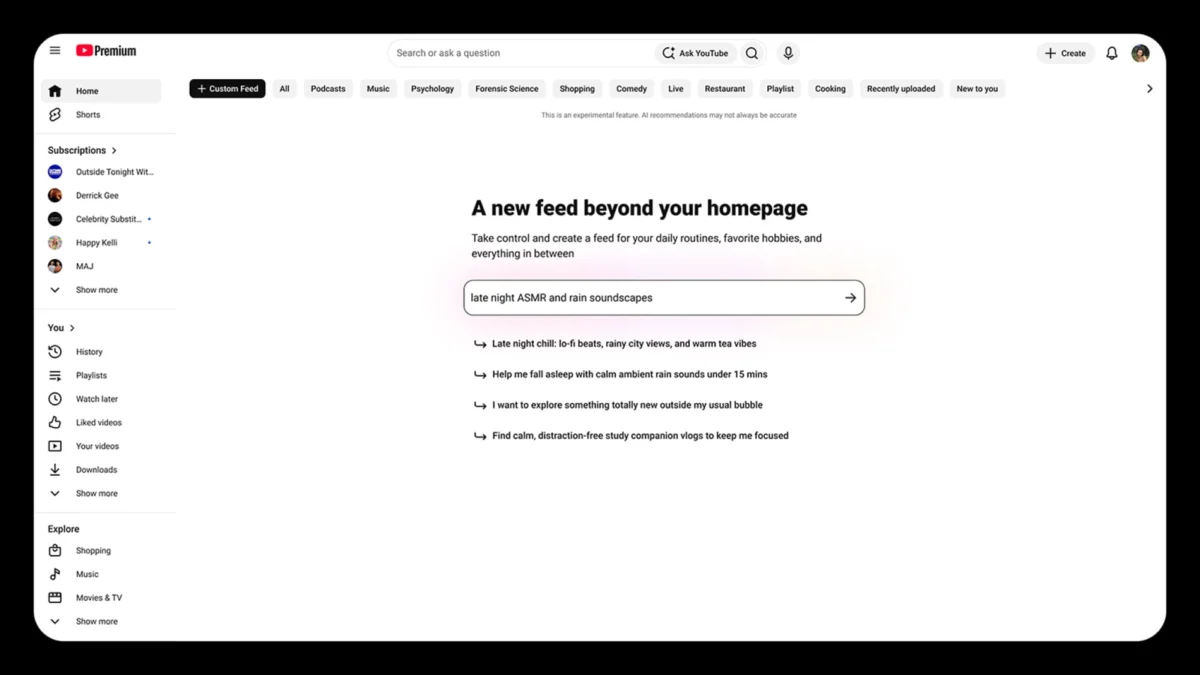
Building upon its reputation for sophisticated content discovery, the video-sharing giant hosted its annual Made for YouTube event on Wednesday, unveiling a comprehensive suite of groundbreaking features. Among the most anticipated announcements is the introduction of Custom Feeds, a revolutionary tool that gives users direct, natural-language control over their homepage experience for the first time in the platform’s history.
Alongside Custom Feeds, YouTube rolled out significant enhancements to its interactive "Ask YouTube" AI capabilities, a personalized AI-driven audio guide for podcast enthusiasts, and broader multi-platform integration for community posts. These announcements underscore YouTube’s strategic pivot toward hyper-personalization, blending generative artificial intelligence with user-driven curation to redefine how billions of viewers consume video content.
Main Facts: What YouTube is Introducing
The centerpiece of Wednesday’s announcements is the rollout of Custom Feeds, a feature fundamentally designed to bridge the gap between automated algorithmic recommendations and explicit user intent. Historically, YouTube users have relied entirely on the platform’s underlying recommendation engine to dictate what appears on their homepages. While this system excels at surfacing adjacent content based on past viewing habits, it has occasionally lacked the nuance required for a viewer who wants to temporarily pivot their viewing experience toward a specific niche without permanently warping their algorithm.
Under the new Custom Feeds framework, users can dictate precisely what kind of content they wish to see using natural, conversational language. Rather than navigating rigid category menus or wrestling with algorithmic feedback loops, a viewer might type a prompt such as:
- "Show me long-form history documentaries with high production values," or
- "Curate a stream of new, independent DIY creators focusing on home renovation."
Once the prompt is processed, a dedicated Custom Feed tab instantly populates at the top of the YouTube homepage. This allows users to seamlessly toggle between their standard algorithmic recommendations and multiple, highly specialized custom feeds, each tailored to distinct moods, learning goals, or entertainment preferences.
Beyond Custom Feeds, YouTube’s sweeping product update includes several other critical upgrades:
- Enhanced "Ask YouTube": The platform is expanding its conversational AI tool, allowing users to ask detailed questions about products featured within review videos. The AI will synthesize information from the video, provide deeper product insights, and recommend supplemental videos for further research.
- AI Podcast Guides: Recognizing the explosive growth of audio and video podcasting, YouTube is introducing a personalized, AI-generated audio guide. This guide introduces listeners to their current podcast lineup while intelligently recommending new episodes and shows based on individual tastes.
- Community Posts Expansion: YouTube is expanding the reach of creator Posts by integrating them into the dedicated Shorts feed and bringing creator community content directly to YouTube’s television applications.
Chronology of Content Discovery on YouTube
To understand the significance of Custom Feeds and the Made for YouTube announcements, it is vital to examine the historical evolution of YouTube’s content discovery mechanisms. The platform’s journey from a simple video repository to an AI-driven media titan spans nearly two decades.
2005–2011: The Era of Manual Discovery and View Counts
In YouTube’s infancy, the homepage was largely static, driven by basic metrics such as view counts, "Most Viewed," "Top Rated," and manually curated "Featured" videos. Users relied heavily on search bars, direct links, and related video sidebars that operated on basic keyword matching and simple co-viewing statistics.

2012–2018: The Rise of Deep Learning and Watch Time
As the platform scaled exponentially, simple metadata matching proved insufficient. In 2012, YouTube shifted its core recommendation metric from click-through rates to watch time—prioritizing content that kept users engaged on the platform for longer durations. By 2016, YouTube published a landmark technical paper detailing its transition to deep neural networks for recommendations. This era perfected the modern algorithmic feed, creating a deeply personalized homepage that anticipated user desires based on behavioral patterns.
2019–2023: The Short-Form Boom and Discovery Redesigns
The introduction of YouTube Shorts in 2020 injected a high-velocity, vertical video feed into the ecosystem, demanding a parallel recommendation engine optimized for rapid swiping. During this period, YouTube also introduced features like "New to you" filters and topic clusters at the top of the homepage to help users break out of algorithmic echo chambers.
2024 and Beyond: Conversational AI and User-Directed Feeds
Wednesday’s Made for YouTube event marks the definitive dawn of a new era. By combining deep-learning recommendations with natural language processing (NLP) and generative AI, YouTube is moving away from purely passive algorithmic consumption. Users are no longer just subjects of an algorithm; they are active co-creators of their digital environments. According to company executives, Custom Feeds will begin rolling out to users in the United States in the coming weeks, marking the first major structural overhaul of the homepage layout in years.
Supporting Data: The Scale of YouTube and the Demand for Personalization
The urgency behind YouTube’s continuous algorithmic refinement is reflected in the platform’s staggering global scale. To comprehend why granular curation tools like Custom Feeds are necessary, one must examine the sheer volume of content uploaded and consumed daily.
Platform Statistics and Engagement Metrics
- Massive Scale: YouTube boasts over 2.7 billion active monthly users worldwide, making it one of the largest digital territories on the internet.
- Content Velocity: More than 500 hours of video are uploaded to YouTube every single minute, equating to hundreds of thousands of hours of new media entering the ecosystem daily.
- Television Dominance: According to Nielsen’s Gauge report, YouTube has consistently ranked as the leading streaming platform in the United States in terms of total television screen time, outpacing major subscription-based streaming services month after month.
- The Shorts Phenomenon: YouTube Shorts alone routinely generates tens of billions of daily views, proving that audiences crave both bite-sized vertical content and deep-dive horizontal media on the same platform.
Why Personalization Matters
With billions of hours of content spanning education, entertainment, music, journalism, and gaming, the human brain cannot efficiently parse the sheer volume of available media. Traditional subscription feeds only capture channels a user has explicitly followed, often leaving a massive blind spot for undiscovered creators. Conversely, standard algorithmic feeds can sometimes trap users in repetitive loops—recommending endless variations of the exact same video type.
Market research indicates that digital consumers increasingly demand control over their data and their recommendation feeds. By allowing users to type natural-language prompts for Custom Feeds, YouTube is addressing "algorithmic fatigue." Users can now intentionally curate temporary or permanent viewing silos without disrupting the master profile that feeds their core entertainment habits.
Official Responses and Industry Perspectives
Leadership at YouTube emphasized that these new features stem directly from listening to creator and viewer feedback. During the Made for YouTube presentations, product leads stressed that technology should empower human curiosity rather than dictate it.
"For years, our recommendation engine has worked behind the scenes to connect viewers with the content they love," stated a senior YouTube product manager during the keynote address. "However, we heard loud and clear from our community that there are moments when viewers want to be the architects of their own discovery. With Custom Feeds, we are marrying the power of our underlying technology with the exact intent of the human voice. You tell us what you want to see, in your own words, and we build the room for it."
Industry analysts have responded positively to the announcement, viewing Custom Feeds as a strategic masterstroke that could solidify YouTube’s competitive advantage over rival platforms like TikTok, Instagram, and Meta’s various feeds.

Tech analysts noted that while competitors have focused heavily on algorithmic black boxes that serve content based on instantaneous engagement triggers, YouTube is taking a mature approach by handing the steering wheel back to the consumer. The integration of generative AI into product reviews via "Ask YouTube" and the creation of AI podcast guides further demonstrate that Google (YouTube’s parent company) is aggressively deploying its frontier AI capabilities directly into consumer-facing surfaces.
Creators have also voiced cautious optimism. For independent creators and niche educators, discoverability has always been a primary hurdle. Custom Feeds could provide an organic pathway for dedicated viewers to find hyper-specific niches—such as archival history, specialized coding tutorials, or independent art documentaries—that might otherwise struggle to break through standard mass-market recommendation algorithms.
Implications for Viewers, Creators, and the Digital Ecosystem
The introduction of Custom Feeds, enhanced AI tools, and expanded multi-platform post distribution carries profound implications for all stakeholders in the YouTube ecosystem.
1. For Viewers: Freedom from the Algorithmic Echo Chamber
For the average viewer, Custom Feeds offer a welcome respite from the predictability of standard homepages. Users can compartmentalize their viewing habits. A user can maintain one custom feed for late-night relaxation (e.g., ambient music and nature walks), another for professional development (e.g., software engineering tutorials), and a third for entertainment, all without contaminating their primary recommendation graph. Furthermore, the updated "Ask YouTube" feature transforms passive video watching into an active, interactive research experience, eliminating the need to scour comment sections or external websites for product specifications.
2. For Creators: New Avenues for Discovery
Discoverability is the holy grail for content creators. Historically, breaking into the YouTube recommendation engine required optimizing metadata, thumbnails, and titles to appease the algorithm’s appetite for high click-through rates and retention. With Custom Feeds driven by natural language, creators who produce long-form, highly specialized, or educational content may find a renewed audience. If a viewer explicitly prompts YouTube for "new DIY creators," the algorithm can surface smaller, emerging channels that match those specific semantic parameters, potentially democratizing visibility beyond established mega-channels.
3. For Advertisers and Brands
The integration of advanced product-in-video AI queries ("Ask YouTube") represents a massive shift for digital advertising and brand partnerships. When viewers can instantly query a review video for deeper product specifications, pricing, and alternative recommendations, the journey from content consumption to consumer intent becomes frictionless. Brands featured in review videos will benefit from higher-intent consumer engagement, as users actively seeking details are statistically more likely to make informed purchasing decisions.
4. For the Broader Tech Industry
YouTube’s announcements signal a broader industry trend: the transition from passive AI consumption to agentic and conversational UI curation. As generative AI matures, tech platforms are realizing that users do not just want content served to them—they want to converse with their software to shape their digital environments. By implementing natural-language feeds, YouTube is setting a new benchmark for user-interface design in the streaming and social media sectors.
Conclusion
YouTube’s annual Made for YouTube event has once again proven why the platform remains a dominant force in the global digital landscape. By bridging the gap between sophisticated machine learning and direct user agency, YouTube is addressing the core limitations of modern content curation.
As Custom Feeds begin rolling out to users in the United States, alongside the evolution of conversational tools like "Ask YouTube" and personalized AI podcast guides, the platform is empowering both viewers and creators alike. Whether these features permanently alter how humanity consumes digital video remains to be seen, but one thing is certain: the future of YouTube is no longer just being written by an algorithm—it is being written by you.
 Reynand Wu
 Ali Ikhwan
