

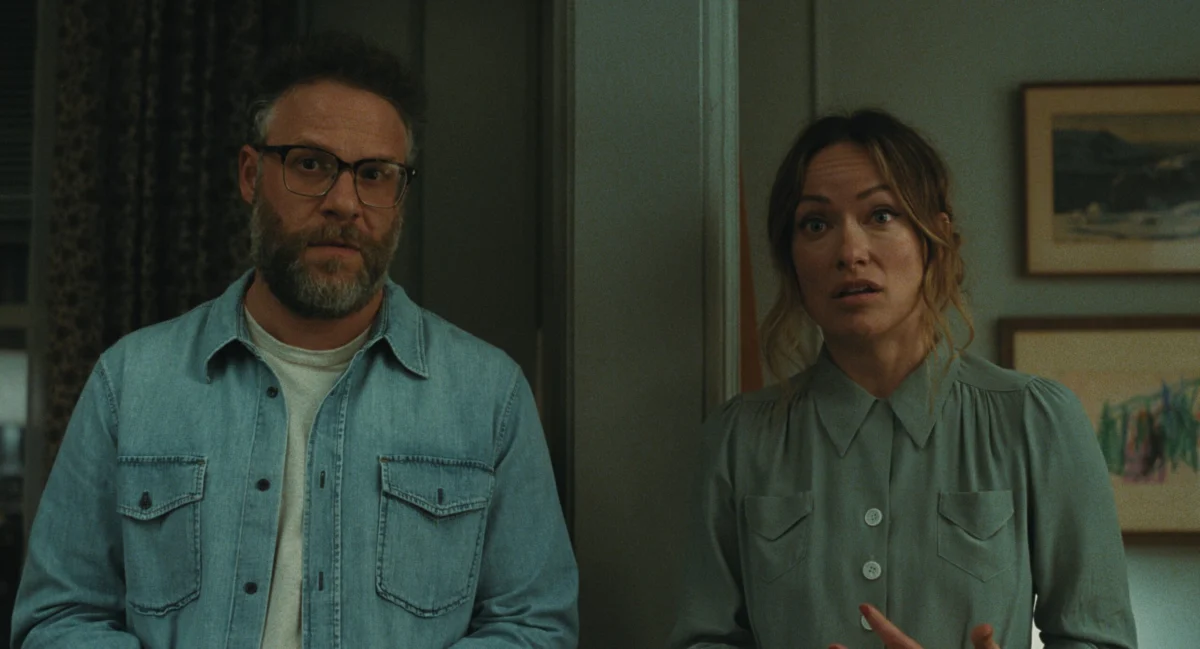
In the contemporary cinematic landscape, where intellectual property is often synonymous with sprawling superhero franchises or established literary epics, director Olivia Wilde has found a different kind of "universal" source material. Her latest film, The Invite, represents the sixth international iteration of a story that began as a Spanish stage play. However, Wilde’s version—a claustrophobic, improvisational, and ultimately devastating look at a crumbling marriage—departs significantly from its predecessors, particularly in its daringly quiet and ambiguous conclusion.
Starring Wilde alongside Seth Rogen, Edward Norton, and Penélope Cruz, The Invite is more than just a remake; it is a psychological deconstruction of the "dinner party" subgenre. By rejecting major studio backing and opting for a lean, 23-day chronological shoot, Wilde has crafted a film that prioritizes character discovery over scripted certainty.
Main Facts: A Global Phenomenon Reimagined for the U.S.
The narrative architecture of The Invite is rooted in Cesc Gay’s Spanish-language play The Neighbors Upstairs. The premise is deceptively simple: a long-married, increasingly bitter couple invites their sexually adventurous upstairs neighbors over for a drink, only to have the evening devolve into a series of uncomfortable revelations and existential crises.
Before Wilde took the helm for the American adaptation, Gay’s material had already proven its cross-cultural resonance. It was first adapted by Gay himself into the 2020 film Sentimental. Within five years, the story was remade in Italy, Switzerland, France, and South Korea. Wilde’s version marks the fifth international film adaptation and the first for an English-speaking audience.
The U.S. production features a powerhouse quartet of talent:
- Olivia Wilde and Seth Rogen as Angela and Joe, a couple whose marriage has withered into a cycle of "manic combativeness."
- Edward Norton and Penélope Cruz as Hawk and Piña, the "sexually adventurous and emotionally open" neighbors who serve as the catalyst for the central couple’s breakdown.
The film is scripted by the writing duo of Rashida Jones and Will McCormack (Celeste and Jesse Forever), who worked closely with the cast to personalize the dialogue through an extensive workshopping process.
Chronology: From the Spanish Stage to an Independent American Set
The journey of The Invite to the American screen is a study in rapid international expansion and creative evolution.

1. The Spanish Origins (2016–2020)
Cesc Gay’s The Neighbors Upstairs premiered on stage, capturing the zeitgeist of middle-class domestic malaise. Its success led to Sentimental in 2020, which garnered critical acclaim and established the blueprint for the story: a single-location chamber piece driven by dialogue and social friction.
2. The Global Wave (2020–2024)
As the film industry looked for high-concept, low-cost projects during and after the pandemic, Gay’s script became a hot commodity. The story’s "plug-and-play" nature—requiring only four actors and one set—allowed it to be localized in various cultures, proving Wilde’s assertion that "relationships are difficult in every language."
3. The American Workshop (Pre-Production)
When Wilde became attached to the project, she brought on Jones and McCormack to refine the script. However, the true "writing" of the American version occurred during a two-week improvisational rehearsal period. Wilde, Rogen, Norton, and Cruz used this time to "breathe life" into the characters, discovering their specific neuroses and histories.
4. The 23-Day Shoot (Production)
The film was shot in just 23 days, almost entirely in chronological order. This method is rare in modern filmmaking due to its logistical complexity, but Wilde insisted on it to allow the actors to experience the exhaustion and emotional escalation of the characters in real-time. This chronological safety net allowed for the script to continue evolving even while the cameras were rolling.
Supporting Data: The Art of the Ambiguous Ending
The most significant departure in Wilde’s version lies in its conclusion. In Cesc Gay’s original Sentimental, the central couple ultimately decides to stay together, finding a strange kind of solace in their shared history despite their flaws.
In contrast, Wilde and Rogen’s Joe and Angela reach a different, more somber conclusion: their marriage is over.
The Piano Motif
A central element of this new ending is the role of Joe’s piano. Joe, played by Seth Rogen, is a man living in the "aftermath" of his dreams. A failed professional musician, he has refused to touch the piano for years—a physical manifestation of his bitterness and sense of failure.

The idea for the finale—Joe playing the piano while Angela listens—came from a misunderstanding by co-writer Will McCormack. While watching the original Spanish film for the first time, McCormack incorrectly predicted that the protagonist would return to the instrument. This "incorrect" assumption became the emotional cornerstone of the U.S. version.
The Power of Silence
Data from the production suggests a lean approach to the final act. Wilde revealed that much of the dialogue written for the ending was "stripped away" during the shoot. The final film relies on silence to communicate the "shell-shocked realization" of the couple’s decision to separate. Rather than a grand, dramatic confrontation, the characters discuss the "smaller logistics"—who sleeps where, and what to do with a summer rental.
Official Responses: Insights from the Creative Team
During a recent guest appearance on the Filmmaker Toolkit Podcast, Olivia Wilde and her writers provided deep insights into the creative risks taken during production.
Olivia Wilde on Universal Truths:
"I thought any story that has been adapted by different cultures in this way must have a kind of root to it that feels very universal… I think that what drew me to it as a director was the idea that there was a chance to make a version of this that felt specific to not only an English-speaking audience, but to this cast."
On the Fear of Silence:
Wilde admitted that the decision to end the film with an ambiguous, quiet scene was a significant personal challenge. "I fear silence in general, but particularly when making films, it’s sometimes the hardest thing. I’m always tempted, ‘Okay, we should put some more music in. We should add some lines.’ But the ability to be quiet and to trust that the audience is listening is something that I’ve learned quite a lot about through this process."
Will McCormack on Character Archetypes:
At a WGA screening in New York, McCormack explained that the guiding theme of the adaptation was "how being an adult is reconciling who you actually are with who you wanted to be." He described Joe’s character as the vessel for "somebody whose life has become the aftermath of the life that they wanted to have."
Wilde on Independent Freedom:
Wilde has been vocal about her decision to avoid the traditional studio system for The Invite. "I can only imagine the battle I would’ve had at a studio about that ending," she noted, emphasizing that the creative risks taken—such as the decision to end the marriage—would likely have been vetoed by executives seeking a more traditional, "happily ever after" resolution.

Implications: The Future of Mid-Budget Adult Dramas
The production and release strategy of The Invite offer several implications for the broader film industry.
1. The Viability of Independent Theatrical Releases
By rejecting a lucrative offer from a streamer like Netflix, Wilde has staked a claim for the importance of the theatrical experience for adult-oriented dramas. The film’s staggered rollout—starting in major hubs like New York and L.A. before expanding nationwide—is a throwback to "platforming" strategies that allow word-of-mouth to build.
2. The Rise of "Hyper-Local" Remakes
The Invite demonstrates a growing trend where global stories are remade not just for a "new" audience, but as a way to explore how different cultures handle the same stressors. The fact that the U.S. version is the only one to suggest a definitive breakup may reflect a specific American perspective on individual fulfillment versus the preservation of the family unit.
3. A New Chapter for Olivia Wilde
Following the tabloid-heavy cycle of Don’t Worry Darling, The Invite serves as a "reset" for Wilde. By focusing on a single-room drama and leaning heavily into the workshop process, she is re-establishing herself as a "performance-first" director. Her willingness to embrace "creative risk" and "intentional ambiguity" suggests a move toward more experimental, auteur-driven projects in the future.
4. The "Seth Rogen" Evolution
The film also marks a significant step in Seth Rogen’s career as a dramatic actor. By playing a character defined by suppressed rage and failed musical aspirations, Rogen continues to move away from his "stoner-comedy" roots, proving his range in a role that requires deep vulnerability and "verbose, almost manically combative" energy.
The Invite is currently playing in select cities, including San Francisco, Chicago, and Toronto, with a nationwide expansion scheduled for July 10. As it reaches a wider audience, the film’s central question remains: in the face of absolute honesty, can a marriage survive, or is the "aftermath" the only place where true life begins?
 Sagoh
Sagoh
 Neng Nana
