

By Anna Lee
Published September 18, 2026
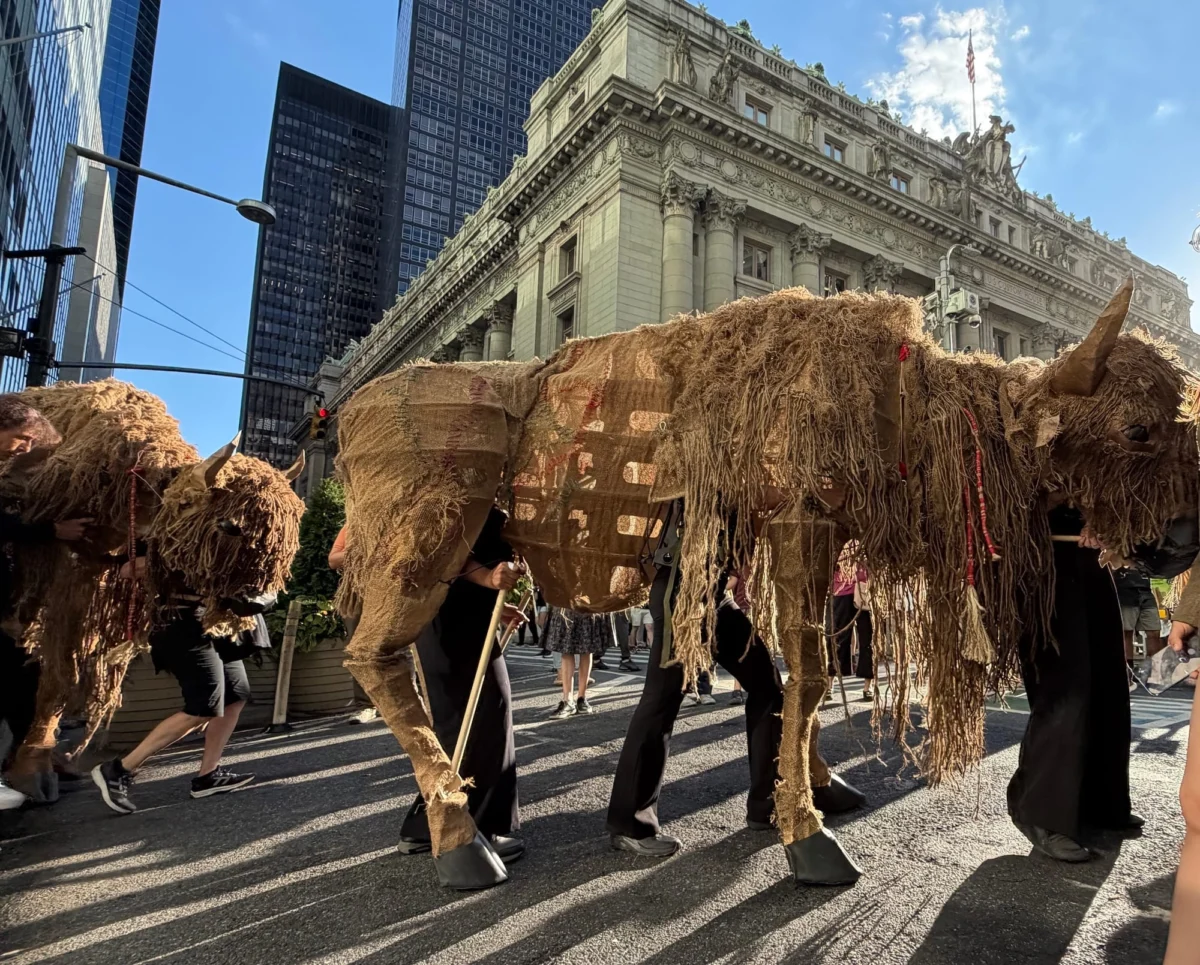
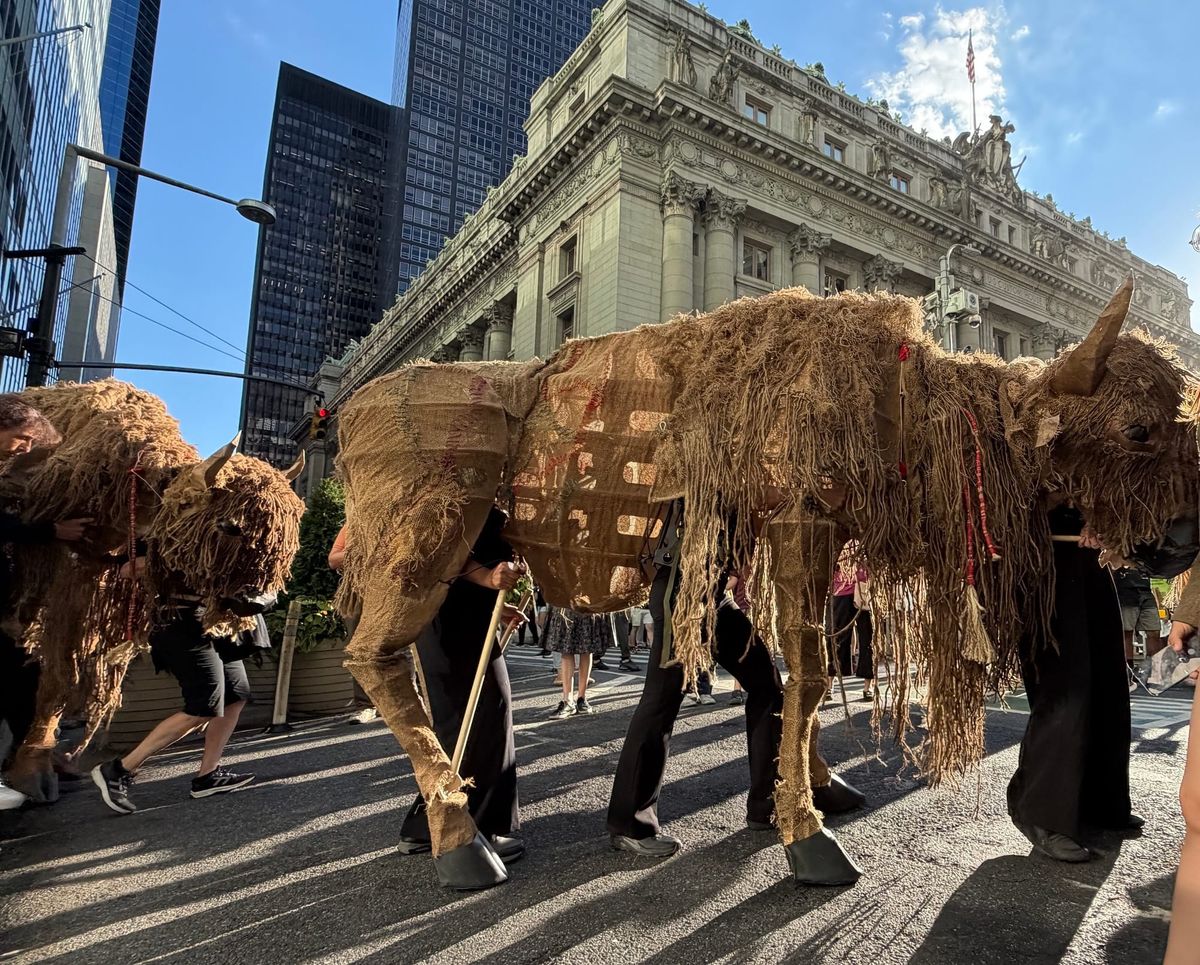
NEW YORK — Lower Manhattan transformed into a living canvas of memory, grief, and survival today as a migration of 40 life-sized buffalo puppets wound its way through the historic canyons of the city. Titled Return of the Buffalo: Tatanka Owe Akupi—utilizing the Lakota phrase for "buffalo trail home"—the massive public art performance pays solemn homage to the 38 Dakota men executed by order of President Abraham Lincoln in Mankato, Minnesota, in December 1862.
The procession began its journey near Bowling Green Park, pausing intentionally in front of the Smithsonian’s National Museum of the American Indian before treading northward. Passing iconic and heavily trafficked urban landmarks including Federal Hall, the World Trade Center, Zuccotti Park, Broad Street Plaza, and the bustling avenues of Chinatown, the herd bridged the gap between modern metropolitan life and the deep, often erased Indigenous histories embedded in the land.
Following its striking debut across Manhattan, the production is scheduled to cross the East River for its second and final leg, traversing downtown Brooklyn. Conceived by acclaimed theater writer and director Amir Nizar Zuabi, the project is a collaborative triumph built in close consultation with descendants of the Lenape—the original Indigenous stewards of the region now known as New York City—and Lakota elders, whose sacred, millennia-old relationship with the American bison forms the spiritual bedrock of the entire endeavor.
Main Facts
- The Production: Return of the Buffalo: Tatanka Owe Akupi features a herd of 40 meticulously crafted, life-sized buffalo puppets migrating through urban centers.
- The Route: The Manhattan leg crossed Bowling Green, Federal Hall, the World Trade Center, Chinatown, Broad Street Plaza, and Zuccotti Park on September 18, 2026. A final leg in downtown Brooklyn follows on September 19.
- Core Inspiration: The performance honors the 38 Dakota men hanged in Mankato, Minnesota, on December 26, 1862—the largest mass execution in United States history—while simultaneously acknowledging the broader history of the deliberate near-extinction of the North American bison and its ongoing ecological and cultural restoration.
- Key Collaborators: Created by theater director Amir Nizar Zuabi, the project was developed alongside Lenape descendants, Lakota elders, and JJ Lind (Cherokee-Shawnee), artistic director of the performance group Immediate Medium.
- Interdisciplinary Elements: The procession is accompanied at nine historic urban sites by concurrent performances featuring Native dance troupes, gospel choirs, and Lenape youth.
Chronology: From Mankato to Manhattan
To understand the profound weight of Tatanka Owe Akupi, one must trace a historical arc that spans over 160 years of American expansion, state violence, and Indigenous survival.
December 1862: The Mankato Executions
The direct historical anchor of the project dates back to the aftermath of the U.S.–Dakota War of 1862 in Minnesota. Following a summer of conflict driven by broken federal treaties, starvation, and withheld government annuities, hundreds of Dakota men were tried by a hastily convened military commission.
President Abraham Lincoln ultimately reviewed the sentences and approved the execution of 38 Dakota men. On December 26, 1862, in Mankato, Minnesota, they were simultaneously hanged in what remains the largest mass execution in U.S. history. The event fractured Dakota society, precipitating forced removals and generations of generational trauma that reverberate to this day.
The 19th-Century Buffalo Slaughter
Parallel to the suppression of Indigenous nations was the systematic decimation of the American bison (Tatanka). Once numbering in the tens of millions, the herds roamed freely across the Great Plains and beyond, serving as the physical and spiritual lifeblood of numerous Plains Indian nations, providing food, shelter, clothing, and spiritual structure.
In the post-Civil War era, the federal government and industrial interests weaponized the destruction of the buffalo as a deliberate military strategy to subjugate Indigenous populations by stripping away their primary sustenance. By the late 1880s, commercial hunting, sport shooting, and military campaigns reduced the bison population to fewer than a thousand individuals, driving the species to the brink of biological extinction.
September 2026: Tatanka Owe Akupi in New York City
Fast forward to mid-September 2026. The ghosts of 1862 and the sweeping ecological tragedy of the plains converge on the concrete labyrinth of Lower Manhattan. The life-sized puppets, operated by teams of puppeteers working in synchronized harmony, plod deliberately past symbols of American financial and political power—Wall Street, Federal Hall, and the World Trade Center. By marching these majestic, resilient creatures through the heart of global capitalism, the creators physically reinscribe Indigenous presence onto stolen Lenape land, turning the urban landscape into a site of collective reckoning.
Supporting Data and Production Scope
The logistical footprint of Return of the Buffalo matches its artistic ambition. Bringing 40 life-sized mammalian puppets through dense urban traffic required months of planning, community outreach, and institutional coordination.
- Puppetry Scale: Each buffalo puppet requires multiple handlers, mimicking the subtle weight, breath, and herd dynamics of real bison. The visual impact of 40 massive figures moving in unison creates a surreal, arresting contrast against towering skyscrapers and asphalt.
- The Nine Historic Stops: Along the Manhattan route, the procession paused at nine carefully selected historic sites. At each stop, site-specific performances transformed the public square. Native dance troupes performed traditional and contemporary styles, gospel choirs offered resonant vocal harmonies addressing grief and redemption, and Lenape youth spoke and performed, grounding the project firmly in the contemporary reality of the local First Nations.
- Geographic Reach: Spanning two boroughs over two days—starting in Lower Manhattan’s financial and colonial hubs and concluding in downtown Brooklyn—the route maps out an alternative geography of New York City, prioritizing Indigenous landmarks over colonial monuments.
Official Responses and Creative Vision
The creation of Return of the Buffalo broke away from traditional top-down theatrical models, prioritizing Indigenous leadership, protocol, and community consensus at every stage of development.
"We just followed the elders’ lead in who they wanted involved, what they wanted to be said, really letting them shape the conceptual backbone of the work," JJ Lind, the Cherokee-Shawnee artistic director for the performance group Immediate Medium, told Hyperallergic during the event.
Lind emphasized that the collaborative framework was non-negotiable. "We’d bring community members in to provide feedback on the activities that happen along the route," he explained, ensuring that the performance remained culturally resonant, respectful, and politically sharp.

Director Amir Nizar Zuabi, known for large-scale immersive theater projects that engage with geopolitical displacement and historical trauma (such as The Walk, featuring the giant puppet Little Amal), turned his lens toward the Americas. By engaging Lakota elders who maintain an unbroken, sacred relationship with the bison, Zuabi and his team ensured that the production did not fall into the trap of historical voyeurism. Instead, the buffalo function not merely as symbols of victimhood, but as active agents of return, endurance, and kinship.
Cultural historians and participating Native artists noted that the inclusion of gospel choirs and youth performances created an intercultural dialogue about suffering and survival in America. The choirs provided an emotional bridge, acknowledging that historical wounds—from the 1862 hangings to the erasure of Lenape homelands—demand collective, communal mourning that transcends any single community.
Implications: Art, History, and Urban Space
Return of the Buffalo: Tatanka Owe Akupi arrives at a critical cultural juncture in the United States, where public monuments, civic spaces, and educational curricula are increasingly scrutinized for their historical omissions.
1. Reclaiming Public Space
For centuries, the architectural and monumental landscape of New York City has celebrated colonial figures, financiers, and political leaders who directly profited from or oversaw the displacement of Indigenous peoples. By flooding Lower Manhattan—the birthplace of New York’s colonial footprint—with a herd of 40 buffalo, the production temporarily but powerfully reclaims public space. It forces daily commuters, tourists, and financial workers to reckon with the ecological and human cost upon which the modern American metropolis was built.
2. Ecological Restoration as Cultural Healing
The narrative arc of the buffalo is intimately tied to modern Indigenous-led conservation efforts. In recent years, tribes across the United States have spearheaded the return of bison to tribal lands, viewing ecological restoration as an essential component of cultural revitalization, food sovereignty, and healing from historical trauma. Tatanka Owe Akupi reflects this contemporary movement, framing the buffalo not as a relic of a dead past, but as a living symbol of an unbroken future.
3. Ethical Collaborations in Public Art
The project sets a high benchmark for how international and mainstream theater companies can ethically engage with Indigenous histories. By ceding creative control to Lakota elders and Lenape descendants, the production models a framework where art serves as a vehicle for restitution, truth-telling, and community empowerment rather than aesthetic extraction.
As the herd prepares for its final migration across the river into Brooklyn, the legacy of the 38 Dakota men, the memory of the great plains herds, and the enduring sovereignty of the Lenape people linger in the streets of New York—a powerful reminder that history is never truly past, and that the buffalo trail, against all odds, leads home.
 Nana
Nana
 Iffa Jayyana
 Muslim
