

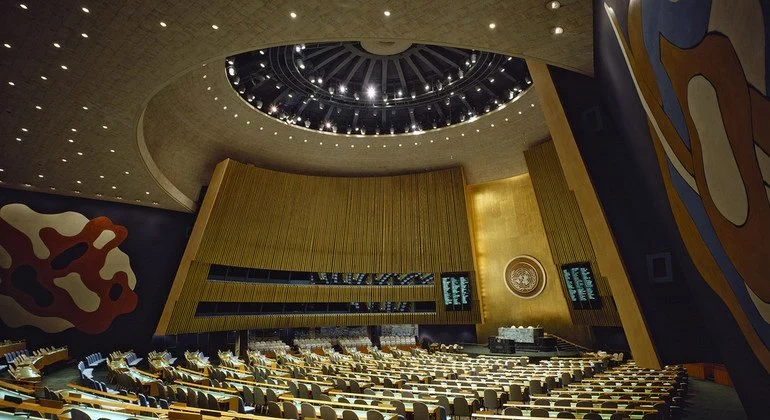
As the world prepares for the high-level week of the United Nations General Assembly (UNGA), the global community finds itself navigating an era of profound fragmentation. With geopolitical tensions rising and traditional alliances fraying, critics often question the relevance of the world’s most representative body. However, for Richard Gowan, Director of UN and Multilateral Diplomacy at the International Crisis Group, the UNGA is far from a relic of a bygone era. It remains the vital, albeit imperfect, stage where the international order is negotiated, contested, and maintained.
The Genesis: From Security Council Paralysis to General Assembly Action
To understand the modern UNGA, one must look back to its inception in 1945. The architects of the post-World War II order originally envisioned a world governed primarily by the Security Council—a body designed to reflect the power realities of the time, with the five permanent members holding veto power.
However, the onset of the Cold War quickly shattered these expectations. As the United States and the Soviet Union entrenched themselves in ideological conflict, the Security Council fell into a state of chronic gridlock. Almost immediately, the political center of gravity shifted. "The founders assumed the Security Council would be the center of decision-making," Gowan notes. "But when the Council became paralyzed by Cold War tensions, the General Assembly stepped into the breach."
By the late 1940s and early 1950s, the Assembly became the primary forum for addressing explosive crises, including the Korean War and the Palestinian question. It was here that the foundational mechanisms of modern multilateralism were forged, not in the quiet rooms of the Council, but on the floor of the Assembly, where middle powers and smaller nations began to exert influence.
Chronology of Influence: Key Turning Points
The evolution of the UNGA can be traced through several critical historical inflection points that transformed it from a Western-dominated debating chamber into a truly global institution.
1956: The Suez Crisis and the Birth of Peacekeeping
The first major test of the Assembly’s authority arrived in 1956. With the world facing simultaneous crises—the Suez Crisis, involving military intervention by Britain and France, and the Soviet invasion of Hungary—the Security Council was powerless. The General Assembly bypassed the impasse, mandating the very first UN military peacekeeping operation. This historic act established the Assembly as a functional body capable of crisis management, effectively creating the blueprint for modern peacekeeping missions.
The 1960s: The Wave of Decolonization
The 1960s marked the most dramatic shift in the Assembly’s demographics. As dozens of newly independent nations from Africa and Asia joined the UN, the organization’s original structure—intended to govern a post-imperial world—was fundamentally challenged. The Assembly became the premier platform for the "Global South" to challenge the lingering vestiges of colonial power.
The 1970s: The Fight Against Apartheid
Throughout the 1970s, the General Assembly focused its moral and political weight on dismantling apartheid in South Africa. Through a series of sweeping resolutions and the eventual suspension of South Africa’s membership, the Assembly proved that it could serve as a powerful vehicle for human rights advocacy, even when the major powers were hesitant to act.
2005: Institutional Reform
The post-Cold War era brought a renewed spirit of cooperation. In 2005, the Assembly demonstrated its capacity for internal evolution by establishing the Peacebuilding Commission, an effort to bridge the gap between emergency crisis response and long-term stability.
Supporting Data: The Expanding Global Voice
The expansion of the UNGA’s membership is the most significant indicator of its transformation. In 1945, the organization comprised 51 member states. Today, that number has grown to 193. This growth has fundamentally changed the nature of global discourse.
In 1974, the Assembly passed a landmark resolution calling for a "New International Economic Order," a direct response to the perceived unfairness of the global financial system. While the structural changes sought by developing nations were not fully realized, the movement forced a global conversation about wealth distribution, trade, and economic sovereignty that continues to resonate in today’s debates over the Sustainable Development Goals (SDGs).
The Shifting Landscape of Modern Challenges
As globalization accelerated in the 2000s, the UNGA faced new hurdles. The 2008 global financial crisis exposed the limits of the UN’s economic influence, as major powers opted to address the turmoil through the G20. This prompted significant criticism from the Global South, who felt sidelined by exclusive clubs of wealthy nations.
Yet, despite these shifts, the UNGA has found new vitality in environmental diplomacy. The Assembly has become the primary arena for coordinating international efforts to mitigate climate change, providing a platform where even the smallest island nations—those most vulnerable to rising sea levels—can hold major emitters accountable.
Official Perspectives and Diplomatic Implications
Richard Gowan emphasizes that the UNGA’s location in New York is more than a logistical detail; it is a diplomatic necessity. "There is no alternative to the General Assembly," Gowan argues. "It is the only place in the world where every state, regardless of its economic or military power, has a voice."
In an era of competing "diplomatic clubs"—such as the G7, BRICS, and various regional blocs—the UNGA serves as the ultimate "great equalizer." While major powers may prefer forums where they can dictate the agenda, smaller and middle powers depend on the General Assembly to assert their interests on the world stage.
The resilience of the Assembly is evidenced by the participation levels during the annual high-level week. Despite the rise of digital diplomacy and frequent predictions of the UN’s decline, record numbers of heads of state continue to make the pilgrimage to New York each September. This indicates that, for all its bureaucratic limitations, the Assembly remains the premier "theater" of global politics.
Looking Ahead: The Future of the Assembly
If the founders of 1945 were to observe the modern General Assembly, they would likely be startled. Figures like Winston Churchill, who viewed the UN as a structure to maintain the stability of the existing order, would likely be shocked to see the Assembly transformed into a radical space for decolonization, human rights advocacy, and global equality.
The advice they might offer, Gowan suggests, would likely focus on the need for adaptability. The Assembly’s history is defined by its ability to evolve—from a Cold War arena to a voice for the Global South, and finally to a forum for planetary survival.
The implications for the future are clear: as the world faces existential threats—from climate change to the erosion of international law—the General Assembly remains the only institution with the legitimacy to build a global consensus. It is a stage that is not merely symbolic; it is the essential machinery of international order.
When a crisis erupts, the world turns to the Security Council first, but it turns to the General Assembly for the moral, political, and collective mandate to act. In an age of division, the UN General Assembly is the one place where the world still attempts to speak with a single, if often discordant, voice. As long as that stage remains, the hope for a rules-based international order remains alive.
 Nana Muazin
 Azzam Bilal Chamdy
 Layla Zulfa
