

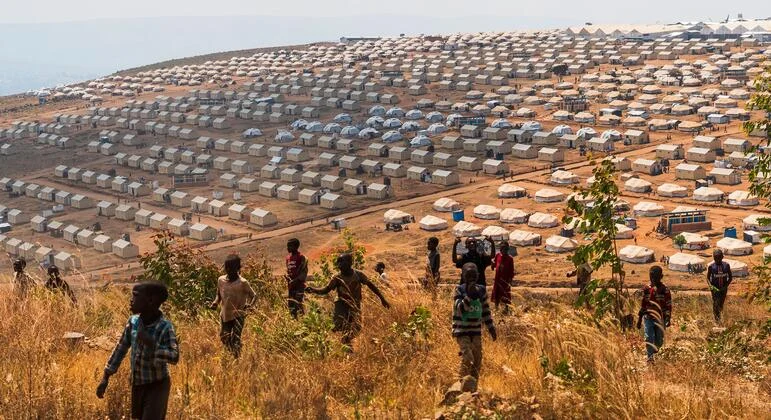
The United Nations Security Council recently convened for a critical session aimed at addressing what humanitarian observers are calling a "perpetual state of emergency": the unprecedented surge in global forced displacement. With conflicts spanning from the Democratic Republic of the Congo (DRC) to the Middle East and Eastern Europe, the architecture of international protection is being pushed to its breaking point.
This report examines the current state of global displacement, the history of this trend, the empirical data defining the crisis, and the profound geopolitical implications of a world where millions remain permanently uprooted.
1. Main Facts: A World in Motion
At the heart of the Security Council’s recent deliberations is a harrowing reality: more people are forcibly displaced today than at any point since the Second World War. The figures, tracked by the UN Refugee Agency (UNHCR), indicate that the number of individuals forced to flee their homes due to persecution, conflict, violence, human rights violations, or events seriously disturbing public order has surpassed 110 million.
The current crisis is not merely a quantitative increase; it is a qualitative shift in the nature of displacement. Unlike the post-WWII era, where displacement was often characterized by distinct, finite geopolitical shifts, the modern era is defined by "protracted displacement." Refugees are spending longer periods in limbo, often in host countries that lack the infrastructure to provide sustainable integration.
The Security Council’s recent meeting served as a stark reminder that displacement is no longer a peripheral humanitarian issue. It is a fundamental threat to regional stability, economic development, and international security. When borders are overwhelmed and resources are stretched thin, the social contract within host nations often frays, leading to domestic political instability—a dynamic the Security Council views as a potential catalyst for further conflict.
2. A Chronology of Escalation
To understand how the world arrived at this juncture, one must look back at the shifting landscape of global instability over the last decade.
- 2011–2015: The Arab Spring and Regional Destabilization. The onset of the Syrian civil war and the subsequent instability across the MENA region triggered the first massive wave of displacement that tested the capacity of international aid agencies. The Mediterranean crisis of 2015 remains a watershed moment in how displacement intersects with national sovereignty and border policy.
- 2016–2019: The Fragmentation of Conflicts. During this period, the nature of war shifted from conventional state-on-state conflicts to complex, multi-actor civil wars. This was evident in the DRC, Yemen, and the Sahel region, where climate change began to act as a "threat multiplier," exacerbating resource competition and fueling migration.
- 2020–2022: The Pandemic and the Return of Great Power Conflict. The COVID-19 pandemic effectively closed borders, leaving millions of displaced people trapped in dangerous environments. The onset of the war in Ukraine in 2022 added millions more to the global count in a matter of months, forcing a re-evaluation of how wealthy nations handle influxes of displaced populations.
- 2023–Present: The "Polycrisis" Era. Today, the world faces a confluence of war, climate-induced migration, and severe economic downturns. The situation in the DRC, where refugees now languish in camps that lack basic sanitation and security, serves as a microcosm for the global inability to find political solutions to underlying grievances.
3. Supporting Data: The Metrics of Misery
The data provided to the Security Council paints a picture of systemic failure. According to the UNHCR’s latest annual report:
- Host Nation Burden: Roughly 75% of the world’s refugees are hosted by low- and middle-income countries, often those bordering the very conflicts from which the refugees are fleeing. This creates a "geography of inequality" where the states least equipped to manage the burden bear the heaviest load.
- Children in Limbo: Approximately 40% of the world’s forcibly displaced population are children. This represents a "lost generation" whose education and developmental milestones are permanently interrupted, creating a long-term risk of recruitment by armed groups and radicalization.
- Climate Linkages: The International Organization for Migration (IOM) estimates that by 2050, over 200 million people could be internally displaced due to climate change. This data point is particularly significant for the Security Council, as it shifts the narrative from "refugee crisis" to "existential security threat."
- Funding Gaps: Humanitarian appeals for displaced populations are currently funded at less than 50% of the required amount. This "funding gap" translates directly into reduced food rations, limited healthcare access, and the collapse of shelter programs in major refugee hubs like Burundi, Uganda, and Bangladesh.
4. Official Responses and Institutional Stances
The Security Council’s recent session was marked by a divide between member states advocating for stricter border enforcement and those calling for a fundamental reform of the international protection framework.
The Humanitarian Perspective: UN agencies, led by the High Commissioner for Refugees, argued that "there is no humanitarian solution to a humanitarian problem." Their position is that the Security Council must leverage its political weight to force diplomatic resolutions to the conflicts in the DRC, Sudan, and Ukraine. They emphasize that aid is a stop-gap measure, not a cure.
The Geopolitical Stance: Major powers on the Council highlighted the need for "burden-sharing." While some nations advocate for financial support for host countries, others demand more robust repatriation programs. There is a palpable tension between the legal obligations under the 1951 Refugee Convention and the nationalistic political climate currently prevailing in many Council-member states.
The Regional Voice: Representatives from nations hosting large refugee populations, such as those in the Great Lakes region of Africa, issued a plea for more than just rhetoric. They argued that the Security Council’s failure to prevent the spread of regional conflict directly creates the displacement crisis, making the Council an architect of the problem it is currently trying to manage.
5. Implications: The Path Forward
The implications of this rising tide are profound and multi-dimensional.
Economic Impact
Displacement is a drain on human capital. When millions of people are barred from the workforce in host countries due to legal restrictions, the host economy loses a potential labor source, while the displaced population suffers from extreme poverty and dependency. Long-term, this creates a cycle of poverty that is difficult to break, even if the refugees are eventually able to return home.
Security and Regional Stability
The Security Council recognizes that refugee camps, when left unsupported, can become hotbeds for recruitment by non-state armed actors. Furthermore, the demographic shift caused by sudden influxes of refugees can trigger social friction within host communities, leading to domestic unrest that provides an opening for extremists to exploit.
The Erosion of International Law
Perhaps the most dangerous implication is the erosion of the international legal framework. As states increasingly prioritize national sovereignty over treaty obligations, the norms that have protected the displaced since 1951 are being normalized away. If the Security Council cannot uphold these norms, the international order risks reverting to a "might makes right" paradigm, where the vulnerable are left to fend for themselves.
The Call to Action
The final consensus of the Security Council meeting was that a paradigm shift is required. The focus must move from reactive crisis management—simply providing tents and medicine—to proactive conflict resolution and sustainable development. This involves:
- Diplomatic Mediation: Prioritizing political settlements in active conflict zones to stop the flow of new refugees.
- Investment in Host Countries: Providing significant financial aid to developing nations that host the majority of the world’s displaced, thereby stabilizing both the host community and the refugees.
- Climate-Resilient Development: Acknowledging that environmental stability is a prerequisite for preventing future waves of displacement.
- Legal Protections: Reaffirming the global commitment to the 1951 Convention, ensuring that the "right to seek asylum" is not sacrificed at the altar of political expediency.
As the Security Council continues to monitor the situation, the world waits to see if these high-level deliberations will translate into tangible changes on the ground. The tide of displacement is rising, and the window for a coordinated, effective international response is narrowing. The crisis is not merely a challenge for the refugees; it is a defining test for the integrity and efficacy of the United Nations itself.
 Nana Muazin
 Azzam Bilal Chamdy
