

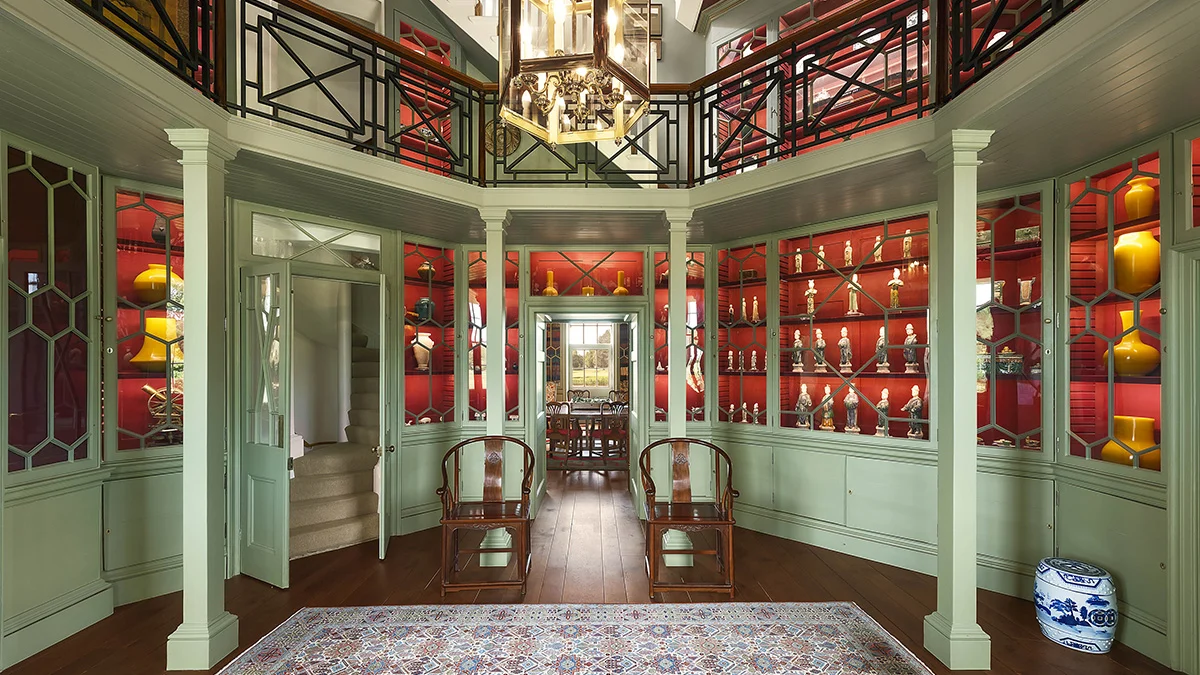
In the quiet, verdant expanse of Richmond’s Old Deer Park, a Grade I-listed architectural masterpiece stands as a testament to both the Age of Enlightenment and the modern era’s obsession with preserving the past. The King’s Observatory, a building commissioned by George III in 1769 to facilitate his fascination with the cosmos, has officially hit the market for £18 million (approximately $24 million). Represented by Charlie Willis London, this rare listing offers a prospective buyer more than just a home; it offers a chance to own a piece of scientific history, complete with a rooftop dome that once allowed a monarch to map the stars.
The Genesis of a Royal Scientific Hub
Designed by the celebrated architect Sir William Chambers—the same visionary behind the Great Pagoda at Kew Gardens—the Observatory was born out of necessity. King George III, a man of intense intellectual curiosity, sought a dedicated facility to observe the Transit of Venus, a rare celestial event of immense importance to 18th-century astronomy.
Completed in 1769, the structure was purposefully built in the seclusion of the Old Deer Park to minimize light pollution and vibrations, ensuring the most accurate readings possible. For over two centuries, the building served as a silent sentinel for the scientific community, evolving from a royal observatory into a critical hub for meteorology and timekeeping. It remained an active site for the Meteorological Office until 1980, bearing witness to some of the most significant scientific shifts in modern history.

A Chronology of Scientific Significance
The history of the King’s Observatory is not merely a record of architectural longevity; it is a timeline of intellectual progress.
- 1769: The building is commissioned and completed under the direction of Sir William Chambers, serving as the King’s private observatory.
- 18th & 19th Century: The Observatory becomes a pivotal center for the "Royal Society" and various scientific missions, including the standardization of time and global meteorological tracking.
- Mid-20th Century: The site plays a vital role in wartime strategy. Notably, the meteorologist James Stagg utilized the facility’s data to provide the critical weather forecasts that allowed Allied leaders to finalize the timing of the D-Day landings in 1944. A plaque inside the residence still honors his contribution to the Allied victory.
- 1980: The Meteorological Office vacates the building, leaving the structure in search of a new purpose.
- 2018: Following a multi-year, painstaking restoration led by developer Robbie Brothers, the building is transformed into a modern residential estate while preserving its heritage status.
- 2026: The property officially enters the luxury real estate market, marking its first listing since its royal inception.
Architectural Integrity and Modern Adaptation
Spanning approximately 7,300 square feet, the residence is a masterclass in the balance between historical preservation and contemporary luxury. The challenge, according to the developers, was to honor the "scientific soul" of the building without sacrificing the comforts required for 21st-century living.
The library remains the most striking example of this philosophy. It houses the original Georgian bookshelves—still filled with thousands of leather-bound volumes—evoking the atmosphere of an 18th-century scholar’s study. The dining room, meanwhile, features intricate, hand-painted wallpaper depicting an 18th-century view of Canton, a nod to the global trade and exploration interests of the era.

Perhaps the most visceral connection to the past is the original dome. Still functioning and fully accessible, it serves as the crowning jewel of the residence. Standing under the dome, one can look through the same aperture that George III used to track the movements of Venus, bridging a 250-year gap between the monarch and the modern occupant.
The Estate: A Garden of Capability
The Observatory is situated on seven acres of meticulously curated land. The landscape architecture is a marriage of historical grandeur and contemporary design. Portions of the grounds were laid out following the principles of the legendary landscape architect Capability Brown, known for his ability to shape nature into a living painting.
In recent years, the grounds were further refined under the expert eye of renowned landscape designer Kim Wilkie. The result is a private sanctuary that includes an ornamental lake, a stone-built boathouse, and several outbuildings that originally served the needs of the resident astronomers. The estate feels remarkably removed from the hustle and bustle of London, yet it sits adjacent to the world-famous Kew Gardens, providing a rare green buffer that is virtually impossible to replicate in the capital.

Official Perspectives and Market Implications
The listing of the King’s Observatory by Charlie Willis London has sent ripples through the ultra-high-net-worth real estate market. The price tag of £18 million reflects not only the square footage but the "trophy asset" status of the property.
"There is nothing else like this in the United Kingdom," says Charlie Willis. "When you purchase the King’s Observatory, you are not just acquiring a home with four bedrooms and expansive grounds; you are becoming the custodian of a significant piece of British history. It is a rare opportunity to live within walls that have shaped our understanding of the weather and the heavens."
Market analysts note that the property is likely to attract collectors of heritage assets—individuals who value the rarity of the provenance as much as the interior finishings. The fact that the property includes planning permission for a massive 10,000-square-foot expansion—including staff quarters, expanded living areas, and a 17-car underground garage—adds a layer of functional versatility that is highly prized by international buyers who require modern amenities alongside historic charm.

Implications for Heritage Real Estate
The successful conversion of the King’s Observatory highlights a broader trend in luxury development: the adaptive reuse of historic civic and scientific buildings. As space becomes increasingly scarce in London, developers are looking toward decommissioned institutions to create unique, high-end residences.
However, this transition is not without controversy. Critics often worry that the conversion of such sites into private homes risks "privatizing" public history. Yet, the restoration of the Observatory has been largely lauded for its commitment to structural integrity. By retaining the original dome and the library’s historic shelves, the developers have ensured that the building’s primary identity remains intact.
The potential expansion, if realized, would bring the property to nearly 19,000 square feet. This would arguably make it one of the most substantial private estates in the Richmond area. The implications for the local market are significant; such a high-profile listing tends to set a benchmark for other heritage properties in the borough, potentially driving up the value of surrounding Grade I and Grade II-listed structures.

Conclusion: A Legacy for the Next Custodian
The King’s Observatory is more than a house; it is a narrative. From the days of King George III to the strategic meteorological calculations that helped win a world war, the walls of this building have held secrets of the sky and the earth.
As it awaits its next owner, the Observatory remains a silent observer of time. It stands as a reminder that luxury is not just about square footage or high-end appliances—it is about the weight of history and the privilege of stewardship. For the buyer who values the intersection of science, royalty, and nature, this London estate offers a life lived under the stars, in a home that truly belongs to the ages.
The future of the King’s Observatory is now in the hands of the market. Whether it becomes a private retreat for a global citizen or a gallery for a private collection, one thing is certain: the dome will remain, watching over the Old Deer Park, waiting for the next generation to look upward.
 Pevita Pearce
 Suro Senen
 Sagoh
Sagoh
