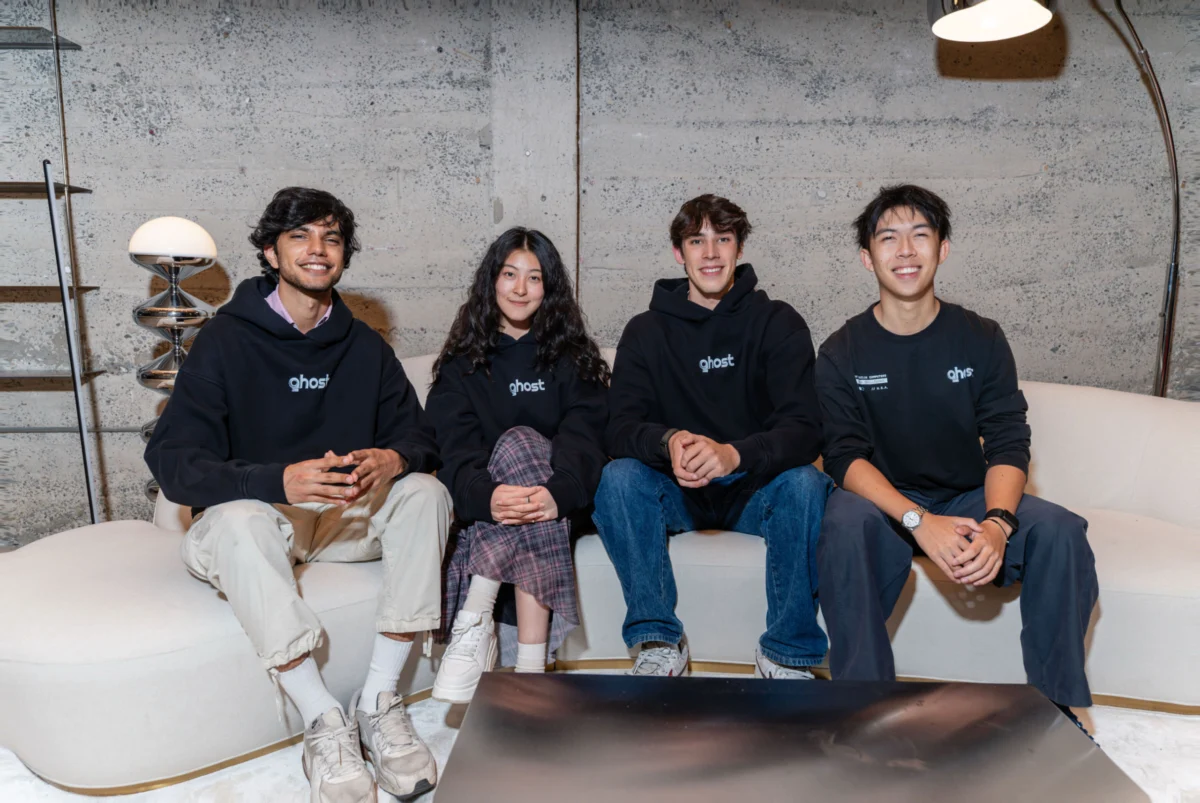
The landscape of personal computing is undergoing a structural shift, moving away from general-purpose operating systems toward hardware tailored specifically for artificial intelligence. Entering this race is Ghost, a San Francisco-based hardware and software startup founded by a cohort of exceptionally young entrepreneurs. After operating in stealth mode for a year, the company has officially emerged to announce an $11 million seed funding round led by heavyweight venture capital firm Andreessen Horowitz. Additional participants in the round include Abstract, Audacious Ventures, SV Angel, and Nova.
Ghost’s flagship product is the Core, a headless personal computer priced at $3,499. Designed from the ground up to continuously run autonomous AI agents, the device acts as a centralized repository for a user’s digital footprint—ranging from desktop files and applications to connected smart-home systems. Pre-orders for the first production batch opened on Monday, with shipping scheduled to commence by the final week of October.
Unlike standard desktop rigs or mini-PCs configured piecemeal by enthusiasts, the Core arrives as a turnkey solution. It packages high-end processing hardware, pre-installed open-source large language models, a dedicated filing system, and a proprietary software layer into a single, screenless enclosure often described by its creators as a "brain in a box."
Chronology
From Quantitative Finance to the AI Awakening
For 19-year-old Zain Javaid, the journey toward founding an AI hardware company began in the world of finance. For much of his early life, Javaid envisioned a career as a quantitative analyst, leveraging mathematics and complex data sets to guide investment strategies. While he briefly pursued this path, the routine nature of the work eventually led to professional stagnation.
The turning point arrived in November 2022 with the public launch of OpenAI’s ChatGPT. The breakthrough moment ignited a profound paradigm shift in Javaid’s trajectory. As he recounted to industry reporters, the arrival of consumer-facing generative AI produced a sense of foundational excitement he had never experienced before. This enthusiasm quickly channeled into a deep fascination with personal AI—the notion that artificial intelligence could transition from a cloud-based chatbot into a deeply integrated, proactive companion capable of managing human workflows.
Building in Stealth and Assembling the Team
Driven by this vision, Javaid abandoned his quantitative finance pursuits to dive headfirst into the consumer hardware and agentic AI space. Over the past year, he assembled a multidisciplinary, youth-led founding team to bring his concepts to life.
The core leadership team reflects the generational shift currently disrupting Silicon Valley:
Zain Javaid (19): Chief Executive Officer and visionary lead.
Nicholas Chua (19): Co-founder specializing in core systems and technical architecture.
Gautam Sharda (23): Co-founder overseeing software integration and security frameworks.
Operating out of a dedicated facility in San Francisco, the team spent twelve months designing, prototyping, and iterating on the hardware and software architecture that would ultimately become the Core. Their work culminated in the recent $11 million seed infusion and their public market debut.
Supporting Data
The Core is engineered to eliminate the friction typically associated with running localized, high-parameter AI models. Below is a breakdown of the hardware specifications, economic model, and software ecosystem powering the device:
Hardware Specifications & Economics
Retail Price: $3,499 per unit.
Processing Unit: Features an integrated Nvidia RTX Pro 4000 SFF Blackwell GPU. Javaid noted that bundling this specialized AI chip directly into the retail price ensures customers do not need to navigate the complexities or additional costs of purchasing enterprise-grade graphics hardware separately.
Form Factor: A compact, screenless desktop enclosure ("brain in a box") manufactured and assembled at Ghost’s San Francisco facility.
Interaction Model: Users interact with the device remotely via a dedicated mobile or desktop application. While voice-command functionality is supported, interactions are routed through the application interface rather than spoken directly into the hardware enclosure.
Software, Models, and Local Intelligence
Preinstalled Models: The device ships out-of-the-box with three distinct open-source models loaded onto the local system:
Qwen-3.8-Next
Qwen-3.8-27B
Gemma-4-31B
Ecosystem Flexibility: Users are not restricted to the factory defaults. Additional models can be seamlessly sideloaded from Hugging Face or custom-trained models can be deployed locally.
Over-the-Air (OTA) Updates: Modeled after automotive software deployment paradigms (similar to Tesla), the Core supports continuous OTA updates. Users can configure updates to install automatically, ensuring they are always running the latest iterations of available AI models, or they can manually select when to transition to new model generations.
Data Sovereignty and Privacy: Unlike cloud-dependent AI assistants, all model weights, personal memory stores, and source logic reside locally on the hardware. Personal data is encrypted locally, ensuring that cloud providers, third-party entities, and even Ghost cannot access or exploit user telemetry.
Official Responses
Confronting the Giants: Apple and the Incumbents
The launch of a dedicated AI hardware appliance naturally invites comparisons to established consumer electronics manufacturers, most notably Apple and its popular line of compact desktop computers, such as the Mac Mini. Many early adopters have attempted to configure Apple’s hardware to run local LLMs and agentic workflows. However, Javaid argues that comparing the Core to a Mac Mini fundamentally misunderstands the product categories.
"People sometimes give incumbents credit for having already built the product because they have the ingredients," Javaid explained, acknowledging Apple’s prowess in hardware design and market disruption.
However, Javaid emphasizes that the Core’s true innovation lies in its specialized software layer rather than raw processing power alone:
"Much of what Core is aiming to tackle is software: the model reasons over your life, how it remembers, how it takes action, how it knows when to reach out."
Javaid remains pragmatic regarding market competition, maintaining that Ghost’s survival rests entirely on its ability to deliver an indispensable user experience:
"Our main focus is building a product people love. If we can’t do that, Apple isn’t the reason we failed."
Architectural Independence and Security
A core design philosophy of Ghost is ensuring that users maintain absolute ownership over their hardware and digital identity. Javaid stressed that the device functions autonomously, completely decoupled from external cloud infrastructure dependencies.
"All of the source code, logic, and model weights live on the device, not the services," Javaid stated. "We built this device to not be dependent on having an outside entity maintaining the service." He added that even if Ghost were to cease operations entirely, the Core is programmed to continue functioning independently in the user’s home.
To address the inherent security risks of autonomous AI agents interacting with web services, APIs, and personal credentials, Ghost has engineered a custom hardware firewall.
"The firewall monitors every outgoing network request on the computer," Javaid explained. "And if it sees the agent performing a sanctioned action or exfiltrating data it shouldn’t be, it rejects the request and flags it for user review."
Users retain granular control over the level of autonomy granted to their agents, ensuring that convenience never supersedes personal consent and data security.
Implications
The Rise of Ambient Computing and Proactive AI
The introduction of Ghost’s Core highlights a broader, rapidly accelerating transition in consumer technology: the shift from reactive software (where humans input prompts and wait for answers) to proactive, ambient computing (where AI agents continuously monitor our lives and take autonomous action).
To illustrate this paradigm, Javaid provided a concrete scenario of how the Core operates in daily life:
"Core proactively sends you a notification that you might be getting sick because it sees your resting heart rate is elevated, sees from computer history that you were up late working on a project, and has seasonal context that it is flu season in San Francisco."
This level of contextual synthesis requires processing pipelines that run continuously, analyzing disparate data streams—biometrics, professional schedules, environmental context, and personal communications—without human prompting. Running such persistent workloads on traditional operating systems often results in thermal throttling, battery drain, privacy compromises, and software bloat. Ghost’s hardware-first approach posits that agentic AI demands dedicated infrastructure, much like graphic design once demanded dedicated GPUs or machine learning demanded tensor processing units.
Decentralization and the Rejection of the Cloud Monopolies
By anchoring data, model weights, and compute locally, Ghost is positioning itself at the vanguard of a broader philosophical pushback against centralized cloud-based AI. As enterprise and consumer anxiety surrounding data harvesting, cloud outages, and subscription-model fatigue grows, hardware solutions that guarantee local ownership and offline resilience may carve out a lucrative niche.
At $3,499, the Core is currently positioned as a high-end appliance for early adopters, developers, and privacy-conscious professionals rather than an immediate mass-market commodity. However, if startups like Ghost successfully prove the viability of dedicated agentic hardware, it may force mainstream tech giants to rethink their hardware roadmaps—potentially paving the way for a new generation of personal computers built from the silicon up to think, remember, and act on our behalf.



 Basiran
 Lina Irawan
 Evan Lee Salim
