

This week’s curated selection of cultural discourse navigates the precarious boundary between historical memory and contemporary political urgency. From the streets of New York City to the coast of Lebanon, the narratives explored here underscore the power of artistic expression as both a beacon for communal identity and a target for systemic erasure.
I. Honoring the Legacy of Scott Burton in Greenwich Village
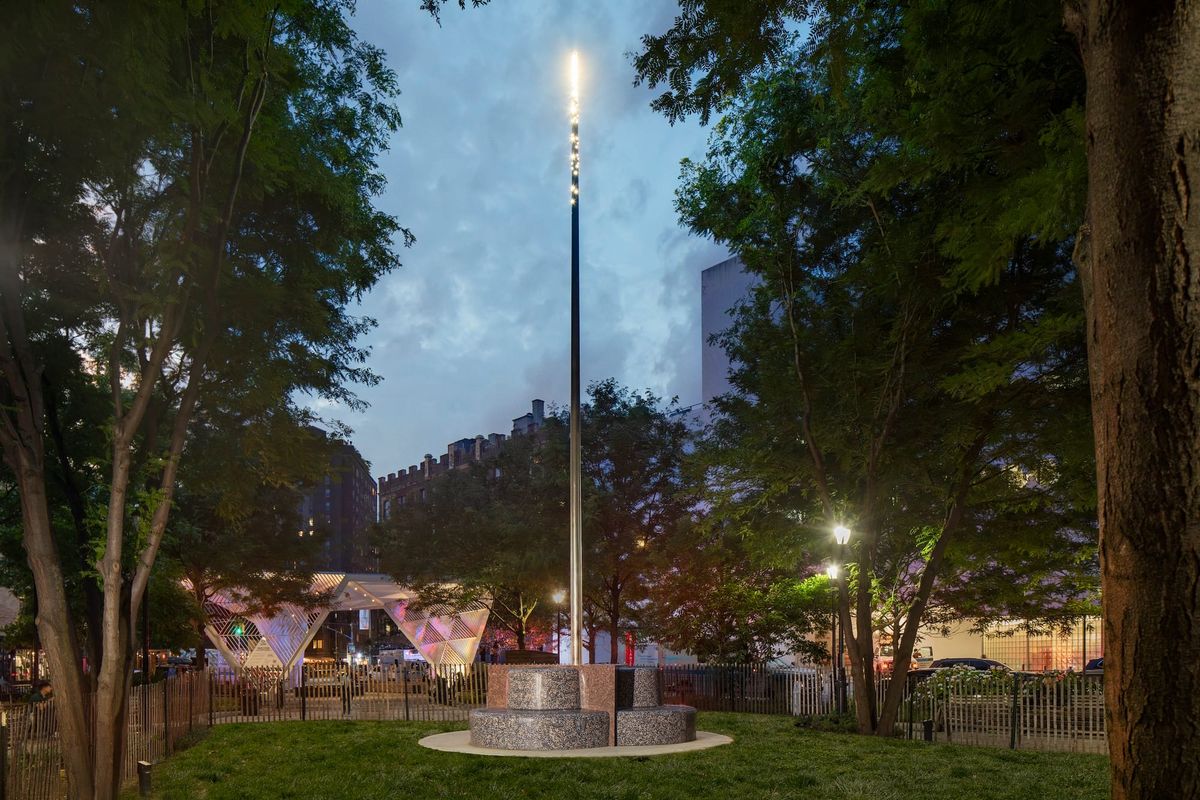
The New York City AIDS Memorial in Greenwich Village has become the site of a profound artistic homecoming. Earlier this week, the neighborhood hosted a vibrant, flower-filled celebration to mark the unveiling of Eternal Flame for Scott Burton, a new sculpture by Oscar Tuazon.
The work serves as a reimagining of Burton’s final public project. Burton, a pioneering American artist, succumbed to AIDS-related complications in 1989 at the age of 50. Tuazon’s towering, starlit sentinel functions as more than a static monument; it acts as a kinetic dialogue with the past. The ceremony—a blend of drag performances, music, and communal mourning—reaffirmed the importance of maintaining public spaces that honor the generations of queer artists lost to the AIDS crisis.
II. Rockwell Kent and the Political Geography of Greenland
As political rhetoric surrounding the potential acquisition of Greenland intensifies, historian Andrew Holter, writing for The Nation, invites us to re-examine the 1930s paintings of Rockwell Kent. Rather than viewing the island as a mere backdrop for Western exploration, Kent’s work reflects an evolving awareness of the Indigenous communities of Kalaallit Nunaat.
The Anti-Imperialist Lens
Holter argues that Kent’s canvases serve as vital, albeit late-arriving, testimonies against imperial vanity. “Kalaallit Nunaat was no blank canvas,” Holter writes, noting that Kent’s neighbors influenced his work to the point of explicit political commentary. His later works, including the WPA mural Mail Service in the Tropics, demonstrate a shift toward overt anti-imperialist messaging. In today’s climate, these paintings offer a sobering reminder that the geopolitical desire to "seize" territories often ignores the humanity and sovereignty of those living within them.
III. Resistance in the Stadium: Patrice Lumumba’s Symbolic Return
In the world of international sports, political symbolism has found an unlikely champion in Michel Kuka Mboladinga. As reported by Vogue, the DR Congo superfan has turned his support for the national football team into a performance art piece, honoring the memory of the assassinated revolutionary Patrice Lumumba.
Chronology of a Protest
- December 2025: During the Africa Cup of Nations match against Botswana, Mboladinga debuted a striking, flag-inspired outfit, signaling his role as a living statue.
- January 2026: At a match against Algeria, he refined the performance, utilizing color palettes that mirrored the Congolese flag.
- Policy Intervention: Due to an Ebola outbreak in the region, strict 21-day quarantine protocols for travelers from the DRC threatened to sideline Mboladinga. Recognizing his role as a vital emotional pillar for the squad, the team successfully lobbied President Félix Tshisekedi to grant him status as an official member of the delegation, allowing him to quarantine with the team in Belgium.
Mboladinga’s stillness during matches is a deliberate, arduous sacrifice—a "small price to pay" for the morale of his nation.
IV. The High Cost of Historical Reinstatement
A recent investigation by Mother Jones has uncovered significant financial questions regarding the National Park Service’s (NPS) "beautification" efforts. The agency spent $527,000 in taxpayer funds to reinstate a statue of a slave owner at Freedom Plaza, a monument that had been removed in 2020.
Administrative Irregularities
The report highlights a lack of transparency in the procurement process. The NPS initially contracted the refurbishment of Freedom Plaza in December but added the statue to the project via a no-bid contract modification in January. When questioned about the lack of competitive bidding, an Interior Department official cited an "expedited" timeline, claiming the work was essential to meet the deadlines for the nation’s 250th anniversary. This move has drawn sharp criticism from those who see the rush to reinstall controversial monuments as a strategic, state-sponsored effort to rewrite the American narrative.
V. The Digital Front: AI Slop and the Death of Journalism
The art community is facing a new threat: the proliferation of AI-generated content designed to mimic legitimate art journalism. Southwest Contemporary recently exposed a network of "slop" websites, including one known as ArtReview USA, which systematically plagiarizes content from reputable sources like Hyperallergic, The Art Newspaper, and Glasstire.
Implications of the Scam
The investigation revealed that these sites, often featuring AI-generated imagery and faux-patriotic branding, are tied to a Bulgarian marketing firm. The operation is a classic bait-and-switch: they "legitimize" their platform by stealing real journalism and then charge artists 300 Euros to be featured. This underscores a desperate need for the public to support independent, human-led journalism, as the rise of automated plagiarism threatens to devalue the critical labor of arts writers.
VI. Remembering Mona Khalil: The Guardian of the Sea
The ongoing conflict in Lebanon has claimed the life of Mona Khalil, a 76-year-old conservationist whose "Orange House" on the beach served as a sanctuary for sea turtles. Her death, detailed by Defector, highlights the devastating collateral damage of the Israeli airstrikes.
Despite the declaration of a ceasefire in the Gaza Strip, reports from Al Jazeera suggest that Israel has violated the agreement thousands of times since October 2025. Khalil’s legacy is defined by her daily labor: protecting nesting grounds, cleaning beaches, and educating local families. Her work was a testament to the idea that conservation is not merely an academic pursuit, but a daily, physical struggle to maintain life in the face of destruction.
VII. The Criminalization of Dissent
In Texas, a disturbing shift in the judicial treatment of political protestors has emerged. Anti-ICE demonstrators have been sentenced to prison terms ranging from 50 to 100 years, a move critics characterize as a weaponization of the judicial system to silence dissent.

Official Responses
The Trump administration has publicly lauded these sentences. Acting Attorney General Todd Blanche stated, "The sentences handed down today make clear that Antifa terrorists who attack law enforcement and federal facilities will face swift and uncompromising justice." Legal experts, however, point to the "stacking" of sentences—a rare and severe tactic—as evidence that the punishment is intended to serve as a deterrent against future activism, rather than a proportional response to the actions taken by the protesters.
VIII. The Opaque Art of By Hook or by Crook
Writer and historian Kaitlyn Greenidge recently sat down with the directors of the cult classic queer film By Hook or by Crook for Harper’s Bazaar. The discussion centered on the trap of "representation" in media.
The directors argue that the pressure to make oneself "legible" to mainstream capitalism is a form of exploitation. By refusing to explain their work or make it "transparent," artists can maintain their power. "To remain opaque," the filmmakers noted, "is to hold on to a kind of power." It is a poignant reminder that not all art is intended for mass consumption or easy digestion; some of it is meant to remain stubbornly, irreducibly specific.
IX. Rollerena: The Fairy Godmother of Queer NYC
In a piece for JSTOR Daily, curator Emilie Hardman explores the archives of Rollerena, the rollerskating AIDS activist and New York icon. Known for her frilly gowns and skating prowess, Rollerena was a staple of the Christopher Street Liberation Marches and a regular presence at Studio 54.
Her mission—"to bring love, to bring happiness, to unite people in a common cause"—was the antithesis of the exclusion prevalent in the era. The archives reveal that Rollerena’s audience was intentionally inclusive, bridging the gaps between drag queens, activists, and the general public, proving that joy is an essential component of political resistance.
Required Reading is published every Thursday afternoon, providing a window into the long-form articles, videos, and essays that define our current cultural moment. As we navigate a complex landscape of political tension and creative innovation, these stories remind us that the work of observing, questioning, and preserving history remains more vital than ever.
 Muslim
 Evan Lee Salim
 Jia Lissa
