

Every September 11, the United States pauses to collectively grieve the thousands of lives lost during the 2001 terrorist attacks on the World Trade Center, the Pentagon, and aboard United Flight 93. While national television broadcasts replay the catastrophic collapse of the Twin Towers and tributes ring out across New York City, a secondary, equally profound history often lingers in the shadows.
For Muslim, South Asian, and Southwest Asian and North African (SWANA) communities, the anniversary marks not only a day of national mourning but also the ignition of an era defined by aggressive state surveillance, sweeping civil rights infringements, and a vicious, institutionalized wave of Islamophobia. Twenty-five years after the phrase "never forget" first entered the American lexicon, a reckoning is taking place—led largely by artists, curators, and cultural workers whose lives were indelibly reshaped by the geopolitical fallout of that fateful Tuesday.
In a sweeping feature compiled by Hyperallergic associate editor Lakshmi Rivera Amin, prominent creatives such as Wafaa Bilal and Shahzia Sikander reflect on the twin realities of the post-9/11 world: the immediate human empathy for the victims, swiftly poisoned by a predatory political apparatus that weaponized trauma to launch the "War on Terror."
Main Facts: The Structural Transformation of Post-9/11 America
The aftermath of September 11, 2001, fundamentally altered the legal, social, and physical landscape of the United States. Within weeks of the attacks, the federal government enacted the USA PATRIOT Act, radically expanding the surveillance powers of law enforcement agencies and granting intelligence communities sweeping authority to monitor citizens and non-citizens alike.
Parallel to these domestic policy shifts, the Bush administration orchestrated a foreign policy doctrine centered on pre-emptive war. This rhetoric directly catalyzed the invasions of Afghanistan in 2001 and Iraq in 2003—the latter under the demonstrably false pretense that Saddam Hussein possessed weapons of mass destruction.
These geopolitical maneuvers did not exist in a vacuum. Domestically, they were fueled by—and in turn fueled—an unprecedented surge in hate crimes, racial profiling, and government-sanctioned harassment directed at anyone perceived to be Arab, Muslim, or South Asian. Communities that had long contributed to the cultural and economic fabric of the United States suddenly found themselves cast as internal enemies, subjected to mandatory special registration programs, mosque infiltration, and persistent public hostility.

Chronology: From the Towers to the Global Quagmire
To understand how the cultural landscape of the United States shifted so violently, it is vital to trace the rapid escalation of events following the 2001 attacks:
- September 11, 2001: Commercial airliners hijacked by al-Qaeda strike the World Trade Center towers and the Pentagon; a fourth crashes in Shanksville, Pennsylvania. Nearly 3,000 people are killed.
- October 2001: Congress passes the USA PATRIOT Act with overwhelming bipartisan support. President George W. Bush signs authorization for the invasion of Afghanistan.
- 2002–2003: The Department of Homeland Security and Immigration and Customs Enforcement (ICE) implement the National Security Entry-Exit Registration System (NSEERS), disproportionately targeting men and boys from Muslim-majority nations.
- March 2003: The United States and its coalition allies launch the illegal invasion of Iraq, triggering a multi-decade sectarian conflict that destabilizes the entire Middle East.
- 2004: The human toll hits close to home for many diaspora artists. Notably, Iraqi-born artist Wafaa Bilal loses his brother, Haji Bilal, who is killed by a U.S. missile strike at a checkpoint in Iraq.
- 2007–2010: Artists begin pushing back against the cultural amnesia and state-sponsored violence through immersive, provocative performances, such as Wafaa Bilal’s Domestic Tension (2007) and and Counting… (2010).
- Present Day: Twenty-five years after the towers fell, artists and scholars evaluate the enduring legacy of the "War on Terror," analyzing how Islamophobia and imperial violence continue to reverberate globally.
Supporting Data: The Human Toll of Imperial Policy
The statistics underlying the post-9/11 era paint a grim picture of domestic alienation and international devastation:
- Casualties of War: According to Brown University’s Costs of War Project, post-9/11 wars waged by the United States in Iraq, Afghanistan, Pakistan, Syria, and elsewhere have resulted in the direct deaths of over 900,000 people—including hundreds of thousands of civilians—and displaced tens of millions more.
- Domestic Surveillance: In the decade immediately following the PATRIOT Act, the New York Police Department (NYPD), in collaboration with the CIA, operated a secretive demographic unit that mapped entire Muslim neighborhoods, placing informants in student associations, mosques, and halal restaurants, despite producing zero terrorism leads.
- Hate Crimes Spike: According to FBI data and civil rights organizations like the Council on American-Islamic Relations (CAIR), anti-Muslim hate crimes spiked by over 1,600% in the final months of 2001, establishing a baseline of persistent Islamophobia that fluctuates upward during every subsequent geopolitical crisis.
Official Responses: Security Rhetoric vs. Lived Realities
In the immediate wake of the attacks, official government messaging emphasized national unity, resilience, and patriotism. However, this rhetoric was quickly co-opted to justify sweeping infringements on civil liberties and unchecked military expansionism.
Political leaders framed the conflict not as a targeted response to a criminal enterprise, but as an existential "clash of civilizations." This binary framework—"you are either with us, or you are with the terrorists"—effectively silenced anti-war dissent and delegitimized the nuanced warnings of Middle Eastern and South Asian intellectuals who predicted that endless foreign interventions would only breed further instability.
For those living on the receiving end of state policies, official responses felt less like protection and more like persecution. Government agencies demanded absolute loyalty while simultaneously treating immigrant and minority communities with systemic suspicion.
Implications: Artistic Resistance and Reclaiming the Narrative
Confronted with decades of state violence, Islamophobia, and cultural erasure, artists from affected diasporas have transformed their grief and anger into vital cultural production. Rather than allowing political narratives to reduce their identities to passive victims or perpetual threats, these creators use their work to expose the hypocrisies of the security state.

Wafaa Bilal: Bearing Witness to Transnational Trauma
Iraqi-born artist Wafaa Bilal remembers the exact moment the second plane struck the World Trade Center. Having lived through the Iran-Iraq War, the Gulf War (Desert Storm), and years inside violent conflict zones, he recognized the psychological turning point instantly.
"When the second plane hit, I knew this was no accident, and I sensed at once that the comfort and security Americans had long taken for granted were gone," Bilal recalls.
While his first instinct was to seek out local hospitals to donate blood, Bilal immediately anticipated the domestic fallout. Walking through downtown Chicago, he was accosted and branded with the name of Osama bin Laden. Middle Eastern neighbors lived in constant anxiety, and Muslim women grew terrified to wear the hijab in public.
Bilal hoped the United States would rise to the occasion and respond with moral clarity. Instead, politicians leveraged public trauma to launch unjustified wars. In 2004, the personal cost of these policies struck home when his brother, Haji, was killed by an American missile at an Iraqi checkpoint.
Bilal’s artistic career serves as a sustained interrogation of these traumas. In his landmark 2007 performance Domestic Tension, Bilal lived inside a Chicago art gallery for a month, enduring a live-streamed barrage where online users could remotely fire paintball pellets at his body—a physical manifestation of the vulnerability and constant surveillance experienced by Iraqis under U.S. occupation. Three years later, in his 24-hour performance and Counting…, Bilal tattooed one dot onto his skin for every Iraqi and American casualty of the war: UV ink (visible only under black light) for Iraqi lives, and red ink for American lives.
Shahzia Sikander: Dismantling the Myth of the "Rescue" Narrative
For artist Shahzia Sikander, the post-9/11 climate weaponized gender and ethnicity to manufacture consent for foreign military interventions.

"In the aftermath of 9/11, Muslim and South Asian bodies were made newly legible through surveillance, suspicion, and fantasies of rescue," Sikander explains. "The figure of the ‘Muslim woman’ became, with devastating efficiency, an alibi for war."
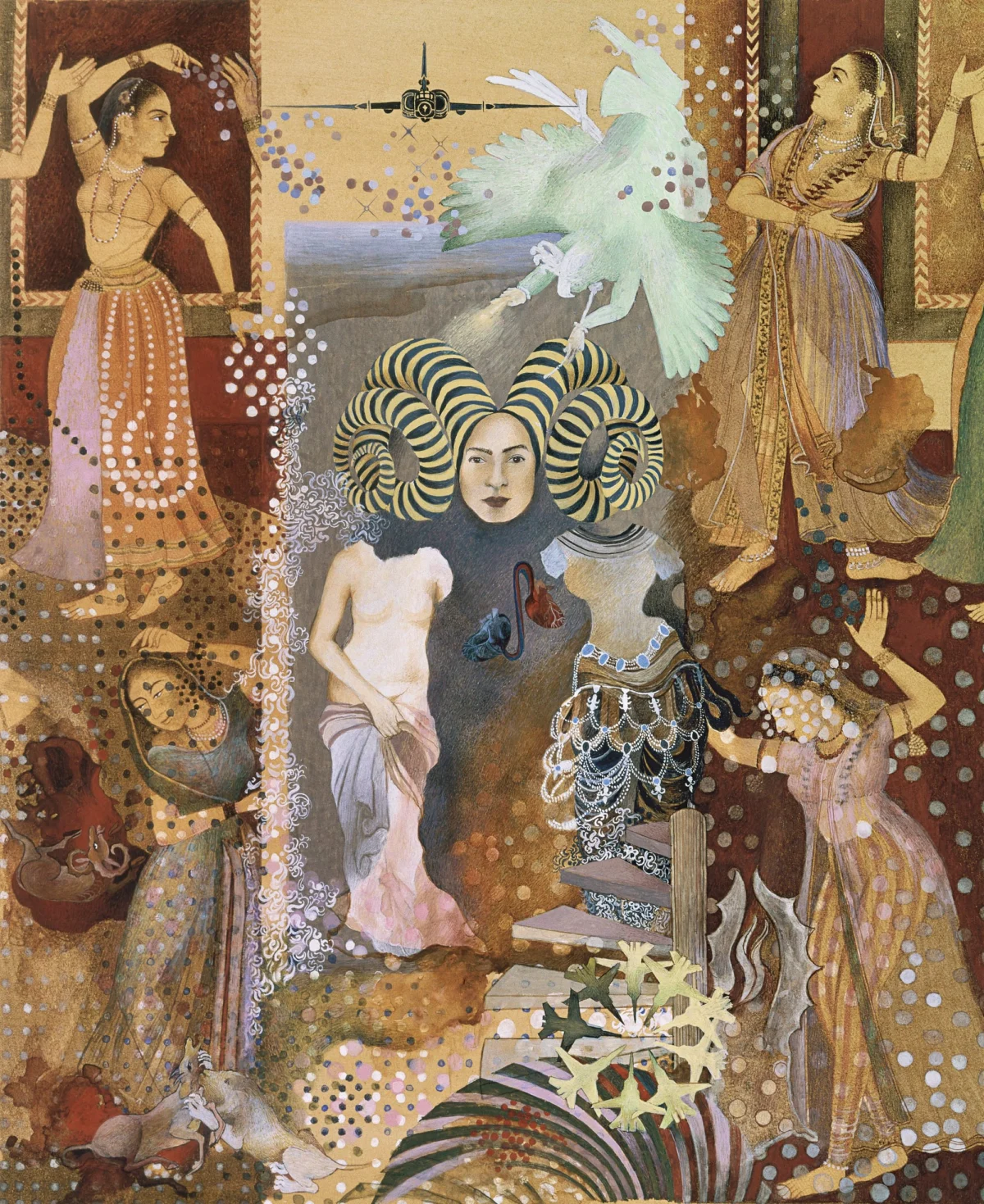
To counter this paternalistic construction—which falsely cast Muslim women as fragile victims waiting to be saved by Western imperialism—Sikander created her renowned 2001 work, Pleasure Pillars. The piece features a central head built out of feminist thought, sensuality, and historical pride, crowned with ram’s horns and floating above torsos inspired by Venus, Devata figures, and traditional Mughal and Rajput miniature dancers.
Sikander later integrated an image of a fighter jet into her visual vocabulary, symbolizing the violent collision of imperial power with ancient diasporic histories. Citing cultural theorist Gayatri Gopinath, Sikander emphasizes that the true counterweight to state violence is the endurance of shared, non-linear histories: "What endures, 25 years on, is what she calls ‘the promiscuous intimacies of our shared pasts and presents.’"
Conclusion: Twenty-Five Years Later
As the United States marks a quarter-century since the tragedies of September 11, the cultural legacy of the era remains heavily contested. The official monuments in Lower Manhattan stand as solemn memorials to the dead, yet the ideological monuments of the "War on Terror"—militarized borders, pervasive digital surveillance, and normalized xenophobia—continue to cast long shadows over global society.
Through the courageous and evocative work of artists like Wafaa Bilal, Shahzia Sikander, and countless others, cultural workers refuse to let the history of the past 25 years be sanitized by state propaganda. By holding up a mirror to the fractures of American empire, these creators ensure that the true human cost of the post-9/11 world is neither forgotten nor forgiven.
 Muslim
 Evan Lee Salim
 Jia Lissa
