

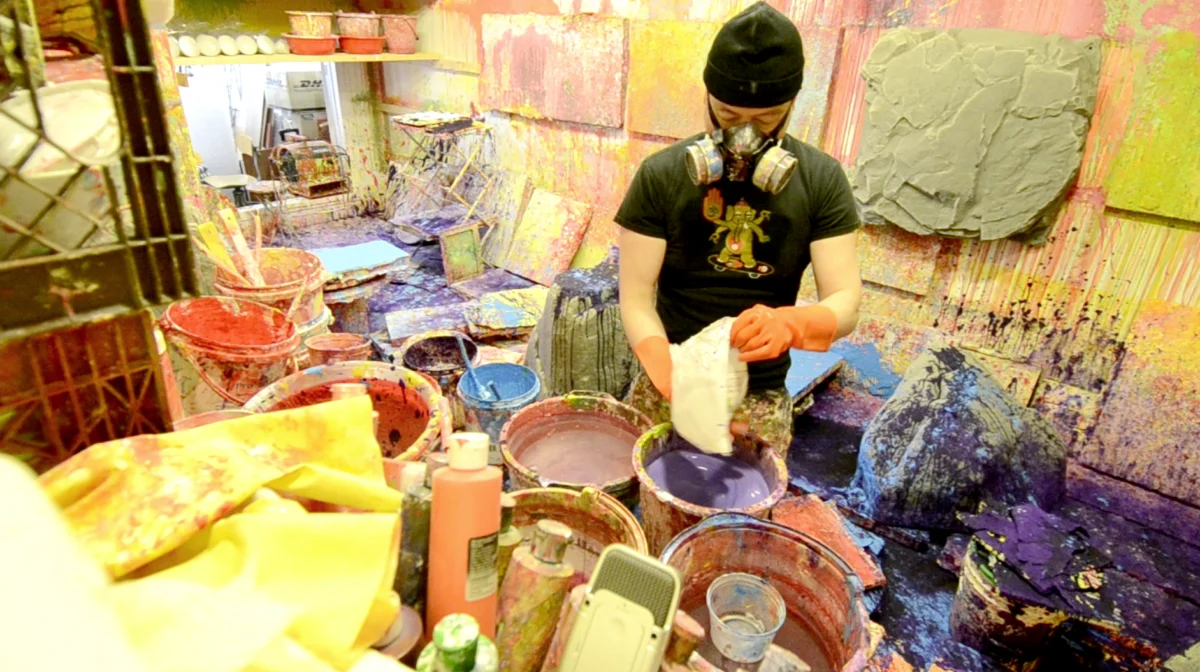
In the bustling, sensory-rich neighborhood of Jackson Heights, Queens, Richard Tsao has spent the better part of five decades cultivating a practice that defies easy categorization. As a cornerstone of the New York art world and a revered queer elder, Tsao’s journey from his native Bangkok to the epicenter of the international avant-garde is as layered and profound as the surfaces of his signature “Flood Room” paintings.
As part of Hyperallergic’s 2026 Pride Month series, this profile explores the intersections of identity, labor, and the fundamental human necessity of creative expression. For Tsao, art is not merely an aesthetic output; it is a vital, metabolic function—a “need for food.”
The Genesis of the "Flood Room"
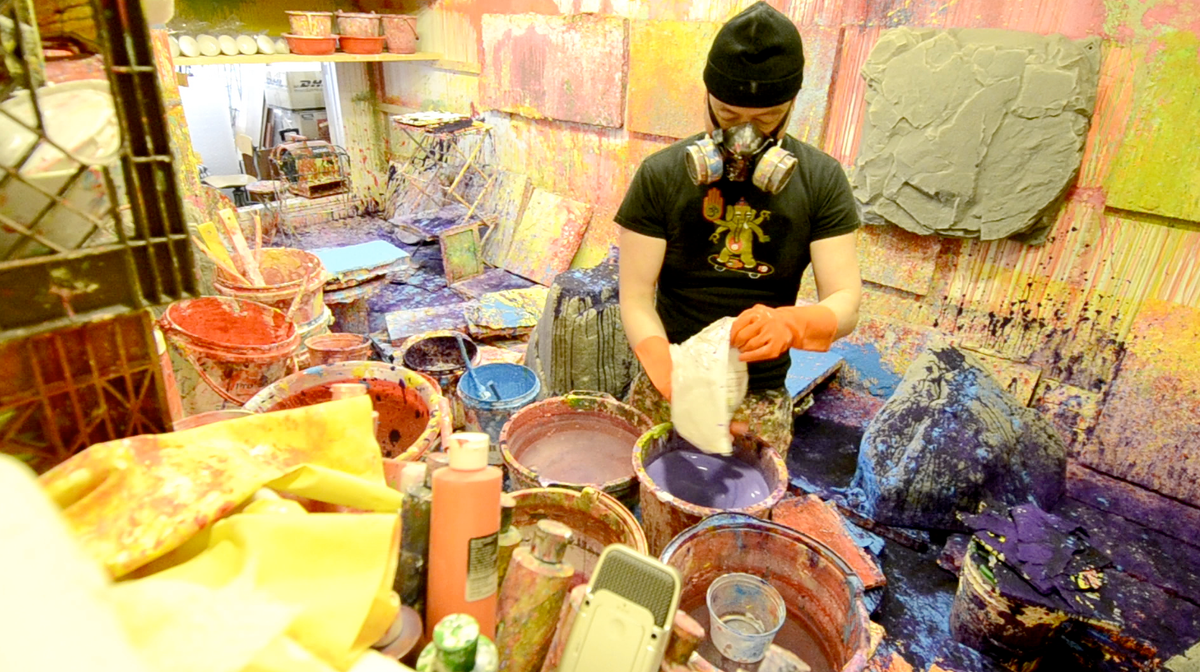
Tsao’s reputation rests primarily on his “Flood Room” series—a body of work defined by an obsessive, labor-intensive process. These are not paintings in the traditional sense of brush-to-canvas; they are geological events. By pouring, soaking, and layering pigments, water, and fine marble dust, Tsao creates surfaces that pulse with a rhythmic, alien vibrancy.
The process is inherently slow. A single work can gestate for years, a testament to Tsao’s philosophy of patience. To witness these works in person—as seen recently in his solo exhibition daydreamin’ at the Amelie A. Wallace Gallery or the group show How Asian Is It? at the Milton Resnick and Pat Passlof Foundation—is to experience a form of “psychedelic moon landing.” They possess a sculptural weight that renders digital reproduction nearly impossible; the depth of the pigment and the physical accumulation of material demand a physical presence that a camera lens simply cannot capture.
Chronology of a Creative Life
Tsao’s trajectory has been marked by a slow, deliberate unfolding of both self and craft.
- Early Years in Bangkok: Growing up in Thailand, Tsao was raised in a cultural environment that prioritized social harmony and subtlety over the Westernized concept of the performative “individual.” Identity, in his youth, was a private matter rather than a public proclamation.
- The Migration to New York: Arriving in New York City over 50 years ago, Tsao found himself at the intersection of a rapidly changing art scene and a burgeoning gay liberation movement. The city provided the space for him to exist as an artist and a queer man, though he describes his “coming out” as a gradual process rather than a singular event.
- The Development of the Hybrid Practice: Beyond the canvas, Tsao established himself as an accidental but accomplished designer. His studio in Jackson Heights is as much a textile laboratory as a painting atelier, where he produces luminous Thai silk garments—jackets, scarves, and coats that mirror the luminous quality of his paintings.
- The Present Transition: As Tsao prepares to depart New York City for Washington, DC, he enters a new chapter of his life, bringing with him the accumulated wisdom of a decades-long career that has successfully bridged the gap between fine art and artisanal craft.
The Intersection of Art, Identity, and Sanuk
When speaking with Tsao, the conversation inevitably drifts toward the philosophy behind his output. He often references the Thai concept of sanuk—a philosophy that emphasizes play, joy, and the necessity of finding pleasure in one’s daily labors.
“It’s like planting a seed in the garden,” Tsao explains, noting that his artistic practice is as essential to his survival as eating. This framing provides a vital insight into his identity as a queer elder. For many of his generation, the pressures of assimilation were immense. Tsao notes that while he was perhaps more cautious about declaring his sexuality in his youth, he found the prospect of declaring himself an “artist” to be equally daunting.
“The big question is always: how are you going to support yourself?” he reflects. This tension between the romantic calling of the artist and the practical reality of survival has remained a constant companion throughout his career. Yet, it is precisely this tension that has fueled the depth of his work. By viewing art as a form of sustenance, he removes the ego from the equation, treating the canvas as a site of nourishment rather than a platform for ego-driven performance.
Implications for Queer Artistic Legacy
The importance of documenting the lives of queer elders like Richard Tsao cannot be overstated. As the contemporary art world continues to grapple with questions of representation and the erasure of historical narratives, figures like Tsao serve as living archives.
His transition to Washington, DC, represents not just a personal relocation, but the movement of a significant creative energy. It highlights the often-unspoken reality of the “artist’s life” in New York: the inevitable cycles of gentrification, the aging of the bohemian class, and the resilience required to maintain a practice across half a century.
Furthermore, Tsao’s refusal to separate his painting from his textile work—or his art from his identity—challenges the siloed nature of the commercial art market. He operates in a space of confluence. His work is a reminder that the “queer experience” is not a monolith; it is defined by diverse cultural roots, varying speeds of assimilation, and a relentless commitment to the act of creation.
A Legacy of Luminous Surfaces
In the twilight of his New York era, Tsao remains a figure of quiet, profound intensity. His studio, filled with the scents of pigment and the texture of Thai silk, is a sanctuary of his own making. As he prepares to transition to a new city, he leaves behind a body of work that has influenced generations of painters and has provided a blueprint for what it means to lead an authentic, creative life.
His legacy is not merely in the objects he has produced, but in the endurance of his philosophy. To see a Tsao painting is to understand the value of slowness in a culture obsessed with immediacy. It is to recognize that beauty is a form of work, and that work, when performed with intention and sanuk, is the truest form of nourishment.
As the art world looks back on his contribution, it is clear that Richard Tsao has succeeded in doing what he set out to do: he has sustained himself through his art, and in doing so, he has sustained us all. His departure from New York marks the end of an era, but his influence—like the layers of pigment in his “Flood Room” paintings—will remain, deeply embedded in the cultural landscape of the city he helped define.
 Neng Nana
 Ali Ikhwan
 Basiran
