

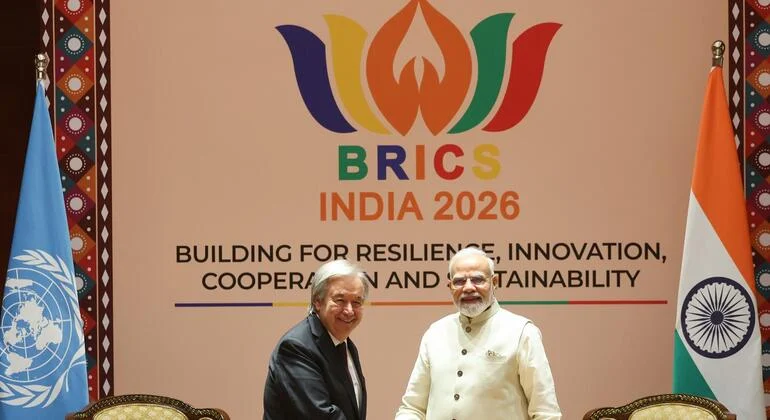
NEW DELHI — 13 September 2026 — In a landmark address that echoed through the halls of the New Delhi summit, United Nations Secretary-General António Guterres delivered a blunt assessment of the current geopolitical landscape: the institutions that have governed the world since 1945 are no longer fit for purpose. Speaking to the assembled leaders of the BRICS+ bloc—a growing coalition of major emerging economies—Guterres argued that the shift toward a multipolar world is an "irreversible" reality that demands a fundamental redesign of international financial, political, and security architecture.
The Winds of Change: A Shifting Global Order
For decades, the global order has been defined by the post-WWII framework, dominated by the UN Security Council and the Bretton Woods institutions. However, as BRICS (Brazil, Russia, India, China, South Africa, and their expanding list of partners) gathers in India, the narrative has shifted from Western-led hegemony to a more distributed model of influence.
Guterres did not mince words regarding the necessity of this transition. "Today’s economic, demographic, and geopolitical realities are not those of 1945," he told the summit. His presence at the event served as a tacit recognition of the group’s rising influence. By acknowledging that these nations embody the "changing reality," Guterres signaled that the United Nations is prepared to facilitate a transition toward a multipolar order—provided that such a transition is rooted in equity and institutional reform.
Chronology of an Evolving Block
To understand the weight of the Secretary-General’s message, one must look at the rapid evolution of the BRICS grouping:
- 2006: The group’s origins as a loose diplomatic dialogue between Brazil, Russia, India, and China.
- 2010: South Africa joins, cementing the BRICS acronym and signaling the inclusion of the African continent’s primary emerging market.
- 2020–2024: A period of rapid expansion and strategic ambition, focusing on de-dollarization initiatives and the establishment of the New Development Bank (NDB) as an alternative to traditional Western-backed lenders.
- 2026: The New Delhi Summit. The coalition has grown significantly in membership, bringing together nations that represent a massive share of the global population and GDP, forcing the international community to reckon with their demand for a seat at the "top table."
Supporting Data: Why the System is Strained
The urgency of the Secretary-General’s remarks is backed by data that highlights the widening gap between 1945 power dynamics and 2026 realities.
- Economic Shift: The combined GDP of the BRICS+ nations now rivals, and in many sectors surpasses, the G7. Yet, their voting power in the International Monetary Fund (IMF) and the World Bank remains disproportionately low compared to their current economic output.
- Demographic Weight: The nations represented at the New Delhi summit account for nearly half of the world’s population. Guterres argued that a system that excludes such a significant portion of humanity from permanent representation in the UN Security Council is inherently unstable.
- The Technological Divide: Artificial Intelligence is currently concentrated within a handful of companies and states, largely in the Global North. Guterres warned that without a global governance framework, the "AI divide" will exacerbate existing inequalities in income, opportunity, and sovereignty, effectively creating a new form of digital colonialism.
Official Responses and Strategic Pillars
Secretary-General Guterres framed his reform agenda around four "inclusive growth" pillars, which he urged the summit participants to champion.
1. Financial Architecture Reform
Guterres called for multilateral development banks to be "bigger, better, and bolder." He emphasized that developing nations require massive international support to meet the Sustainable Development Goals (SDGs), arguing that current debt-servicing requirements often prevent emerging economies from investing in their own citizens.
2. The AI Governance Challenge
"Its power sits with a few companies, in a few countries," Guterres noted. He warned that if left unchecked, the unregulated proliferation of AI will deepen global divides. He urged the BRICS+ leaders to advocate for a collaborative, ethical, and inclusive international regulatory framework for artificial intelligence.
3. Climate Justice and "Enough Plundering"
Perhaps the most visceral portion of his speech concerned the climate crisis. With a "supersized El Niño" looming, Guterres was scathing in his assessment of global inaction. He demanded that wealthy nations honor their financial pledges—specifically $300 billion annually—and criticized the predatory extraction of critical minerals from developing nations, stating firmly: "Enough plundering."
4. Peace and the UN Charter
Amidst the crises in Gaza, Sudan, and Ukraine, the Secretary-General reminded the leaders that the UN Charter is not a suggestion but a framework for collective survival. He called for a recommitment to "sovereign equality," territorial integrity, and the peaceful settlement of disputes, warning that if the multilateral system fails to deliver on these basic promises, the world risks descending into a period of prolonged, chaotic conflict.
Implications for the Future of Global Governance
The implications of Guterres’s call to action are profound. By aligning himself with the demand for reform, the Secretary-General is attempting to prevent the fragmentation of the global order. He fears that if the UN and the Bretton Woods institutions refuse to evolve, nations will simply abandon them in favor of parallel, exclusive, and competing blocs.
The Risk of Paralysis
The primary challenge, as noted by international analysts, remains the resistance from the current permanent members of the Security Council. Any reform to the UN’s most powerful body requires consensus from those who currently hold veto power—a hurdle that has historically stalled progress.
A Multipolar Future
Guterres’s stance suggests a pragmatic shift. He is no longer advocating for the preservation of the post-WWII status quo but is instead proposing a "managed transition." In this view, multipolarity is not a threat to the UN but a necessary condition for its continued relevance. By incorporating the interests of emerging economies, the UN could theoretically transition from a Cold War-era relic into a more robust, representative forum for global diplomacy.
Conclusion: A Shared Project
The Secretary-General closed the summit on a note of cautious optimism. He characterized the reform agenda not as a concession to the rising powers, but as a collective responsibility.
"As we move irreversibly to a multipolar world, all countries must work to strengthen and safeguard a multilateral system that delivers for all with the United Nations at its centre," he stated.
The message was clear: the world is changing, and the structures of power must change with it. Whether the global community can navigate this transition without succumbing to the pressures of nationalism and protectionism remains the defining challenge of the decade. For Guterres, the path forward is singular: reform, or face the obsolescence of the very system that has attempted to keep the peace for the last eighty years.
As the summit concluded, the focus shifted to whether the leaders in New Delhi would follow through on these high-level commitments or continue the cycle of rhetoric that has characterized much of the last decade’s global summits. The urgency, however, is undeniable—as are the consequences of failing to act.
 Lina Hope
 Asro
Asro
 Layla Zulfa
