

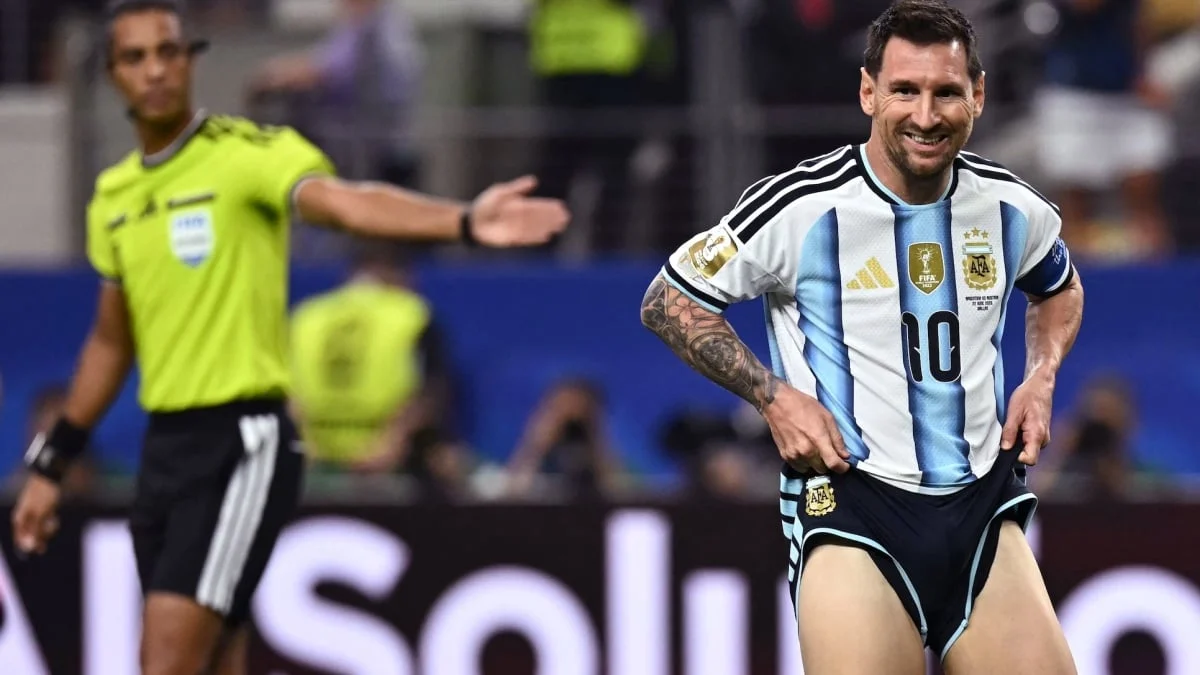
In the twilight of a career that has already redefined the parameters of professional football, Lionel Messi has achieved the improbable. Just days before his 39th birthday, the Argentine icon delivered what may well be the definitive performance of his career, officially becoming the highest goalscorer in the history of the FIFA World Cup.
In a high-stakes clash against Austria, Messi did not merely break the record—he obliterated it. Entering the match tied at 16 goals, he needed only a single strike to surpass the long-standing record held by Germany’s Miroslav Klose. Not content with a marginal victory, Messi produced a clinical brace, netting his second goal in the dying embers of stoppage time to bring his total to 18. This latest feat serves as a poignant reminder that while age may be a number, for Messi, it is merely a backdrop for greatness.
Chronology of a Historic Night
The atmosphere in the stadium was electric from the opening whistle, with anticipation palpable among the thousands of fans who had traveled to witness history. For the first 45 minutes, the match remained a tactical stalemate, with the Austrian defense deploying a disciplined, low-block formation designed specifically to neutralize the Argentine captain.
However, the deadlock was broken in the second half. As the match progressed, the fatigue of the Austrian side became apparent, and Messi began to exploit the pockets of space between the midfield and defensive lines. His first goal, a trademark curling effort from the edge of the penalty area, signaled the official transition of the record into his hands.
The drama, however, was not without its complications. Midway through the second half, Messi was presented with a golden opportunity to extend his lead from the penalty spot. In a moment that stunned the crowd, he missed—marking the third separate World Cup in which he has failed to convert a penalty. While critics might have viewed this as a lapse in form, the broader footballing community interpreted it as a testament to the immense psychological burden of the record. Social media was flooded with theories that the maestro, ever the purist, preferred to claim his throne through open play rather than a set-piece.
The narrative arc reached its crescendo in the final seconds of added-on time. With the Austrian defense scrambled, a lightning-fast counterattack found Messi in the box. He slotted the ball home with the precision of a surgeon, cementing his 18th goal and triggering a global celebration.
Supporting Data: The Statistical Weight of the GOAT
To understand the magnitude of this achievement, one must look at the historical context of the World Cup goalscoring charts. For years, the record stood as a monolith, held by Germany’s Miroslav Klose at 17 goals, a mark he reached during the 2014 tournament. The fact that this record held firm for over a decade underscores the difficulty of consistency at the highest level of international football.
Messi’s 18 goals represent more than just raw output; they represent a sustained period of dominance across five World Cup cycles. Below is the current landscape of the all-time leaderboard:
- Lionel Messi (Argentina): 18 Goals
- Miroslav Klose (Germany): 17 Goals
- Ronaldo Nazário (Brazil): 15 Goals
- Gerd Müller (Germany): 14 Goals
- Kylian Mbappé (France): 14 Goals
Beyond the raw goal count, Messi’s stature—standing at 5 feet 7 inches—continues to be a focal point of his narrative. He remains the antithesis of the modern, physically imposing athlete, relying instead on a low center of gravity, extraordinary vision, and a technical proficiency that has remained largely unchanged since his debut in the mid-2000s.
Digital Recognition: The Google Effect
The impact of the record-breaking night was not confined to the pitch. As the final whistle blew, Google, the world’s most used search engine, marked the occasion with a spontaneous digital celebration. Fans searching for "Messi" were met with a virtual shower of blue-and-white confetti, a testament to the crossover appeal of the Argentine striker.
This digital tribute sparked a viral wave of user-generated content. From memes highlighting his signature goal-scoring posture—a pose he has replicated with uncanny consistency across his club career—to humorous observations regarding the sartorial frustration of the opposing Austrian squad, the internet was, for one night, entirely under the spell of "La Pulga."
Official Responses and the "Respect" Narrative
The reaction from the global football fraternity has been one of universal acclaim. Perhaps most telling is the humility shown by his closest challenger, France’s Kylian Mbappé. Currently sitting at 14 goals, Mbappé is arguably the only active player with a legitimate path to eclipsing Messi’s record in the future.
Despite their rivalry, Mbappé has consistently maintained a stance of profound respect. In recent media appearances, the French star openly referred to Messi as the superior player, reinforcing the "mentor-protégé" dynamic that has defined their interactions on the pitch. This camaraderie speaks to the unifying power of the sport, where even the most intense competitors acknowledge that they are witnessing a once-in-a-generation talent.
Implications for the Future of the Sport
As the dust settles on this historic achievement, the conversation naturally shifts to the legacy Messi leaves behind. With his 39th birthday approaching, questions regarding his retirement are becoming more frequent. Yet, his performance against Austria suggests that he still possesses the tactical intelligence and technical skill to dominate at the international level.
The emergence of younger talents like Mbappé creates an intriguing future narrative. If the World Cup concludes with an Argentina vs. France final, the match would be more than just a championship—it would be a passing of the torch. For now, however, the throne belongs to the man from Rosario.
The Tactical Legacy
Messi’s evolution from a lightning-fast winger into a playmaking deep-lying forward has been the key to his longevity. By adapting his game to rely on intelligence over pure pace, he has managed to remain relevant in a sport that increasingly prioritizes physicality. Analysts have noted that his movement off the ball, which often goes unnoticed by the casual viewer, is what allowed him to secure his 18th goal. He does not chase the game; the game, inevitably, comes to him.
Looking Toward the Final
As the tournament progresses, all eyes remain fixed on Messi. Whether he adds to his tally or not, his place in the pantheon of sporting legends is secure. He has provided a generation of fans with moments of joy that defy logic, and this latest milestone serves as the crowning jewel in a collection of achievements that may never be surpassed.
In the end, it was perhaps best summarized by the fans in the stadium, some of whom noted that they had been waiting for a performance of this caliber for nearly a century. Whether or not one chooses to label him the "Greatest of All Time" (GOAT), the numbers provide an objective argument that is difficult to dispute. Lionel Messi has not only conquered the record books; he has elevated the World Cup to a new level of prestige.
As we look toward the remainder of the tournament, the only certainty is that the world will continue to watch. Whether it is the digital confetti on a Google search or the roar of the crowd, the message is clear: we are living in the era of Messi, and it is a privilege that few will ever forget.
 Suro Senen
 Nana Wu
 Neng Nana
