

By Chase DiBenedetto
June 9, 2026
New York City has been gripped by a palpable, electric fervor—a phenomenon residents are calling "orange and blue fever." For the first time in 27 years, the New York Knicks have fought their way to the NBA Finals, transforming the city into a sprawling carnival of optimism. From corner stores selling custom airbrushed merchandise to exuberant celebrations in the subway and atop taxis, the city’s pulse is dictated by the team’s championship run.
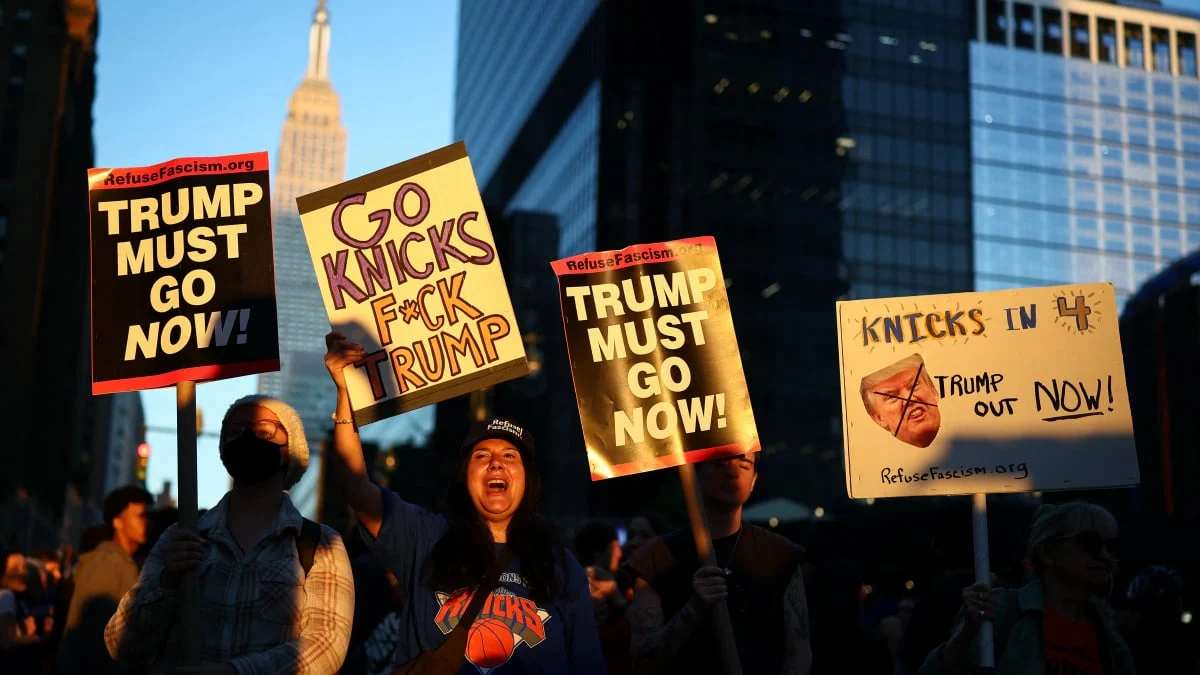
However, the high-octane excitement of the Finals reached a jarring, politically charged intersection on June 9, 2026, when President Donald Trump arrived at Madison Square Garden (MSG) for Game 3 of the series against the San Antonio Spurs. What was intended to be a historic moment for the office of the presidency instead devolved into a chaotic spectacle, characterized by widespread public disdain, logistical disruption, and an internet-fueled narrative surrounding a "presidential curse."
The Build-Up: A City on Edge
The tension began shortly after the Knicks secured a pivotal win in Game 2, when the White House announced that the President would be in attendance for Game 3. The announcement was met with immediate, visceral pushback. For many New Yorkers, the presence of an unpopular administration at a beloved local institution felt like an unwelcome intrusion into a hard-won celebratory moment.
Social media platforms, particularly TikTok and X (formerly Twitter), became hubs for this collective anxiety. Users began to openly speculate that the President’s arrival would bring bad luck—a "curse" that would derail the Knicks’ momentum. This wasn’t merely idle chatter; it was a rallying cry. One viral TikTok tutorial, which garnered millions of views, provided viewers with a step-by-step guide on how to "properly boo" the President, framing the act as a necessary spiritual defense against the "curse" looming over the Garden.
Chronology of a Controversial Night
The disruption began hours before tip-off. To facilitate the President’s arrival, the U.S. Secret Service implemented an unprecedented security perimeter. Sidewalks surrounding the iconic venue were barricaded, and a highly anticipated public watch party, slated to take place just outside MSG, was abruptly cancelled by authorities citing security concerns.
The city’s leadership responded with defiance. Mayor Zohran Mamdani, who was among those present inside the arena, took steps to ensure the public could still gather, coordinating an alternative watch party at Bryant Park. As the evening progressed, the city’s mood shifted from festive anticipation to targeted, unified protest.
When the national anthem concluded and the stadium cameras panned to the President’s private box, the response was immediate and deafening. A wave of booing, so intense it was audible on the broadcast, swept through the arena. The dissent was not confined to the Garden; attendees at the Bryant Park watch party echoed the sentiment, creating a surreal, city-wide chorus of disapproval that reverberated across Manhattan.
Despite the intensity of the atmosphere, the game itself proved to be a grueling affair. In a nail-biting contest that saw the Spurs capitalize on the Knicks’ fragmented focus, the visitors emerged victorious, effectively deepening the narrative among fans that the President’s presence had indeed served as a catalyst for the team’s downfall.
Supporting Data: The Digital Reaction
The online reaction served as a real-time barometer of public sentiment. Analysis of social media engagement during the game showed that the term "Trump Curse" trended globally. While the President’s supporters attempted to frame his attendance as a gesture of unity, the sheer volume of negative mentions—coupled with the viral success of "how-to" videos on protesting his presence—indicated a profound disconnect between the administration and the electorate.

The cancellation of the watch party served as a major point of contention. Local business owners, who had expected a significant economic boost from the crowds, expressed frustration over the security-driven closures. Data from local transit authorities also noted that the altered traffic patterns and heavy police presence created a logistical gridlock that impacted thousands of New Yorkers, further souring the public mood regarding the visit.
Official Responses and Political Implications
In the immediate aftermath, the President’s response to the reception was markedly detached from the reality observed by those in the arena. Speaking to reporters on the tarmac at Joint Base Andrews after returning from New York, President Trump offered an interpretation of the night that stood in stark contrast to the footage captured by news outlets.
"I mean, I thought it was amazing, actually," Trump remarked, addressing the hostile crowd reaction. "You mean when they had the camera on me? I thought it was very good. Yeah. It was certainly amazing. It was, I think, mostly cheers. It was loud and it was very enthusiastic."
When asked about his history of criticizing the NBA, the President maintained his position, stating, "It tends to be a little left wing, but it’s great entertainment. It’s great."
The comments highlight a growing ideological chasm. The President’s attempt to reframe the audible booing as "enthusiastic cheers" suggests a strategy of deflection, common in his political communication style, yet one that seems increasingly difficult to reconcile with the visceral evidence provided by modern broadcast technology.
The Broader Implications for Sports and Politics
The incident at Madison Square Garden serves as a potent case study for the modern entanglement of sports and national politics. For decades, the arena was viewed as a sanctuary from the complexities of the political world. However, as cultural polarization deepens, the ability of high-profile political figures to attend public sporting events without sparking protest is diminishing.
1. The Erosion of Neutral Ground
The "Garden event" signifies that there is no longer a "neutral" space in American public life. When a sitting president enters a space defined by local identity and community, that entry is now viewed as an act of political theater rather than a gesture of civic solidarity.
2. The Power of Digital Coordination
The success of the protest was driven by decentralized, digital organization. The ability of New Yorkers to coordinate their dissent—from the viral TikTok tutorials to the simultaneous booing across different physical locations like MSG and Bryant Park—demonstrates how social media has fundamentally changed the nature of public protest.
3. The Future of Presidential Appearances
The logistical failure of the event, specifically the cancellation of the watch party and the massive security disruption, raises questions about the feasibility of future high-profile visits to densely populated urban centers. If the cost of such visits includes the disruption of local economic activity and widespread public hostility, the administration may be forced to rethink its strategy for public engagement.
Conclusion
The night at Madison Square Garden will be remembered not for the tactical brilliance of the Spurs or the desperation of the Knicks, but as a moment where the simmering tensions of the American political landscape boiled over into the mainstream of sports culture. Whether or not one believes in the "curse" of the President’s presence, the reality of the night was clear: the city of New York made its voice heard, and the President, in his own words, was left to interpret a chorus of disapproval as an ovation. As the Finals progress, the city remains on edge, caught between the hope of a championship and the inescapable, often turbulent, realities of the national political climate.
 Neng Nana
 Reynand Wu
 Dwi Wanna
