

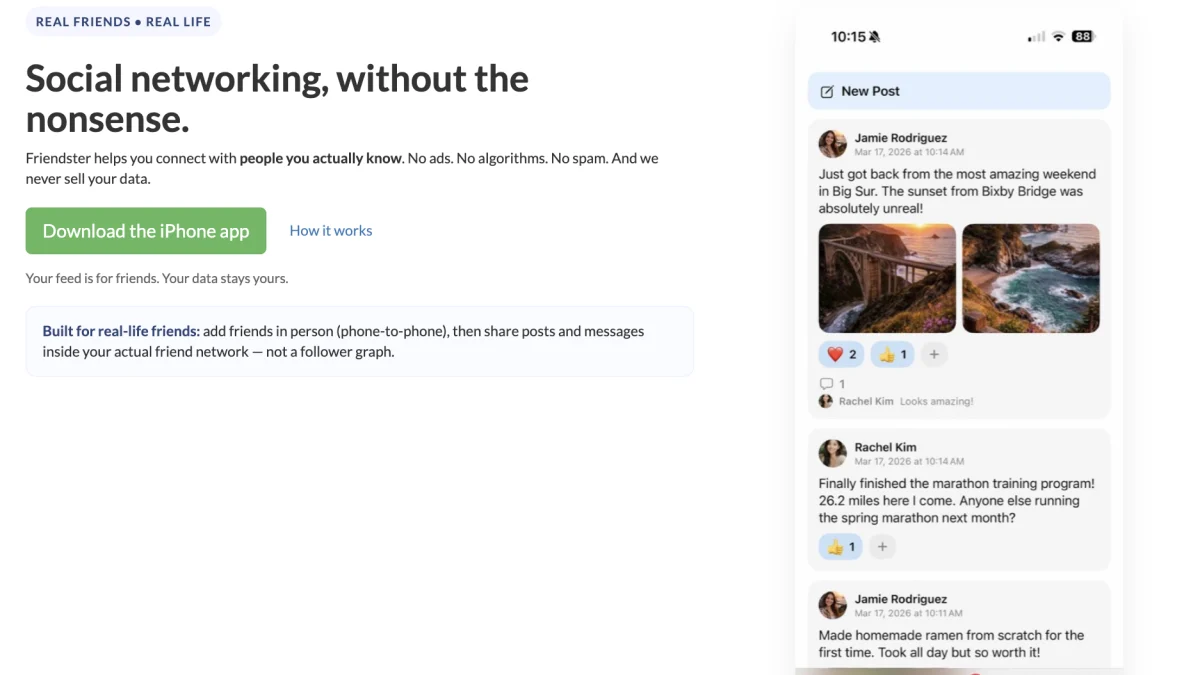
For a generation that came of age during the dawn of the internet, the name "Friendster" carries a specific, nostalgic weight. It was the primordial soup of social networking—a digital town square that predated the ubiquity of MySpace, Facebook, and the endless scroll of modern algorithmic feeds. Now, nearly a quarter-century after its initial launch, the brand has been exhumed. But in a twist that feels both ironic and radically contrarian, the new Friendster is designed specifically to do as little as possible.
Under the stewardship of new owner Mike Carson, the platform has returned not as a nostalgic clone, but as a digital experiment in radical proximity. In an era defined by influencers, targeted advertisements, and AI-driven engagement loops, the new Friendster arrives with a stark mandate: users can only connect with people they have met in real life. It is an app that promises nothing, offers no suggestions, and—most shockingly—has absolutely no content until you create it with someone standing right in front of you.
The Chronology of a Digital Pioneer
To understand the audacity of the current project, one must look at the meteoric rise and complicated fall of the original platform. Launched in March 2002 by Jonathan Abrams, Friendster was the first true juggernaut of the social networking era. It introduced the world to the concept of the "social graph"—the idea that our digital identities could be mapped through our real-world associations.
By 2003, the platform had millions of users, but it was plagued by severe technical infrastructure issues. As the site grew, page-load times became agonizingly slow, frustrating a user base that was still transitioning from dial-up to broadband. This bottleneck provided the opening for MySpace, which offered a more customizable, high-energy environment. As MySpace captured the cultural zeitgeist, Friendster’s influence in the United States waned.
The company found a second life in Southeast Asia, where it maintained a loyal user base for several years. However, the pivot to social gaming in 2011 signaled the end of its relevance as a networking site. By 2015, the servers were shuttered, and the once-mighty domain fell into the hands of auctioneers and domain speculators. For years, Friendster.com existed only as a digital ghost town, often redirected to sites laden with intrusive pop-up ads and malicious links.
The Acquisition: From $7,000 Auction to a New Vision
The current iteration of Friendster was born from an opportunistic discovery. In 2023, Mike Carson, a tech entrepreneur, noticed that the venerable domain was being used as a landing page for questionable advertising. Curious, he reached out to the owner, who had acquired the domain at an expired auction for just $7,456.
The ensuing transaction is a testament to the strange valuation of internet history. Carson secured the domain for a package deal: $20,000 in Bitcoin and the trade of another domain he owned that generated approximately $9,000 in annual revenue. With the domain in his possession, Carson faced a choice: attempt to recreate the 2002 version of the site or build something entirely new. He chose the latter, opting to build an iOS app that functions as an "anti-social" social network.
The Architecture of Proximity: How It Works
The new Friendster is perhaps the most minimalist app currently available on the Apple App Store. Upon downloading the application and completing the onboarding process, users are met with a void. There is no news feed. There are no "people you may know" suggestions. There are no trending topics.
The core feature—and the primary barrier to entry—is the "Physical Tap" requirement. To add a contact on the new Friendster, two users must have their apps open and physically tap their phones together. This hardware-level requirement acts as a digital handshake, ensuring that every connection on the platform is rooted in a verified, in-person encounter.
For the modern user, accustomed to the frictionless addition of thousands of "friends" and "followers" whom they have never met, this is a jarring design choice. It effectively turns the social network into a private utility for one’s closest inner circle.
Official Responses and Strategic Roadmap
Mike Carson has been vocal about his desire to break the current social media paradigm. In various blog posts and interviews, he has framed the project as a rejection of the "attention economy." By removing ads and algorithms, he aims to create a space that doesn’t demand constant engagement.
"The goal is not to keep you scrolling," Carson has noted. "The goal is to provide a digital map of your actual social life."
However, Carson is not strictly opposed to growth. He has outlined a roadmap that includes a "Friends of Friends" feature. This would allow users to connect online with individuals they have not met in person, provided that both parties share a common connection who has verified the relationship through a physical tap. This creates a "trust network" that limits the spam and bot-driven interactions that plague platforms like X (formerly Twitter) and Instagram.
Furthermore, Carson is developing a "Fading Connection" feature. This tool will serve as a gentle nudge to users when they have not physically crossed paths with a contact for more than a year. The intent, according to Carson, is to gamify the maintenance of real-world relationships. "It’s not a punishment," he explains. "It’s a reminder that real friendships are kept alive in person, not online."
Implications: Can an "Anti-Social" Network Survive?
The success of the new Friendster hinges on a difficult question: Do users actually want a social network that doesn’t provide them with anything to look at?
Modern social media platforms are built on "infinite scroll" architectures designed to maximize time-on-site. By removing content, Friendster is inherently limiting its ability to retain users. If a user opens the app and sees nothing, the impulse is to close it. The platform essentially requires the user to do the heavy lifting of curating their own social circle before the app provides any utility.
This creates a "chicken-and-egg" problem. Without a critical mass of users, the app feels empty; without a compelling reason to stay, the app struggles to achieve critical mass. However, there is a growing counter-movement in Silicon Valley that advocates for "digital minimalism." Apps like BeReal and various niche, invite-only social clubs have shown that there is an appetite for platforms that prioritize authenticity over vanity metrics.
If Friendster succeeds, it will be because it successfully markets itself as a private, high-trust environment. In a world where data privacy is increasingly under fire and algorithmic polarization is at an all-time high, a platform that forces users to be physically present with their friends might be the ultimate luxury.
The Future of Digital Connection
Ultimately, the revival of Friendster is a bold, if risky, bet on human behavior. It attempts to reverse the trajectory of the last two decades, which saw social networks transform from tools of connection into tools of mass broadcast and content consumption.
Whether the app becomes a staple of our digital diets or remains a boutique experiment for those seeking to escape the noise, it has already achieved one thing: it has forced a conversation about what "social" really means. As we move deeper into an era of generative AI and synthetic content, the value of a verified, in-person human connection is rising. Friendster, in its latest form, is betting that the most valuable digital network of the future will be the one that is hardest to join.
For now, the app remains a blank canvas—a quiet corner of the internet waiting for its users to step away from their screens and, ironically, find each other.
 Nana Wu
 Neng Nana
 Reynand Wu
