

By Chase DiBenedetto | June 9, 2026
The atmosphere in New York City over the past week has been nothing short of electric. For the first time in 27 years, the New York Knicks have fought their way into the NBA Finals, transforming the five boroughs into a sprawling carnival of orange and blue. From subway cars turned into impromptu dance floors to fans scaling taxis in Midtown, the city has been gripped by a fever that only a championship drought spanning nearly three decades can produce.
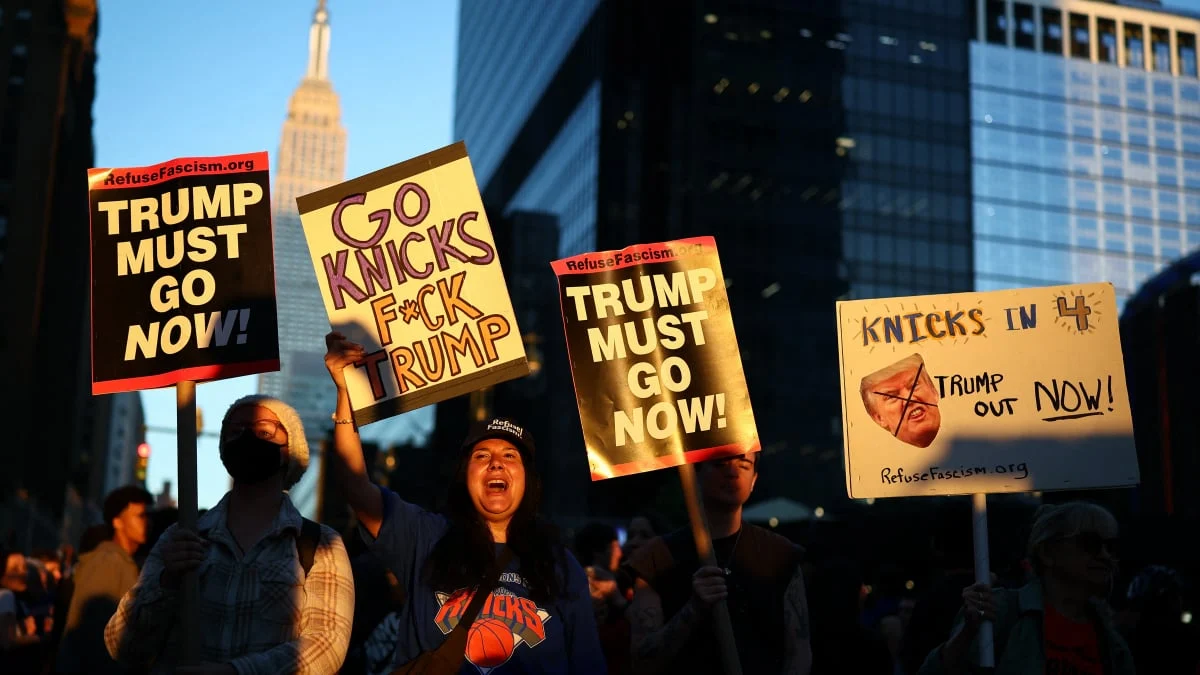
However, that fever met a sudden, icy encounter on the night of Game 3. In a move that bridged the worlds of high-stakes politics and professional sports, President Donald Trump made an unprecedented appearance at Madison Square Garden. What was intended to be a historic presidential outing quickly spiraled into a flashpoint of public dissent, superstitions about sports "curses," and a stark reminder of the deep-seated polarization currently defining American life.
The Backdrop: A City on Edge
The return of the Knicks to the NBA Finals has been the primary narrative of the New York summer. Local commerce has shifted to accommodate the obsession, with corner stores selling out of custom airbrushed merchandise and neighborhoods organizing watch parties that rival the intensity of the games themselves.
The excitement, however, was tempered by news that the President would attend Game 3. While sitting presidents have attended various sporting events throughout history, this was the first instance of a sitting commander-in-chief attending an NBA Finals game. The announcement triggered an immediate, visceral reaction from the local populace. For many New Yorkers, the presence of the President—a figure whose political brand has often stood in opposition to the cultural values of the league’s players and its urban fanbase—was viewed as an intrusion into a sacred local space.
A Chronology of the Confrontation
The tension began long before the tip-off. As the Secret Service established a massive security perimeter around Madison Square Garden, the logistical ripple effects were immediate. A planned public watch party outside the arena was abruptly canceled, forcing fans to scramble for alternatives. Manhattan’s Bryant Park became the primary hub for displaced supporters, with Mayor Zohran Mamdani organizing a last-minute viewing event that served as a rallying point for those who felt excluded from the Garden.
Pre-Game Preparation
Online, the mood was anticipatory and defiant. Social media platforms, particularly TikTok, became staging grounds for what some users jokingly—but passionately—called a "warding off" of the presidential curse. Viral tutorials on how to properly boo, organized with the precision of a protest movement, circulated widely. Users framed the President’s arrival as a "curse" that would inevitably doom the Knicks to a loss against the San Antonio Spurs.
The Arrival and the Chorus
As the national anthem concluded and the camera feed cut to the presidential suite, the arena erupted. It was not the sound of a cheering crowd, but a wall of boos that ricocheted through the rafters. The intensity was palpable, even echoing from the crowds gathered at the Bryant Park watch party. For the duration of the game, the President’s presence hung over the proceedings, turning a sporting event into a referendum on his public standing.
The Game’s Conclusion
Despite the vocal opposition from the crowd, the game itself remained a tight, high-intensity affair. Ultimately, the Knicks fell to the Spurs in a narrow defeat. For the superstitious, the result confirmed their worst fears: the presence of the "unfavorable leader" had indeed acted as a hex, shattering the team’s momentum during the most critical juncture of the series.
Supporting Data and Political Context
The animosity between the President and the NBA is not a new development. Throughout his tenure, the President has frequently criticized the league, characterizing its player-led social justice initiatives as "too left-wing." This rhetoric has created a distinct rift between the administration and the league’s primary demographics.
Data suggests that the President’s approval ratings, particularly in urban centers like New York City, remain significantly polarized. The events at the Garden acted as a microcosm of this national divide. While the President’s supporters often view his attendance at major cultural events as a show of strength and normalcy, critics see these appearances as calculated provocations designed to dominate the news cycle.

The "Curse" Phenomenon
In the world of sports, the concept of a "curse" is often a coping mechanism for fanbases facing high-pressure losses. However, in this instance, the "curse" served a dual purpose: it provided a framework for sports fans to express political disapproval without having to articulate complex policy grievances. By framing the President as a "curse," fans effectively dehumanized his political influence, turning him into a bad-luck charm that needed to be "warded off" through collective noise.
Official Responses and Post-Game Fallout
Following the conclusion of the game, the President addressed the reception he received. Speaking to reporters on the tarmac near Air Force One, his assessment of the evening stood in stark contrast to the footage captured by spectators and news outlets.
"I mean, I thought it was amazing, actually," the President stated. "You mean when they had the camera on me? I thought it was very good. Yeah. It was certainly amazing. It was, I think, mostly cheers. It was loud and it was very enthusiastic."
He doubled down on his critique of the league, adding, "It tends to be a little left wing, but it’s great entertainment. It’s great."
This dissonance—between the visible reality of a hostile crowd and the President’s interpretation of "enthusiastic" cheers—is emblematic of the current political landscape. It highlights a recurring pattern where political figures project their own desired narratives onto public interactions, regardless of the objective reality of the situation.
Implications: The Intersection of Sports and Policy
The events of June 9, 2026, raise significant questions about the future of public figures at sporting events. Madison Square Garden, a venue known for its boisterous and unapologetic fanbase, provided a unique environment where the President could not use the standard tools of political theater—such as controlled rallies or friendly press pools—to dictate the tone of the room.
1. The Erosion of "Neutral" Ground
Traditionally, professional sports have been viewed as one of the few remaining "neutral" spaces in American culture. The incident at the Garden suggests that this neutrality is rapidly eroding. As sports continue to become platforms for social and political dialogue, the ability for political figures to attend these events without facing direct confrontation is likely to diminish.
2. The Power of Viral Organizing
The coordination of the boos through TikTok and other social media platforms underscores the shift in how protest is organized. The "tutorial on how to boo" represents a new form of digital activism, where the barrier to entry for protest is lowered, allowing thousands of fans to synchronize their dissent in real-time.
3. The Future of Presidential Appearances
Moving forward, the Secret Service and political campaigns will have to contend with the reality that public appearances are no longer guaranteed to be photo opportunities. The risk of being drowned out by a hostile crowd is a factor that may influence the decision-making process for future presidential outings, potentially leading to a retreat into more controlled, closed-door environments.
Conclusion
The Knicks’ loss in Game 3 will be analyzed by basketball analysts for its tactical failures and missed shots. However, for the broader public, the game will be remembered for the moment the NBA Finals became the stage for a national debate. Whether or not the President’s presence truly "cursed" the Knicks is a matter of fan superstition, but the event itself proved that in today’s climate, there is no longer such a thing as a quiet seat in the house. As New York continues to rally around its team, the shadow of that night at the Garden remains a testament to the volatility of our shared cultural spaces.
 Suro Senen
 Nana Wu
 Neng Nana
