

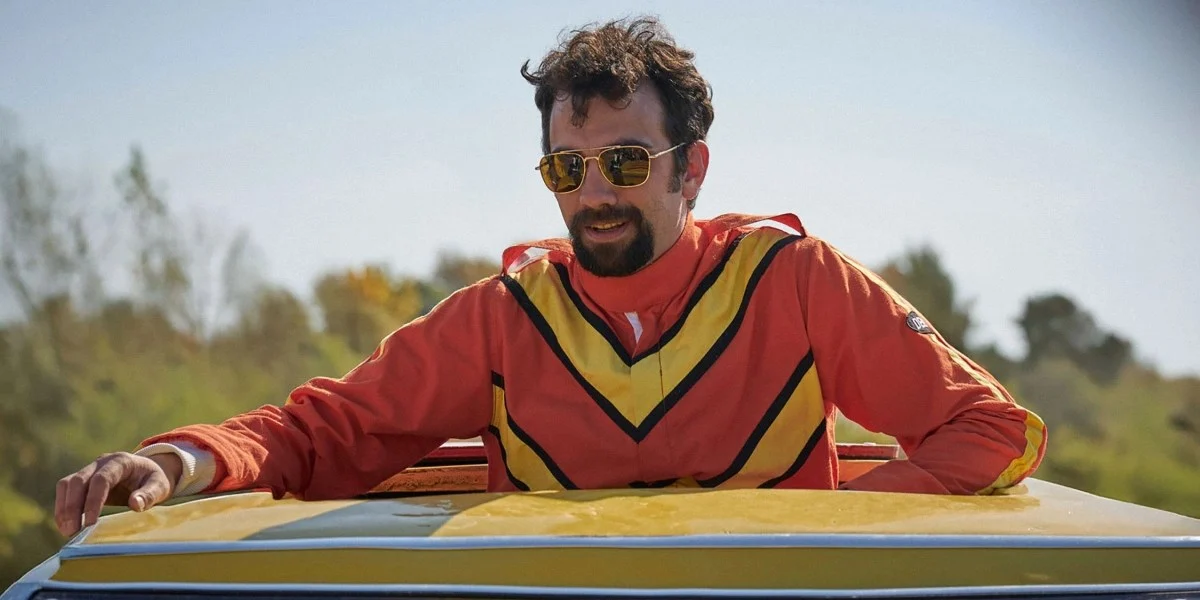
“Ken Carter jumps cars for a living, and people like to see him do it.” These words, delivered with the dry, gravelly gravitas of narrator Gordon Pinsent in the 1981 National Film Board of Canada documentary The Devil at Your Heels, serve as the opening salvo of a legend. The footage that follows is jarring: a man being hauled away in an ambulance, his ankle shattered, the remnants of a ’64 Chevy strewn across a landing zone. It is a snapshot of the bargain Ken Carter struck with destiny—a life traded for a moment of suspension in the air, a quest for cultural immortality fueled by nothing more than raw gasoline and an utter refusal to settle for the mundane.
In The Stunt Driver, filmmaker Michael Dowse—known for his deep, affectionate dives into the eccentricities of Canadian regional culture with hits like FUBAR and Goon—has turned his lens toward this quintessentially Canadian tragedy. The film, which premiered at the 2026 Toronto International Film Festival, is not merely a biopic; it is a profound examination of the masculine psyche, the performative nature of courage, and the high price of obsession.
A Chronicle of Audacity: The Saint Lawrence Project
At the heart of the narrative is Carter’s singular, nearly decade-long obsession: to launch a rocket-powered vehicle across the mile-wide Saint Lawrence River. The endeavor, which bridged the borders of Canada and the United States, was supposed to be the ultimate spectacle. However, as the 1981 documentary chronicled—and as Dowse recreates with painstaking, often agonizing detail—the path to the jump was paved with technical catastrophes, fickle weather, and a series of financial sinkholes that threatened to swallow the project whole.
The production of The Stunt Driver functions as a meta-commentary on the original documentary. Dowse masterfully cannibalizes Robert Fortier’s source material, recreating iconic scenes—such as the image of a paunchy, middle-aged Carter struggling to squeeze into a flight suit—with a blend of humor and reverence. By utilizing the original dialogue, Dowse bridges the gap between the myth and the man, grounding the absurdity of the situation in the very real, very human anxiety of the protagonist.
Chronology of a Crisis: From Radio Booth to Ramp
The structure of the film is as precarious as the stunt itself. Dowse chooses to open the narrative not on the track, but in a Montreal radio booth, where a hypnotist attempts to peel back the layers of Carter’s bravado. This frame narrative allows Jay Baruchel, who delivers a career-best performance as Carter, to showcase the duality of the man: the public showman who speaks in slogans and the private, terrified human being who cannot swim.
The film meticulously tracks the progression of the stunt’s development:

- Phase I: The Vision. Carter recruits engineer Dick Keller (played with grounded warmth by Ed Helms), a man tasked with building a rocket car capable of a feat that defied physics.
- Phase II: The Sale. The arrival of promoter Bill Wilkins (Dan Bakkedahl), a character loosely based on sports agent Edward Keating, who attempts to package the potential death of a man for a mass-market audience, specifically aiming for ABC’s Wide World of Sports.
- Phase III: The Erosion. As the years drag on and the budget evaporates, the dream shifts. The vision of a televised, live-audience spectacular is traded for a deal with Japanese investors, signaling the dehumanization of the stunt.
- Phase IV: The Rivalry. The film introduces a fictionalized, almost pantomime-style rivalry with Evel Knievel (Ben Foster). By giving Knievel a cartoonish Canadian accent, Dowse highlights the absurdity of the "stuntman" archetype, turning provincial pride into a source of desperate, dark comedy.
Supporting Data: The Anatomy of a Stuntman
While The Stunt Driver is rich in period detail, its true strength lies in its character studies. The film’s supporting cast serves as the moral compass for a man who has lost his way.
The relationship between Carter and his engineer, Dick Keller, serves as the emotional core of the film. Keller is the only one who sees through the facade. In one of the film’s most poignant sequences, Keller puts Carter through a high-speed test run. When the rocket car hits 250 mph and comes to a screeching, smoky halt, Carter emerges—shaken, pale, and vulnerable. It is here that Keller stops being an engineer and becomes a friend, attempting to convince a man who is terrified of water that his life is worth more than the distance he can clear in a car.
Furthermore, the documentary crew, led by a fictionalized version of director Robert Fortier (Joe Cobden), provides a voyeuristic layer to the narrative. They are the enablers, the ones who make the tragedy possible by simply recording it. Their presence creates a tension between the act of documenting history and the act of inciting a suicide.
Official Responses and Creative Liberties
Critics have noted that Dowse takes significant creative liberties with the timeline and the supporting cast, particularly with the character of Danny Lafortune (played by Marc Beaupré). While Lafortune serves as the narrative’s "young gun" challenger—a mirror image of what Carter once was—the real-life inspiration for this figure, the American stuntman Kenny Powers, occupies a more complicated space in the historical record.
Despite these changes, the spirit of the film remains anchored to the truth of the 1981 documentary. The, at times, slapstick nature of the logistical failures—a 100-foot ramp that is never properly paved, fuel tanks that explode with alarming frequency—serves to heighten the stakes. When the audience laughs at the absurdity, they are immediately pulled back by the realization that these were the conditions under which a human being was expected to gamble with his life.
The Implications: Why We Watch
The Stunt Driver poses a difficult question: why are we obsessed with the spectacle of self-destruction? Dowse doesn’t offer a simple answer. Instead, he presents a portrait of a man whose primary motivation was the fear of being forgotten. In a world of nine-to-five jobs and quiet lives, Carter’s refusal to accept a mundane existence resonates as both a heroic act and a mental health crisis.

The film’s conclusion, which ventures beyond the scope of the original documentary to touch upon the final years of Carter’s life, provides a necessary closure that feels both earned and devastating. Dowse manages to honor the "legend" while mourning the man.
As the credits roll on The Stunt Driver, the audience is left with the haunting, defiant mantra that defined Carter’s existence: "If life is boring, risk it!" It is a call to action that rings hollow in the face of the tragedy, yet, in the hands of Dowse and the brilliant Baruchel, it serves as a powerful testament to the lengths we go to prove we were here.
As of the conclusion of the 2026 Toronto International Film Festival, The Stunt Driver is currently in negotiations for U.S. distribution. Given the film’s unique blend of dark humor, historical intrigue, and sensitive character work, it is poised to become a staple of the "biopic-as-deconstruction" genre, ensuring that, in some small way, Ken Carter finally achieved the immortality he so desperately chased.
Grade: B
The Stunt Driver (2026)
Directed by Michael Dowse
Starring: Jay Baruchel, Ed Helms, Laurence Leboeuf, Dan Bakkedahl, Ben Foster
 Jia Lissa
 Lina Irawan
 Iffa Jayyana
