

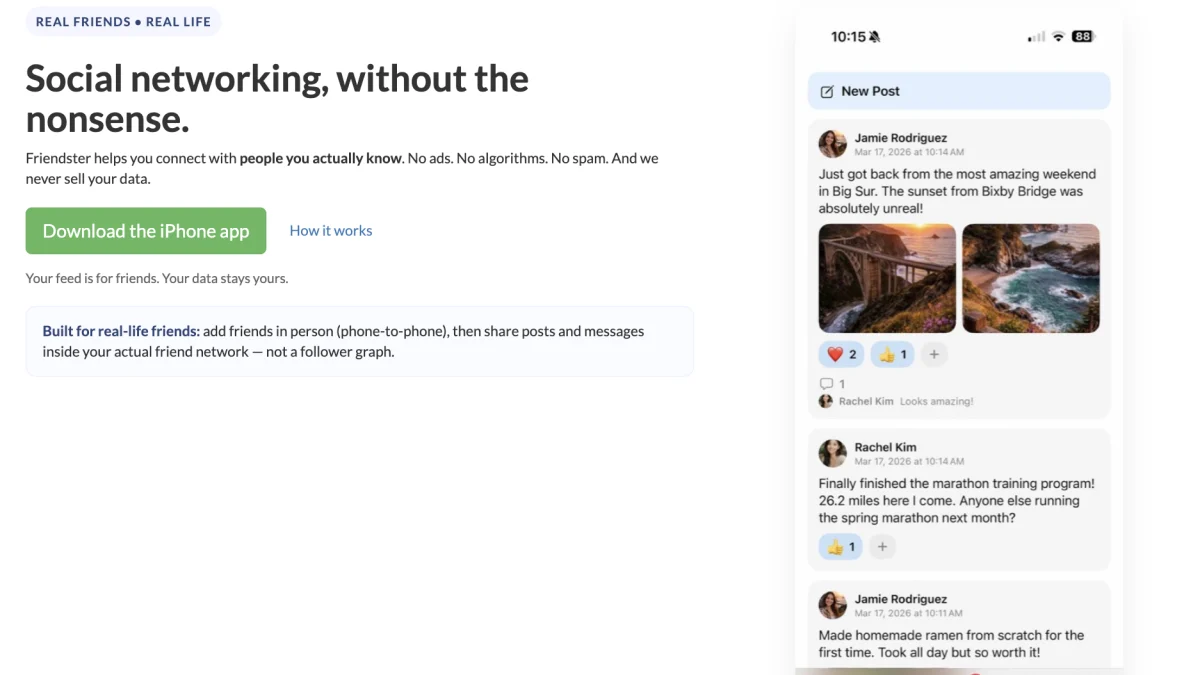
In the early 2000s, the internet was a digital frontier defined by the thrill of the unknown. Among the pioneers of this era was Friendster, a platform that, for a fleeting moment, felt like the future of human connection. Now, nearly a quarter-century after its inception, the name is back. However, the new iteration of Friendster is not a revival of the nostalgia-laden profile pages of 2002. Instead, it is a radical, minimalist experiment designed to address the modern malaise of digital burnout: a social network that refuses to connect you with anyone you haven’t touched in real life.
The Resurrection of an Icon: Main Facts
The relaunch of Friendster, spearheaded by entrepreneur Mike Carson, marks one of the most unorthodox pivots in tech history. While the original platform was the first to scale social networking to a global audience, the "new" Friendster is a deliberate antithesis to the giants that followed it.
The core premise of the app, currently available on iOS, is rooted in radical proximity. There are no feeds, no algorithmic suggestions, no influencers, and, perhaps most importantly, no advertisements. Upon downloading the app, users are greeted by a blank screen. There is no “Recommended for You” tab, no trending topics, and no search bar to hunt down celebrities or acquaintances.
The platform’s central gimmick—and its most restrictive feature—is its onboarding process. To add a friend, users must physically be in the same room, open the app, and tap their phones together. This "physical handshake" protocol is the only way to establish a digital connection. By enforcing this, Carson is attempting to bridge the gap between our physical presence and our digital existence, effectively turning a social network into a digital diary of real-world relationships.
A Legacy of Peaks and Valleys: The Chronology
To understand the audacity of this relaunch, one must look at the meteoric rise and agonizing fall of the original Friendster.
The Dawn of Social Networking (2002–2003)
Launched in March 2002 by Jonathan Abrams, Friendster was the primordial soup from which the modern social web emerged. It allowed users to map their social circles, facilitating connections between friends of friends. It was a cultural phenomenon that predated the dominance of MySpace and the birth of Facebook. By 2003, it had millions of users, but it struggled with technical infrastructure, often suffering from sluggish loading times that left the door wide open for competitors.
The Pivot and the Periphery (2004–2011)
As MySpace gained traction with its customizable HTML profiles and music integration, Friendster’s popularity among North American users plummeted. It found a second life in Southeast Asia, where it maintained a loyal user base for several years. However, the rise of Facebook eventually pushed the platform to the brink. In 2011, in a desperate bid for relevance, the company pivoted entirely to a social gaming site, abandoning its roots as a communication tool.
The Long Silence and the Auction (2015–2023)
The final nail in the coffin came in 2015 when Friendster was shuttered entirely. The domain sat dormant, eventually becoming a graveyard for low-quality pop-up ads and malicious redirects. It remained in this state until 2023, when Mike Carson noticed the site’s decay.
Carson’s journey to acquire the domain was a masterclass in digital archaeology. After tracking down the owner—who had purchased the domain at an expired auction for a mere $7,456—Carson entered into negotiations. The final deal was finalized for $20,000 in Bitcoin plus an additional domain Carson owned that generated $9,000 in annual revenue.
The Economics of Simplicity: Supporting Data
The financial model of the new Friendster is as minimalist as its interface. In an industry addicted to the “attention economy,” where revenue is driven by ad-tech and time-on-site metrics, Carson is attempting to build a sustainable model based on utility rather than exploitation.
By removing the algorithm, the app eliminates the need for massive server-side processing power usually required to curate feeds. This drastically reduces the overhead costs typically associated with running a global social network. However, the challenge remains: How does a platform with no ads, no growth hacks, and no viral content loop achieve critical mass?
Carson’s approach is to treat the app as a tool rather than a destination. He has hinted at a "Friends of Friends" feature in the roadmap, which would allow users to connect online if they share a mutual acquaintance they have both met in person. This adds a layer of "social graph verification" that mimics the original intent of social networking: building trust through existing relationships.
The Philosophy of Presence: Official Responses
Mike Carson’s vision is not merely technical; it is philosophical. In his documentation regarding the project, he emphasizes that the app is designed to honor the sanctity of face-to-face interaction.
One of the most intriguing features in development is the "Fading Connection" alert. This function will nudge users if they haven’t been in the same physical space as a connection for more than a year.
"It’s not a punishment," Carson noted in his blog post detailing the acquisition and development. "It’s a gentle nudge that real friendships are kept alive in person, not online."
This stands in stark contrast to the notification systems of giants like Instagram or LinkedIn, which are designed to create a sense of "Fear of Missing Out" (FOMO) to drive users back to the app. Carson is essentially gamifying the act of leaving the app to go out into the world.
The Digital Divide: Implications and Challenges
The new Friendster faces a monumental hurdle: the “empty room” problem. A social network is only as valuable as the people on it. When a user downloads the app and sees nothing—no posts, no content, no engagement—the immediate psychological response is often to delete the application.
The Barrier to Entry
The requirement to physically tap phones together to add a friend is both a security feature and a significant friction point. While it effectively eliminates spam, botting, and catfishing, it also creates a high barrier to entry for casual users. The app requires a pre-existing social circle that is willing to adopt the platform simultaneously. If a user downloads the app but none of their peers do, they are left with a blank, functional, but ultimately dead space.
The Future of Social Media
The implications of this experiment are significant. We are currently living through a "post-truth" era of social media, characterized by algorithmic radicalization, political polarization, and the erosion of privacy. By stripping away the feed, the algorithm, and the advertisements, Friendster is asking a fundamental question: What is social media for?
If the purpose is to connect with people we actually know, then the current models of Facebook and X (formerly Twitter) are arguably broken. If the purpose is to entertain us with infinite scrolling, then the new Friendster is not a social network at all—it is an anti-social network.
The Verdict
The new Friendster is a fascinating, albeit daunting, experiment. It is a rebellion against the modern internet’s obsession with "engagement." Whether or not it can survive in an ecosystem that demands constant growth remains to be seen. If the goal is to build a high-quality, authentic space for genuine human connection, Carson may have succeeded. If the goal is to compete with the giants of the industry, the lack of content may prove to be a fatal flaw.
For now, the new Friendster sits as a quiet, empty room in the middle of a loud, chaotic internet. Whether that silence is a sanctuary or a death knell will be decided by the users—provided they are willing to meet in person to find out.
 Nana Wu
 Neng Nana
 Reynand Wu
