

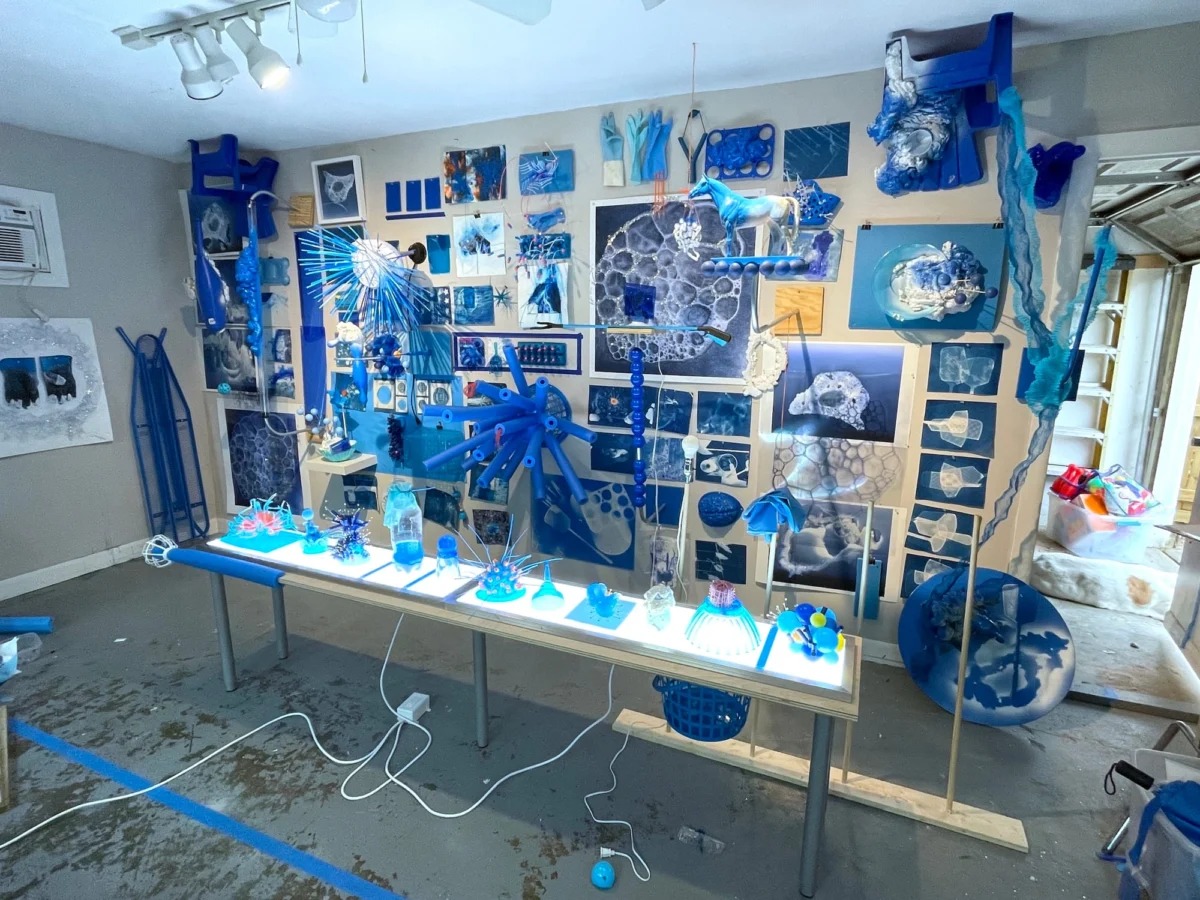
HOUSTON, Texas — For more than 25 years, the husband-and-wife artistic collaboration of Mary Magsamen and Stephan Hillerbrand has blurred the boundaries between domestic life and conceptual art. In the 355th installment of Hyperallergic’s ongoing series A View From the Easel—which explores the intimate environments where artists bring their visions to life—the Houston-based duo opens the doors to their garage studio and two-decade-long home laboratory.
Known for upending traditional notions of family, suburban architecture, and consumer culture through large-scale installations, photography, video, and performance, Hillerbrand and Magsamen have turned their own living quarters into a perpetual worksite. Their creative philosophy embraces creative disarray, defined by the artists themselves as "piles to start a project, piles during a project, and piles of stuff after it is finished."
Main Facts: The Anatomy of a Collaborative Practice
The core of Hillerbrand and Magsamen’s practice is rooted in domestic integration and collaborative friction. Working together for a quarter-century, the couple relocated from New York to Houston, Texas, a transition that fundamentally shifted the scale and scope of their artistic output.
- The Duo: Mary Magsamen and Stephan Hillerbrand.
- Location: Houston, Texas.
- Workspace Tenure: 20 years in their residential home; 10 years in their converted garage studio.
- Artistic Mediums: Interdisciplinary collaboration encompassing site-specific installations, video art, sculpture, photography, and performance.
- Core Workspace Philosophy: A deliberate embrace of structural disruption, messiness, and fluid boundaries between living spaces and production facilities.
Unlike artists who retreat to sterile, white-walled commercial studios to escape the demands of daily life, Hillerbrand and Magsamen invite domesticity directly into the crosshairs of their conceptual investigations. Their workspace is not merely a place where art is made; it is an active participant in the artistic process, frequently serving as both the medium and the subject of their work.
Chronology: From New York Transplants to Backyard Astronauts
The evolution of Hillerbrand and Magsamen’s Houston studio space reads like a narrative of escalating architectural intervention. Their journey from traditional urban art-makers to suburban structural subversives unfolded over two distinct decades.
Phase One: The New York to Houston Transition (The Early 2000s)
When Hillerbrand and Magsamen first arrived in Houston from New York City, they experienced a profound cultural and spatial shock. Confronted with the sprawling suburban landscape of Texas, they famously felt a parallel to the classic Talking Heads lyric: "How did we get here?"
Rather than adopting a conventional studio outside the home, the duo chose to integrate their practice directly into their domestic architecture. Their house became their canvas, their archive, and their primary production facility.
Phase Two: Total Domestic Subversion (The Mid-2000s to 2010s)
As their collaborative projects grew in ambition, the line between "living space" and "art project" vanished entirely. Rejecting gentle home renovations, the artists took chainsaws and sledgehammers directly to the interior load-bearing structures of their home. They tunneled through drywall, punched strategic holes through interior barriers, and fundamentally re-engineered their living environment to suit their conceptual needs.
The apex of this domestic takeover occurred in their backyard, where the duo constructed a massive, three-and-a-half-story spaceship. This ambitious temporary architecture served as the backdrop and focal point for a series of immersive video and photographic works examining space exploration, domestic fantasy, and the American dream.
Phase Three: Containment and the Garage Conversion (The Last Decade)
By the time the indoor interventions and backyard starships reached their peak, the sheer volume of domestic chaos became unsustainable—not necessarily for the artists, but for visitors.

"It finally got to be too much having our house in complete chaos," the artists explained. "People kept asking us, ‘Can I come over and see what it looks like?’"
To accommodate public curiosity and restore a semblance of structural integrity to their primary residence, the couple carved out a compromise. They constructed a simple partition wall down the center of their home garage. Recognizing the realities of the local climate, they installed a dedicated air-conditioning unit—an absolute necessity in Houston’s punishing heat. For the past ten years, this 10-foot-away garage studio has served as their primary operational base.
Supporting Data: The Rhythms and Routines of a 25-Year Partnership
Maintaining a creative partnership for 25 years while sharing a home and a studio requires an extraordinary degree of operational structure. Hillerbrand and Magsamen have developed a rigorous daily and weekly routine designed to balance individual creative impulses with cooperative consensus.
The Shift-Work Schedule
Daily operations in the Hillerbrand-Magsamen household follow a carefully coordinated temporal rhythm:
- Morning Shifts: Stephan Hillerbrand takes primary lead on active projects, utilizing the early hours to advance structural, sculptural, or technical components of their current installations.
- Afternoon and Evening Shifts: Mary Magsamen steps into the workspace, taking over the project to direct video editing, conceptual refinement, installation staging, or photographic composition.
Weekend Debates
While the split-shift model ensures continuous production without stepping on each other’s toes, the weekend brings the collaborators back together in direct contact. This is where the friction of collaboration sparks new creative directions.
"On weekends, we come together and get into wonderful debates and arguments about why something was changed or what we wanted to keep," the duo notes. These rigorous, highly communicative negotiations prevent either artist from steering a project into an isolated aesthetic echo chamber, ensuring that every final piece bears the unmistakable tension of their combined vision.
The Aesthetic of the Pile
The physical environment of the garage studio is characterized by an organized taxonomy of accumulation. Eschewing minimalist workspace trends, Hillerbrand and Magsamen champion "piles" as an essential phase of creative evolution:
- Piles to start a project: Raw materials, reclaimed lumber, salvaged consumer electronics, domestic artifacts, and tools gathered in anticipation of a new body of work.
- Piles during a project: Half-assembled sculptures, cut drywall, discarded test prints, and shifting layers of debris that map out the trial-and-error phase of construction.
- Piles of stuff after it is finished: Remnants and archival artifacts left in the wake of completed installations, serving as a physical memory bank for future iterations.
Official Perspectives: The Complex Emotional Landscape of the Studio
While the garage studio has successfully solved the logistical problems of public accessibility and extreme Texas weather, it has also introduced a layer of bittersweet nostalgia for the artists.
"It’s funny having this kind of space because we love it," Magsamen and Hillerbrand reflect. "It lets us be messy, keep things the way they are, and not have to clean up after ourselves."
The freedom from conventional domestic tidiness remains one of the greatest luxuries of the converted garage. In this dedicated zone, unfinished sculptures can sit indefinitely, materials can cascade across workbenches without drawing complaints from houseguests, and the physical evidence of artistic labor is allowed to accumulate unchecked.

Yet, this liberation comes with an emotional trade-off.
"Sometimes it’s also a little sad because, even though it’s only 10 feet away, we miss our house being the studio."
The intimacy of having their entire living environment directly engaged in the artistic process—of waking up inside the installation, eating breakfast amidst the debris, and walking past sculptural interventions in the hallway—is a magic that a detached garage, however air-conditioned and convenient, cannot fully replicate.
Implications: Redefining the Boundaries of Domesticity and Art
The workspace of Hillerbrand and Magsamen offers a profound commentary on the intersection of contemporary art, labor, and suburban architecture. In an era where many artists feel pressured to maintain polished, highly sanitized studio spaces suitable for social media curation or corporate gallery patronage, this Houston duo proudly champions the unpolished, messy reality of making.
1. Challenging the Division of Labor and Life
By maintaining a collaborative practice that spans a quarter-century, Hillerbrand and Magsamen dismantle the romantic myth of the lone, tortured genius working in isolated confinement. Their art is explicitly relational—born out of domestic negotiations, shared marital space, and cooperative labor. The studio is not a sanctuary from family life; it is the family life, processed, interrogated, and reconstructed.
2. Subverting Suburban Consumerism
Through projects that involve cutting holes in drywall and building backyard spaceships, the artists challenge the sanctity of suburban real estate. In contemporary American culture, the suburban home is typically marketed as a finished, stable commodity meant to protect and preserve middle-class comfort. Hillerbrand and Magsamen weaponize this architecture, turning the suburban home into a volatile site of experimental play, fantasy, and transformation.
3. The Studio as a Living Archive
The enduring presence of "piles" in their workspace suggests that art-making is not a linear march from concept to finished product, but an ongoing cycle of accumulation and decay. By refusing to sanitize their workspace, the artists validate messiness as an essential component of intellectual and physical rigor.
As Hyperallergic’s A View From the Easel series continues to document the diverse environments where artists create, Hillerbrand and Magsamen stand out as pioneers of total domestic integration. Whether they are building rockets under the expansive Texas sky or debating design choices over a weekend workbench in their garage, their workspace remains a testament to the power of keeping your creative life as messy, ambitious, and deeply shared as possible.
 Muslim
 Evan Lee Salim
 Jia Lissa
