

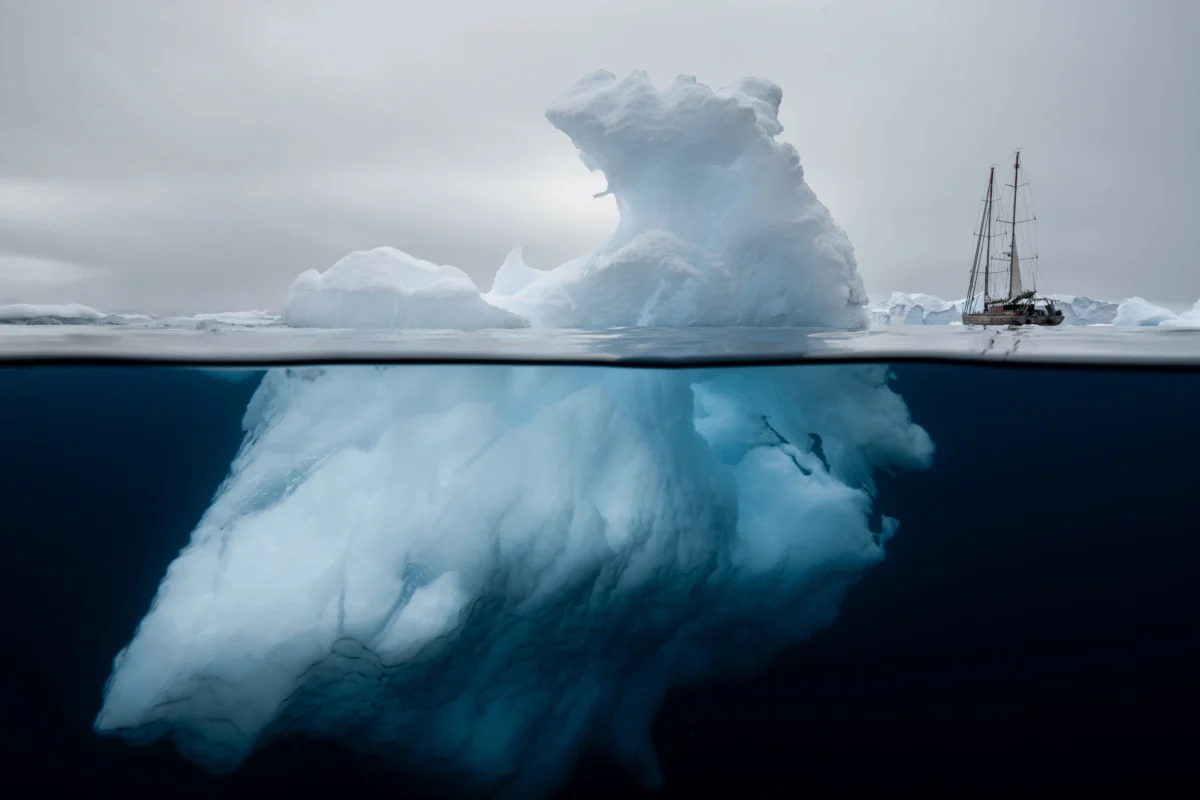
For most of humanity, the polar regions—the Arctic Circle and Antarctica—exist as distant abstractions. They are silent, frozen landscapes relegated to the periphery of our maps and the edges of our consciousness. Yet, these regions serve as the literal cooling system for the planet, holding the key to our climate future.
Bridging the divide between scientific data and public empathy is the primary challenge for conservationists today. A groundbreaking partnership between the luxury expedition cruise line Ponant and the world-renowned Woods Hole Oceanographic Institution (WHOI) is rising to meet this challenge. By merging cutting-edge marine technology with high-impact visual storytelling, this collaboration is working to transform the "white nothing" of the poles into a vibrant, essential heartbeat of the global ecosystem.
The Genesis of a Partnership: Merging Science and Storytelling
The collaboration between Ponant and WHOI, which gained significant momentum in 2025, represents a fundamental shift in how the travel industry and the scientific community interact. Recognizing that traditional academic papers often fail to capture the public imagination, the partners launched the Polar Ocean Image Collection in May 2026.
Hosted on the Ocean Image Bank, this initiative provides a curated, open-access library of over 500 high-resolution images. These visuals, captured by Ponant’s internal Polar Studio and more than 200 volunteer photographers, serve a dual purpose: they document the stark beauty of the poles and provide non-commercial resources for educators, conservationists, and the media.
Chronology of Collaboration
- 2014: Early expeditions highlight the potential for integrating citizen science into luxury polar tourism.
- 2025: Formalization of the strategic partnership between Ponant and WHOI, focusing on research and public engagement.
- May 2026: Launch of the Polar Ocean Image Collection, providing free, high-quality imagery to global audiences.
- December 2027 (Planned): Launch of "Antarctica: Ocean (Re)Imagined," an immersive expedition aboard Le Lyrial designed to synthesize technology, education, and stewardship.
The "White Nothing" Problem: Changing the Cartographic Perspective
A core obstacle in polar conservation is a phenomenon Richard Vevers, director of WHOI’s "Room 71," calls the "white nothing" problem. Because of their remote nature and monochromatic appearance, the public often perceives the poles as empty, lifeless voids.
To combat this, WHOI has championed the use of the Spilhaus Projection. Developed in 1942, this ocean-centered map disrupts the terrestrial bias of traditional world maps, which often treat the ocean as "leftover space" between continents. By centering the map on Antarctica, the Spilhaus projection illustrates that our oceans are not fragmented entities, but a single, interconnected global body of water.
"As terrestrial animals, we’re designed to understand the world above water," explains Vevers. "By reframing our perspective, Antarctica ceases to be the isolated bottom of the world. It becomes the beating heart of the planet."
Technological Frontiers: Research on the Edge of the Ice
The partnership is not merely a communications exercise; it is a serious scientific endeavor. Utilizing Ponant’s Le Commandant Charcot—the world’s only passenger ship with Polar Class 2 certification—WHOI researchers have gained unprecedented access to the most hostile environments on Earth.
Research and Deployment Highlights
- LiDAR Mapping: By deploying Light Detection and Ranging technology, researchers can model the breakup rate of the Antarctic Ice Sheet with a precision that satellites often cannot match.
- Bio-Inspired Robotics: Engineers have developed underwater robots modeled after leatherback sea turtles to survey sub-ice environments, providing data on the behavior of marine megafauna.
- Infrared Whale Detection: To mitigate the risks of vessel-whale collisions, ships are now equipped with infrared cameras capable of spotting whales up to three miles away, a vital data point for both maritime safety and marine biology.
Dr. Catherine Walker, a leading WHOI glaciologist, has overseen these voyages, ensuring that the research conducted by doctoral students from WHOI and MIT contributes directly to our understanding of glacier retreat and sea-level rise.
Official Responses and the Power of Visual Advocacy
The philosophy driving this initiative is rooted in the belief that imagery has the power to influence policy. Richard Vevers, who previously founded The Ocean Agency, draws upon his experience with the documentary Chasing Coral. During the COP21 climate summit in Paris, visuals from the project were instrumental in shifting the narrative around coral bleaching, helping to secure the 1.5 degrees Celsius warming target.
"Imagery can influence policy," Vevers asserts. "When you show people the reality of a place—the movement of a seal pup, the scale of an iceberg, the fragility of a fledgling penguin—you move them from intellectual awareness to emotional connection."
While the scientific community often debates the quantifiable impact of photography on conservation outcomes, WHOI remains committed to the premise. The institution views these images not as static art, but as political tools designed to make the invisible visible.
Implications for the Future of Expedition Travel
The upcoming "Antarctica: Ocean (Re)Imagined" expedition in 2027 serves as a blueprint for the future of the travel industry. By integrating guests directly into the research process—a form of high-level citizen science—Ponant and WHOI are creating "stewards of the ocean."
The "Stewardship Model"
- Education through Immersion: Moving beyond the tourist model toward an educational framework where guests interact with scientists and real-time data collection.
- Technological Integration: Utilizing the ship as a mobile laboratory to collect data that would otherwise be prohibitively expensive or logistically impossible to gather.
- Long-term Advocacy: Transforming the passenger experience from a fleeting holiday into a long-term commitment to ocean health.
This model acknowledges that while less than 0.01% of the world’s population will ever set foot in Antarctica, the fate of the planet is tied to the health of those frozen waters. By leveraging the influence of the travel sector, WHOI and Ponant are attempting to democratize access to the poles—not through travel, but through the shared experience of witnessing the wonders of the deep.
Conclusion: A Single, Unified Ocean
The ambition of the Ponant-WHOI partnership extends far beyond the polar ice caps. The ultimate goal is to foster a global mindset that views the Earth as a water-dominated planet. As the project expands its scope into the deep ocean and tropical reefs, the central message remains consistent: there are no separate regions. There is only one ocean, and its preservation requires us to close the gap between knowing that a place is in danger and feeling the urgency to act.
Whether through a split-shot image of an iceberg or a LiDAR scan of a collapsing glacier, the goal is to make the distant, intimate. In an era of accelerating climate change, this emotional and scientific synthesis may be the most vital tool we have. As Vevers notes, "It’s a bet we are determined to keep making."
By turning curiosity into stewardship, the collaboration serves as a testament to the idea that we protect what we love, and we love what we understand. Through the lens of the Polar Ocean Image Collection and the rigors of scientific exploration, the world is finally beginning to see the poles not as empty, but as essential.
 Asro
Asro
 Siti Muinah
