

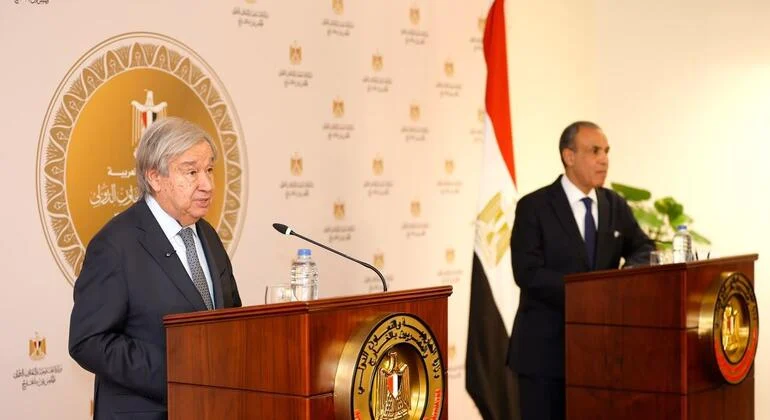
CAIRO — As the geopolitical landscape of the Middle East faces an unprecedented convergence of crises, United Nations Secretary-General António Guterres has issued a stark warning regarding the risk of a catastrophic regional conflagration. During a high-level diplomatic visit to Cairo—his ninth since assuming his post in 2017—the UN chief emphasized that the intersection of the Iran-U.S. standoff, the humanitarian catastrophe in Gaza, and the instability in the West Bank requires immediate de-escalation and a return to multilateral diplomacy.
The Specter of Regional Escalation
The core of Mr. Guterres’ message in Cairo was a direct appeal to global powers and regional stakeholders to exercise "maximum restraint." Speaking alongside Egyptian Foreign Minister Badr Abdelatty, the Secretary-General cautioned that the current "sabre-rattling" between Washington and Tehran carries the risk of spinning entirely out of control.
"I want to send a loud and clear message to the parties," Guterres stated. "We need maximum restraint and diplomatic solutions. If the sabre-rattling we are witnessing now translates itself into a major escalation, the situation in the region can get out of control."
The concern is not merely political; it is economic and structural. Guterres highlighted the vulnerability of global maritime commerce, specifically calling for the restoration of navigational rights and freedoms in the Strait of Hormuz and the Bab el-Mandeb Strait. These corridors serve as the lifeblood of global trade, and their disruption could have severe inflationary and logistical consequences for the global economy.
Chronology of a Widening Crisis
To understand the urgency of the Secretary-General’s remarks, one must look at the recent timeline of the interconnected conflicts currently straining the international order:
- The Gaza Conflict (October 2023–Present): What began as a localized conflict has evolved into a protracted humanitarian disaster. Despite numerous attempts at ceasefires, the blockade remains largely intact, and the scale of human suffering has drawn near-unanimous condemnation from international aid agencies.
- The West Bank Deterioration (2024): Throughout the current year, the situation in the occupied West Bank has seen a sharp uptick in violence. The expansion of illegal settlements, coupled with what the UN describes as "unrelenting" evictions, has created a volatile environment that threatens to open a third front in the regional conflict.
- The Red Sea Crisis: Attacks on commercial shipping vessels, primarily linked to regional proxies, have necessitated a sustained international military presence to protect trade routes, further militarizing a region already struggling to maintain diplomatic equilibrium.
- The Sudan and Libya Impasses: Parallel to the Levant, the civil war in Sudan has entered a phase of extreme volatility, threatening the territorial integrity of the nation, while Libya continues to struggle with the challenge of unifying institutions to hold national elections.
Supporting Data: The Humanitarian and Geopolitical Stakes
The UN’s assessment is backed by deteriorating indicators on the ground. In Gaza, the blockage of aid is not merely a logistical failure but, according to Guterres, a policy choice that must be reversed. The UN has repeatedly signaled that the current levels of aid are insufficient to meet the basic needs of a population facing starvation and disease.
In the West Bank, the data is equally concerning. The UN has documented a surge in assaults on journalists, diplomats, and civilians. The Secretary-General’s use of the term "spectre of ethnic cleansing" marks a significant hardening of rhetoric, signaling that the UN sees the current trajectory not as a temporary skirmish, but as a systematic attempt to alter the demographic and legal reality of the Palestinian territories.
Regarding the maritime corridors, the economic impact is quantifiable. The Bab el-Mandeb Strait handles roughly 12% of global trade. The threat of escalation there has forced major shipping lines to reroute around the Cape of Good Hope, adding weeks to transit times and significantly increasing insurance premiums, costs which are ultimately passed on to global consumers.
Official Responses and the Mediation Role of Egypt
The choice of Cairo as the venue for this urgent appeal was deliberate. Guterres lauded Egypt as a "pillar of multilateralism" and a vital mediator in a world that is increasingly fractured.
"Egypt is a pillar of multilateralism," Guterres remarked. "And at a time when divisions are deepening, it is critical to keep the channels of diplomacy open."
Egyptian Foreign Minister Badr Abdelatty echoed these sentiments, emphasizing that Egypt’s diplomatic efforts are aimed at preventing the total collapse of regional stability. Egypt has acted as the primary conduit for humanitarian aid into Gaza and has played an indispensable role in negotiating prisoner releases and ceasefire frameworks. However, the Secretary-General noted that even the most effective mediation is limited by the political will of the warring parties. He specifically called for the removal of obstacles blocking the implementation of the UN Security Council-endorsed plan to end the Gaza conflict.
Implications for the Future: A Call for a Two-State Solution
The implications of the current crisis are far-reaching. Guterres warned that there can be no durable peace in the Middle East without the realization of the legitimate rights of the Palestinian people to self-determination. He remains a steadfast proponent of the two-State solution, arguing that the alternative—a one-state reality defined by coercion and occupation—is a recipe for perpetual conflict.
Beyond the Levant, the Secretary-General’s focus on Sudan and Libya highlights his broader concern regarding the erosion of sovereignty in Africa. In Sudan, he reiterated that the country’s future must belong to the Sudanese people through an inclusive political process. In Libya, he urged the international community to capitalize on the existing, albeit fragile, political momentum to finally bring the transition period to an end through national elections.
Conclusion: A Legacy of Diplomacy
As António Guterres prepares to leave office at the end of the year, his Cairo visit serves as a capstone to his long-standing focus on the Middle East. Having visited Egypt nine times since 2017, his presence reflects a belief that diplomacy is not a passive act but a continuous, grinding process that requires leaders to be on the ground, engaging with those who hold the keys to peace.
The Secretary-General’s final warnings are clear: the world is operating on borrowed time. Without a decisive move toward de-escalation, a lifting of humanitarian restrictions, and a genuine commitment to international law, the region faces a period of darkness that will have global ramifications.
"Civilians must be protected and international law must be respected," Guterres insisted. His message to the world’s power centers is that the current status quo is unsustainable. As the "sabre-rattling" continues, the international community must decide whether it will allow the situation to descend into total chaos or if it will empower the diplomats and mediators to build a path toward stability.
In this critical hour, the Secretary-General’s plea remains a reminder that in the face of deep divisions, keeping the channels of diplomacy open is not just a diplomatic protocol—it is a moral imperative.
 Ammar Sabilarrohman
 Siti Muinah
