

In the modern era, interaction design is far more than the aesthetic arrangement of buttons on a screen or the seamless flow of a mobile application. It is the invisible architecture of our daily lives—a framework that dictates who can access information, how public services are delivered, and whose voices are amplified in the digital and physical spheres. At the George Washington University’s Corcoran School of Arts and Design, educators are fundamentally rethinking the curriculum to ensure that the next generation of designers understands that every pixel, every interface, and every system carries profound social consequences.
By leveraging its unique position in the heart of Washington, DC, the Interaction Design (IXD) program has moved beyond the ivory tower, establishing a "pedagogy of partnerships." Through deep integration with local institutions, the program is teaching students to dismantle exclusionary design practices and replace them with models that prioritize equity, accessibility, and human-centered ethics.
The Core Philosophy: Design as a Power Structure
At its foundational level, the Interaction Design program at the GW Corcoran operates on a singular, potent premise: design choices do not exist in a vacuum. Every prototype is a political act that either reinforces existing power structures or works to dismantle them.
Faculty at the Corcoran have curated a curriculum that emphasizes "pluriversality"—the idea that design must account for diverse perspectives and cultural contexts rather than adhering to a singular, often Western-centric, standard. Students are encouraged to interrogate the traditional "human-centered design" (HCD) process, asking not just how to build a product, but whose needs are being prioritized and, perhaps more importantly, whose voices are being omitted.
Through a rigorous cycle of research, ethical inquiry, and iterative prototyping, the program demands that students become more than just visual creators; they are tasked with becoming civic stewards. This approach is codified in core courses like Engagement Lab, Collaborative Design Project, and Systems Thinking, which replace abstract theory with the messy, complex reality of real-world problem-solving.
A Chronology of Engagement: From the Classroom to the Capital
The program’s shift toward experiential, partnership-based learning has been a multi-year evolution. By embedding students directly into the institutional fabric of Washington, DC, the Corcoran has created a living laboratory.
2025–2026: The DDOT Initiative
In the most recent academic cycle, the Engagement Lab studio took on a significant challenge in partnership with the DC Department of Transportation (DDOT). The objective was to improve the recruitment, retention, and daily experience of school crossing safety technicians—the vital personnel who ensure the safety of students across the District’s various wards.
- Phase I (Observation): Students were deployed to school zones across the city, observing safety technicians at their posts to understand the environmental and social pressures of their roles.
- Phase II (Inquiry): The team conducted deep-dive interviews with DDOT staff, mapping out the bureaucratic hurdles and communication gaps that hindered the safety techs’ efficacy.
- Phase III (Co-Design): Students facilitated workshops that brought together school representatives, community members, and safety techs themselves. By placing the technicians at the center of the design process, the students shifted the focus from a top-down management solution to a ground-up, human-centric support system.
2026: The National Gallery of Art (NGA) Collaboration
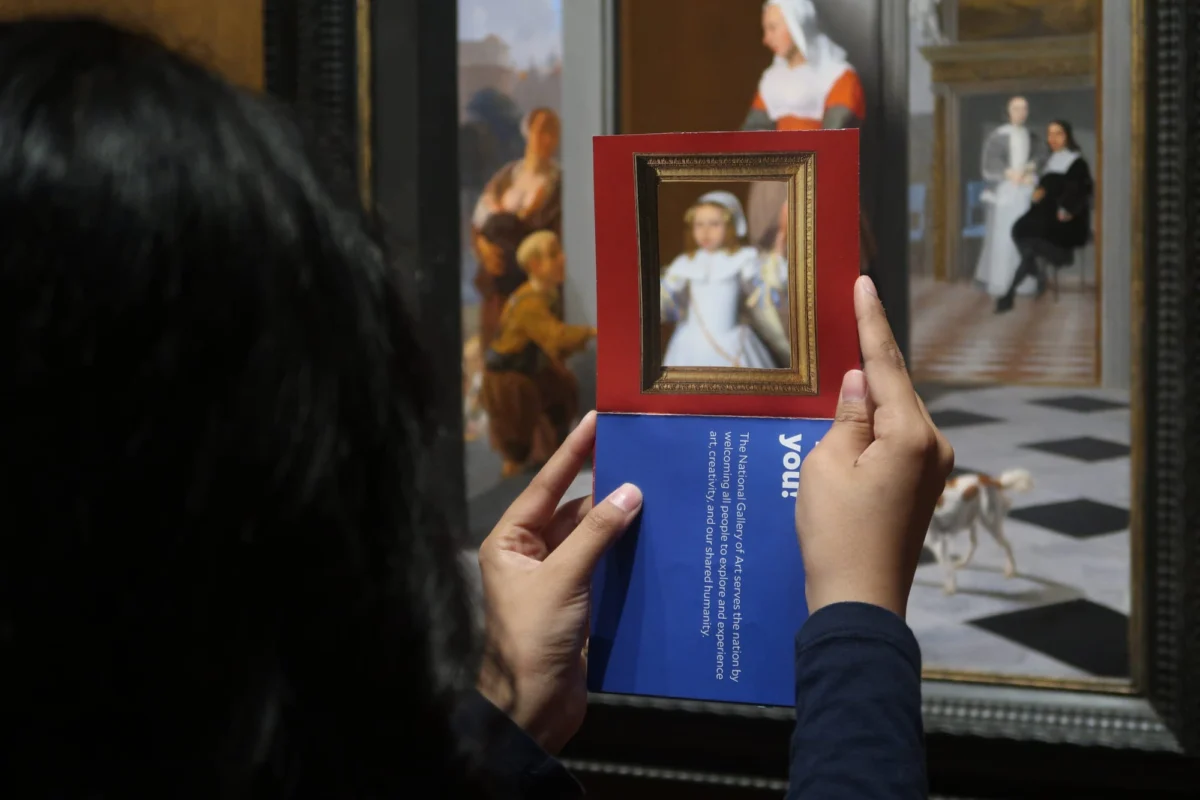
Parallel to the civic-focused work of Engagement Lab, the Systems Thinking course turned its attention to the cultural sector. Partnering with the National Gallery of Art, students were challenged to rethink the visitor experience. The goal was to remove the "velvet rope" of institutional intimidation and make world-class art accessible to a broader, more diverse public.
The students produced a range of prototypes—from digital scavenger hunts to interactive physical brochures—that invited visitors to engage with art through personal frames of reference rather than passive observation. These projects proved that design could bridge the gap between elite institutional spaces and the lived experiences of the general public.
Supporting Data: Why Contextual Learning Matters
The success of the Corcoran’s pedagogy is backed by a growing consensus in the design industry. According to recent academic research in human-computer interaction, projects that involve "community-based participatory research" (CBPR) result in solutions that are 40% more likely to be adopted by the target demographic compared to solutions developed in controlled, studio-only environments.
The Corcoran’s model mirrors this success by prioritizing:

- Qualitative Depth: Moving beyond surface-level user testing to understand the "systemic pain points" of users.
- Iterative Resilience: The ability to fail, pivot, and refine designs based on direct feedback from stakeholders.
- Ethical Scrutiny: A formal pedagogical commitment to identifying algorithmic bias and physical accessibility barriers early in the concept phase.
The data suggests that when students are forced to interface with the bureaucratic and cultural complexity of a city like Washington, their design output becomes more robust, empathetic, and durable.
Official Perspectives: The Value of the "DC Proximity"
Leadership at the Corcoran emphasizes that the location of the school is not merely a geographic convenience—it is a strategic pedagogical asset.
"Washington, DC is a city of systems," notes a faculty spokesperson. "It is a hub of bureaucracy, of civic policy, and of national narrative. When our students sit with a safety technician in a school zone, or when they workshop with gallery staff to improve museum accessibility, they aren’t just learning software. They are learning how to influence the institutions that govern our lives."
The school maintains that the "proximity to power"—and to the people impacted by that power—is the primary driver of their students’ professional development. By graduation, these students possess a portfolio that demonstrates not just technical aptitude, but the political and social literacy required to navigate modern professional environments.
Implications for the Future of Design Education
The model being developed at the GW Corcoran carries significant implications for the broader field of Interaction Design.
1. The Death of the "Designer-as-Expert" Myth
Traditionally, design education has operated under the assumption that the designer is an expert coming to "solve" a problem for a user. The Corcoran’s approach flips this, positioning the student as a facilitator. The expert is no longer the designer; the expert is the community member whose life is being impacted by the design.
2. Civic Responsibility as a Curriculum Pillar
The integration of government and cultural partners into the syllabus signals a shift toward "Civic Design." Future designers are being trained to see themselves as public servants, regardless of whether they end up working for a tech giant, a non-profit, or a government agency.
3. The Pluriversal Standard
By actively seeking partnerships that span different wards, socio-economic backgrounds, and institutional missions, the program is effectively training designers to be "context-agnostic." They are learning that there is no "universal user," and that effective design requires the continuous interrogation of one’s own biases.
Conclusion: Shaping the City, Shaping the Future
The interaction designers emerging from the George Washington University Corcoran School of Arts and Design are fundamentally different from their predecessors. They have been tempered by the reality of the street and the nuance of the institution. They understand that in a world increasingly mediated by screens and interfaces, the stakes of design are higher than ever.
As they move into their careers, these designers carry with them the lessons of their time in DC: that technology should not be an end in itself, but a means to foster deeper human connection and greater social equity. By teaching their students to listen to the city, the Corcoran is ensuring that the designers of tomorrow are equipped to not just build the future, but to ensure that the future is built for everyone.
For those interested in exploring the work of these students and the ongoing evolution of the program, further details and project archives are available at corcoran.gwu.edu. The work of the Corcoran is a testament to the fact that when we change how we teach design, we change the very nature of the society we are designing for.
 Basiran
 Muslim
 Evan Lee Salim
