

By Chase DiBenedetto
June 9, 2026
New York City has been gripped by a fever of orange and blue. For the first time in 27 years, the New York Knicks have fought their way into the NBA Finals, transforming the city into a sprawling carnival of basketball optimism. From the outer boroughs to the heart of Manhattan, residents have donned custom airbrushed jerseys and makeshift fan gear, celebrating in subway cars and atop taxi cabs with the fervor of a fanbase that feels its championship drought is finally at an end.
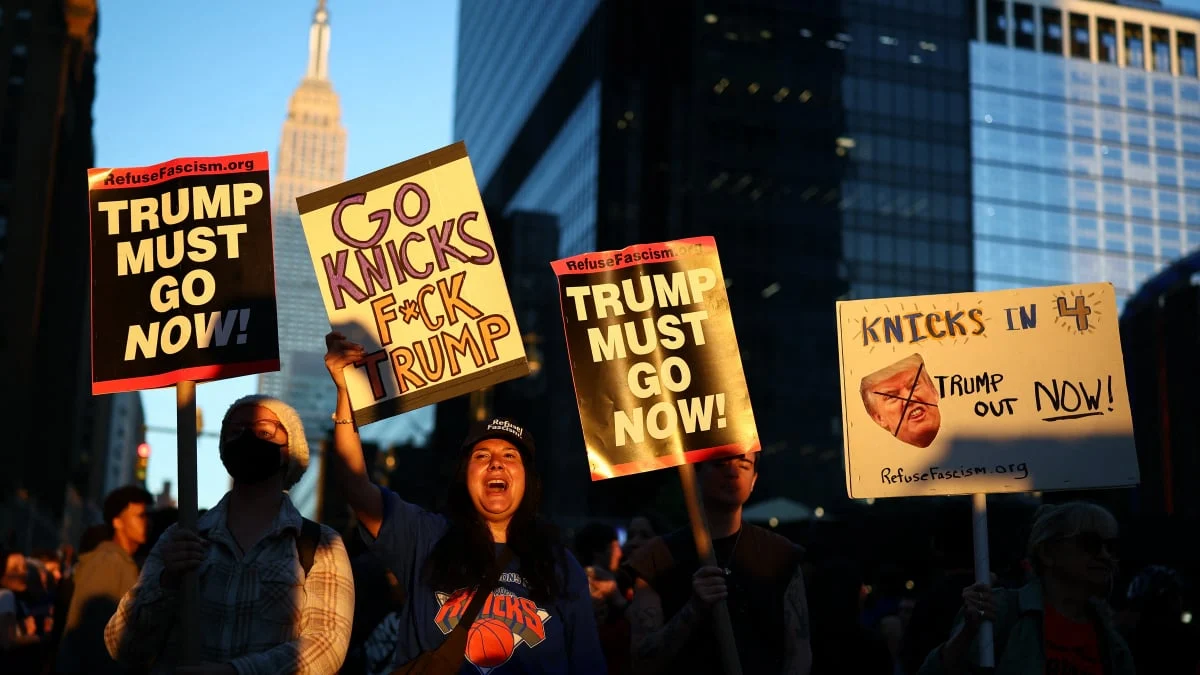
However, that collective euphoria hit a sudden, icy wall on the night of Game 3. The arrival of President Donald Trump at Madison Square Garden (MSG) to witness the Knicks face off against the San Antonio Spurs did more than just disrupt the typical atmosphere of the arena—it triggered a massive, city-wide display of public disapproval that echoed from the rafters of the "World’s Most Famous Arena" to the public screens of Bryant Park.
The Context: A City on Edge
The stakes for this series were already astronomically high. With the Knicks and the Spurs locked in a grueling battle, the announcement that President Trump would be the first sitting president to attend an NBA Finals game added a layer of political tension to what was already a high-pressure sporting event.
For weeks, the city had been riding the high of the Knicks’ postseason success. After a decisive win in Game 2, the mood was one of unbridled potential. However, when news broke that the President would be in attendance for the pivotal third game, that mood shifted toward apprehension. Many fans, prone to the superstitions that define sports fandom, immediately voiced concerns that the presence of an "unfavorable leader" would act as a hex on their team.
This sentiment was not confined to internet forums; it manifested in concrete actions. The U.S. Secret Service, citing security protocols, moved to barricade the sidewalks surrounding Madison Square Garden, effectively forcing the cancellation of a massive public watch party that had been scheduled to take place outside the venue. The move was perceived by many as an attempt to sanitize the atmosphere surrounding the President’s visit, an action that only served to deepen the resolve of the disgruntled fanbase.
Chronology of a Controversial Evening
The tension began building long before the tip-off. As the Secret Service established a perimeter around the Garden, the local response was immediate and organized. Mayor Zohran Mamdani, who attended the game, took the initiative to organize a separate, massive public viewing event at Bryant Park, providing a refuge for those who felt excluded or disillusioned by the security theater at MSG.
Social media platforms became a staging ground for the night’s events. Viral tutorials on "how to properly boo" the President—framed as a civic duty to "ward off the curse"—circulated on TikTok and X (formerly Twitter). The message was clear: the fans were prepared to make their voices heard.
When the national anthem concluded and the stadium cameras panned to the President’s private box, the reaction was instantaneous. A deafening roar of boos erupted from the crowd, a visceral wall of sound that was mirrored by thousands of fans gathered at the Bryant Park watch party. The sound was so intense that it was reportedly audible even through the arena’s broadcast feeds. Despite the fervor, the energy of the crowd proved insufficient to push the Knicks to victory; the Spurs secured a narrow, nail-biting win, leaving many to wonder if the "Trump Curse" was, in fact, a self-fulfilling prophecy.
The Intersection of Sports and Politics
The incident highlights a growing trend in American culture where the lines between professional athletics and political discourse have become increasingly blurred. Trump has long maintained a contentious relationship with the NBA, frequently criticizing the league for its perceived "liberal" player politics and activism.

This visit was, for many, the ultimate collision of these two worlds. For the fans, the act of booing was not merely a political statement; it was an act of reclamation. By disrupting the visual of a President enjoying a "neutral" sporting event, the crowd asserted that even the hallowed ground of Madison Square Garden is not immune to the political realities of the modern era.
Official Responses and Post-Game Spin
Following the game, the President’s reaction to the reception was markedly different from the scene witnessed inside the arena. Speaking to reporters on the tarmac outside of Air Force One, Trump offered a characteristically defiant assessment of the evening.
"I mean, I thought it was amazing, actually," the President stated when asked about the crowd’s reaction. "You mean when they had the camera on me? I thought it was very good. Yeah. It was certainly amazing. It was, I think, mostly cheers. It was loud and it was very enthusiastic."
When pressed further on his history of friction with the league, the President doubled down on his critique. "It tends to be a little left wing," he remarked regarding the NBA, "but it’s great entertainment. It’s great."
The contrast between the reality on the ground—where the sound of thousands of boos was undeniable—and the President’s public narrative underscores the profound polarization currently gripping the nation. It highlights a common phenomenon in modern political communication: the ability to interpret reality through a lens that rejects contradictory evidence in favor of a preferred narrative.
Implications for the Finals and Beyond
As the series progresses, the "Trump Curse" has become a central theme in the sports media cycle. For the Knicks, the loss in Game 3 is a mathematical reality, but for the fans, it represents a deeper frustration. The loss of the outdoor watch party, the heavy security presence, and the eventual defeat of their team in the presence of the President have left a sour taste that will likely linger for the remainder of the series.
Beyond the specific outcome of the NBA Finals, this event sets a precedent for how political figures may be received at high-profile cultural events in the future. As professional sports leagues continue to grapple with their role in social and political issues, the expectation of "neutrality" for public figures is rapidly evaporating.
Furthermore, the incident raises questions about the role of local government in managing public space when high-ranking officials are involved. The coordination between the Mayor’s office and the Bryant Park watch party suggests that in a polarized political climate, city officials may increasingly need to facilitate parallel events to ensure that the public can continue to gather and participate in civic life, even when official security measures restrict access to primary venues.
Conclusion: A City Divided
Whether or not one believes in the "curse" of the Garden, the events of Game 3 will be remembered as a defining moment in this year’s NBA Finals. It was a night where the high-octane excitement of professional basketball was momentarily sidelined by the realities of a divided nation.
For the Knicks, the task remains simple: win the next game and force a reversal of the momentum that has seemingly slipped away. For the rest of the country, the night serves as a stark reminder that in the current era, there is perhaps no such thing as a space that is truly separate from the political fray. As the series moves forward, the city of New York will continue to watch, wait, and—depending on who is in the stands—continue to make its voice heard.
 Ali Ikhwan
 Siti Muinah
