

Introduction: The Birth of a New Aesthetic
For centuries, the visual language of the Western world was dictated by the academies of Europe—the rigid, human-centric portraiture of London, Paris, and Rome. In the early 19th century, however, a seismic shift occurred in the fledgling United States. A group of painters, later dubbed the Hudson River School, sought to forge a distinct American identity. They found their muse not in the salons of the Old World, but in the untamed wilderness of the New.
At the center of this movement was the English-born Thomas Cole. His 1826 painting, Kaaterskill Falls, serves as a foundational document for American art. While contemporaries like Gilbert Stuart were busy immortalizing the faces of the American elite in the vein of European classical tradition, Cole turned his gaze toward the geological history of Upstate New York. By capturing the raw, surging power of the Catskills, Cole did more than paint a landscape; he initiated a dialogue about the precarious nature of the American experiment.
Chronology: From Romanticism to Industrial Ruin
The trajectory of the Hudson River School mirrors the rapid expansion and subsequent ecological reckoning of the United States.
- 1825–1830: The Romantic Genesis. Thomas Cole arrives in the Catskills. His work, characterized by dramatic lighting and an emphasis on the "sublime," reflects the optimism of a young republic. Nature is depicted as a cathedral—vast, spiritual, and untouched.
- 1840s–1850s: The Era of Expansion. As the nation pushes West, painters like Frederic Edwin Church and Albert Bierstadt scale the movement’s ambition. Their massive canvases of the Andes, the American West, and the Arctic mirror the era’s "Manifest Destiny."
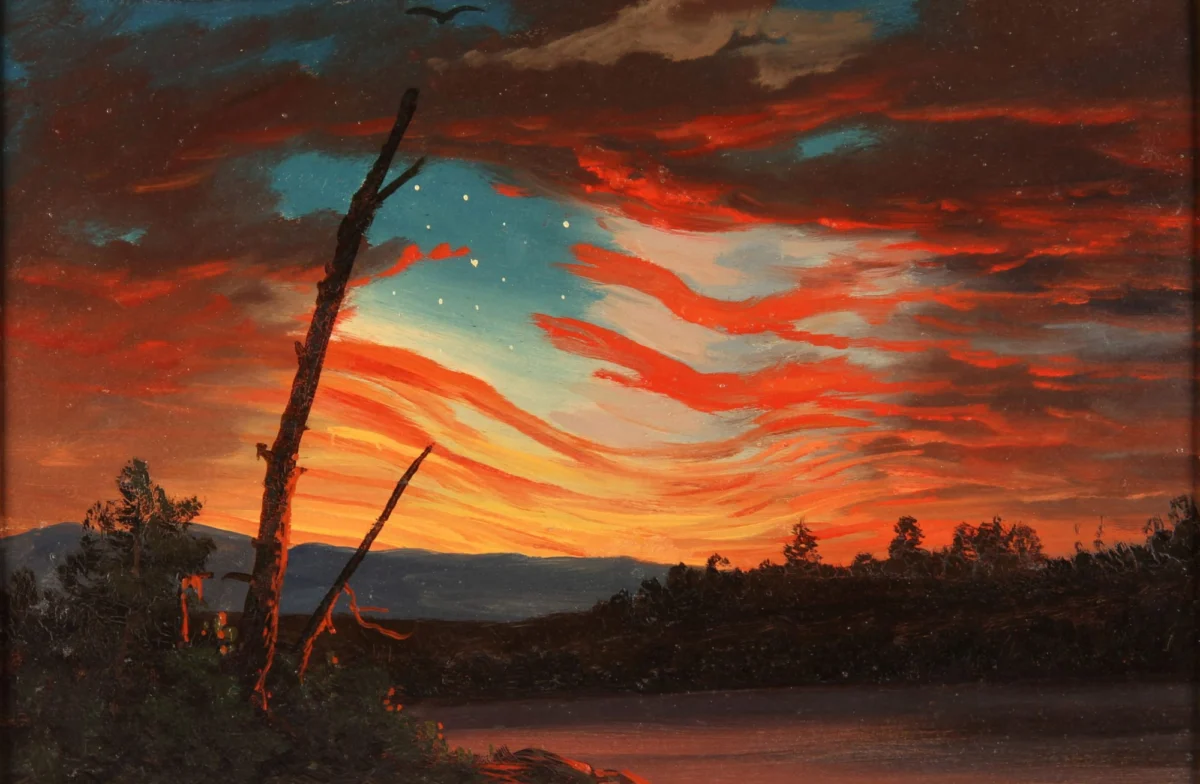
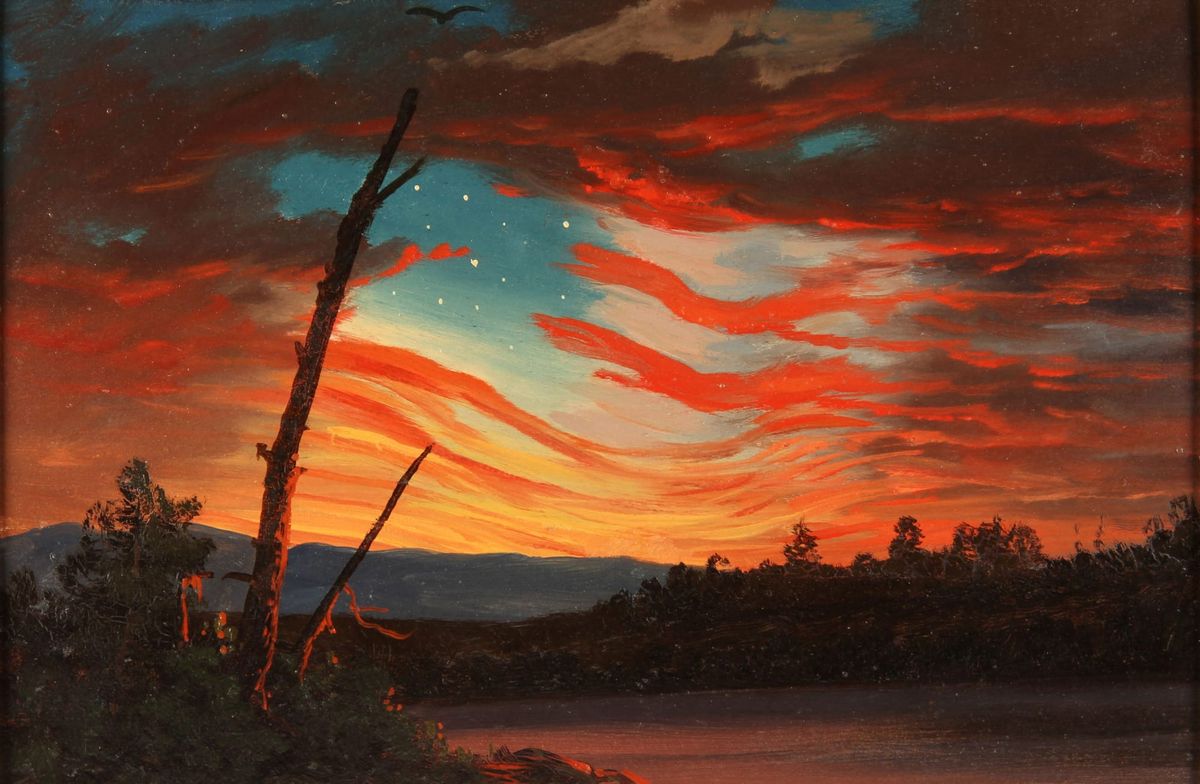
- 1861: The Civil War Fracture. Frederic Edwin Church’s Our Banner in the Sky (1861) marks a pivotal shift. Here, the landscape is no longer just a backdrop; it is a symbol of political dissolution. The colors of the sunset and the geometry of the trees evoke the Stars and Stripes, but the fractured, "bleeding" atmosphere reflects the trauma of a nation tearing itself apart.
- 1870s–1890s: The Industrial Epilogue. As the Gilded Age dawns, the wilderness begins to recede. The Hudson River School painters increasingly incorporate signs of encroachment: railroads, logging, and deforestation. The sublime is replaced by a sense of mourning for a lost, pristine Eden.
Supporting Data: The Sublime and the Scientific
The movement was deeply informed by the theories of the "sublime," most notably articulated by Edmund Burke in his 1757 treatise, A Philosophical Enquiry into the Origin of our Ideas of the Sublime and Beautiful. Burke argued that nature, when perceived as overwhelming or dangerous, produces "astonishment"—a mix of terror and awe.
The Hudson River School adopted this philosophy as their own, but they grounded it in empirical observation. These artists were amateur geologists and botanists. In Kaaterskill Falls, the precision of the rock strata and the specific identification of Eastern Hemlocks and Sugar Maples were not merely aesthetic choices. They were acts of documentation.
According to geological surveys of the Catskills, Kaaterskill Falls is a product of the Pleistocene era, formed by glacial runoff approximately 130,000 years ago. By painting these geological formations, Cole and his successors were reminding the American public that the continent possessed a history far deeper than the political history of the United States. This created a tension: if the land was millions of years old, how could it be "tamed" by a government only decades old?
Official Responses and Contemporary Reception
During the mid-19th century, the Hudson River School was treated as a source of national pride. Critics in the New York Evening Post and other major publications of the time hailed these painters as "American masters."
However, the response was not purely aesthetic. Political figures often utilized these paintings to argue for the preservation of public lands. The movement’s obsession with the "pristine" served as a proto-environmentalist argument. By the 1870s, as the industrial impact became undeniable, the paintings began to function as "official" records of what was being lost. The aesthetic "apocalypse" depicted in later works—often characterized by darkening skies, withered branches, and the encroaching shadows of industrialization—served as a warning that the American dream of infinite expansion was environmentally and morally unsustainable.
Implications: An Ecological Warning
The legacy of the Hudson River School is perhaps more relevant today than at any point since the 19th century. We are currently living through the ecological anxieties that these artists first intuited.
The Myth of Permanence
The primary implication of the movement is the challenge to the myth of human permanence. By centering the landscape—which dwarfs human figures—the Hudson River School painters were suggesting that the American project was subject to the same cycles of growth and decay as the mountains themselves.
Environmental Ruin as Narrative
When viewing Frederic Edwin Church’s work, one sees an artist grappling with the cost of empire. The "bleeding" sunsets and the encroaching black clouds are not just stylistic flourishes; they are visual representations of a nation losing its way. The movement implies that the destruction of the natural world is inextricably linked to the moral and social collapse of the society that exploits it.
The Modern Gaze
Today, institutions like the Wadsworth Atheneum and the Metropolitan Museum of Art continue to curate these works as masterworks of American art. However, a new generation of art historians is re-evaluating these paintings through the lens of the Anthropocene. We no longer see these landscapes as empty, waiting to be settled. Instead, we see them as contested territories—spaces where the seeds of both American democracy and American environmental destruction were sown simultaneously.
Conclusion: The Mirror of the Future
The Hudson River School was never just about capturing the beauty of a waterfall or a mountain range. It was a rigorous, often haunting, meditation on what it means to build a civilization on a frontier.
Thomas Cole’s Kaaterskill Falls remains a touchstone not because it is a "pretty picture," but because it is an honest one. It captures the moment of arrival—the sense of wonder at a new beginning—while simultaneously hinting at the eventual sunset. As we look at these paintings today, we are forced to confront our own anxieties. The "American Apocalypse" predicted by the Hudson River School was not a sudden event, but a slow, creeping realization that the land is not an infinite resource, but a finite, fragile participant in our history.
In the final analysis, the Hudson River School serves as a mirror. When we look into the deep, misty canyons of their canvases, we see the echoes of our own environmental crisis. Their work remains a clarion call, reminding us that while nations may rise and fall, the earth remains, bearing the scars of our ambition and the memory of our choices. The "sublime" they captured was not just the power of nature, but the overwhelming responsibility of those who claim to inhabit it.
 Muslim
 Evan Lee Salim
 Jia Lissa
