

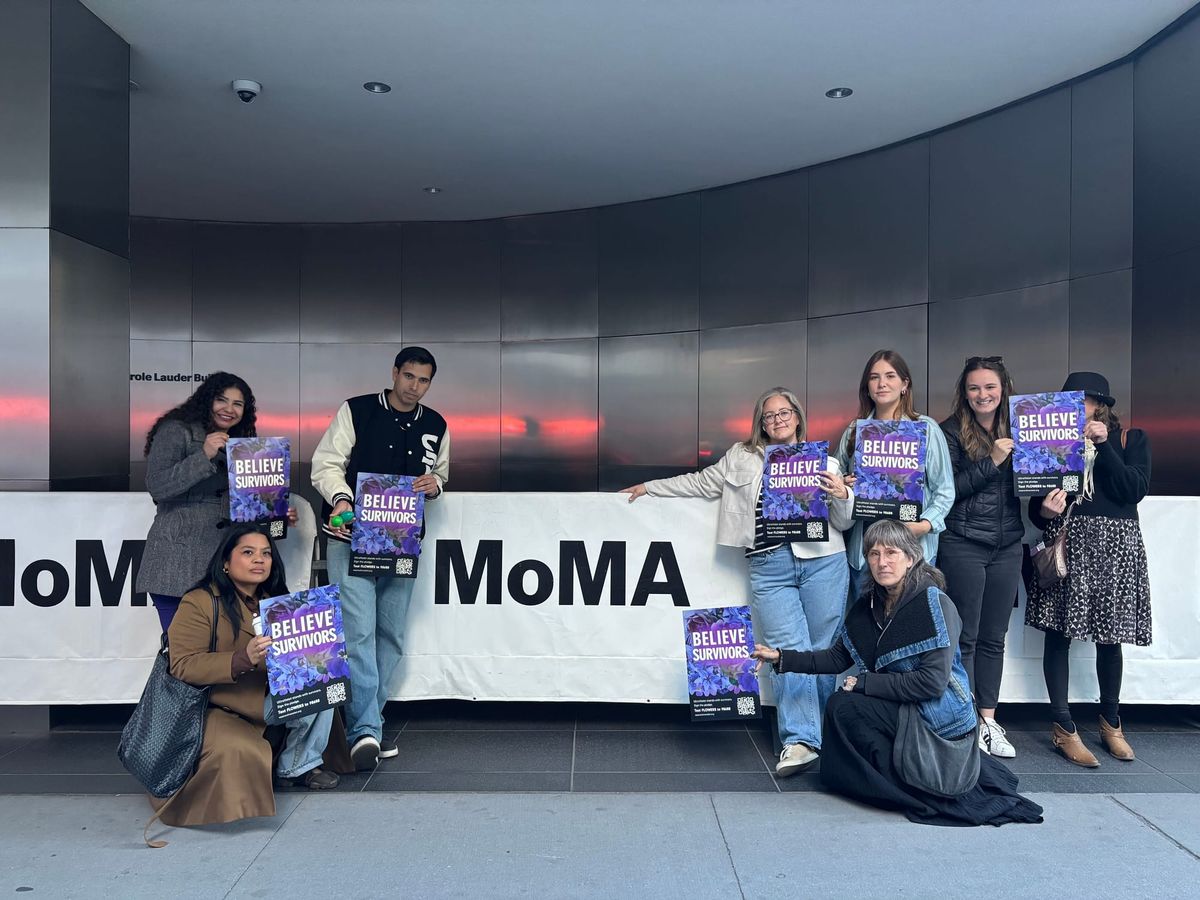
NEW YORK — Tensions boiled over outside the Museum of Modern Art (MoMA) in midtown Manhattan as a coalition of activist groups, feminist organizations, and investigative projects gathered to protest the institution’s continued association with billionaire financier Leon Black.
Demonstrators assembled just down the street from the world-renowned cultural institution to demand Black’s immediate removal from MoMA’s Board of Trustees. Protesters argue that the museum’s ongoing affiliation with Black—who faces intense public scrutiny and multiple allegations of sexual misconduct tied to the late convicted sex offender Jeffrey Epstein—actively shields his public image through association with a premier cultural brand.
The demonstration underscored a broader, escalating reckoning within the global arts and philanthropy sectors regarding "artwashing": the practice where wealthy individuals accused of severe misconduct or unethical behavior utilize charitable donations, museum board seats, and high-profile cultural patronages to rehabilitate their reputations.
Main Facts
The October 6 demonstration brought together over two dozen activists representing a cross-section of political, artistic, and accountability-driven organizations. Among them were members of the feminist advocacy campaign We Are UltraViolet (along with its Epstein Accountability Project), the historical research initiative Time & Memory Project, and the Institute for Primary Facts.
The core grievance centers on Black’s continued tenure as a MoMA board member despite extensive documentation linking him to Jeffrey Epstein. Black has previously faced multiple allegations of rape and sexual abuse, all of which he has consistently denied and which have not resulted in criminal convictions. However, the release of federal investigative documents—colloquially referred to as the "Epstein Files"—revealed that Black’s name appeared over 8,500 times within the cache, pointing to a much deeper financial and professional relationship with Epstein than previously acknowledged.
For cultural institutions like MoMA, trustees hold immense institutional power. They not only provide critical financial backing and acquisitions support, but they also help steer the narrative of contemporary culture, dictating which artists receive major retrospectives, whose histories are preserved, and how the institution engages with the public. Activists argue that granting individuals with close ties to human trafficking rings and sexual abuse allegations a seat at the table compromises the ethical integrity of the museum.
Chronology of Controversy: Leon Black, Epstein, and the Arts
The friction between cultural institutions, wealthy donors, and public accountability did not happen overnight. The timeline of Leon Black’s entanglement with Jeffrey Epstein and the subsequent fallout spans over a decade, marked by corporate restructuring, institutional pressure, and public outcry.
- The Financial Nexus (2012–2020): During these years, financial disclosures and subsequent investigations revealed that Leon Black paid Epstein tens of millions of dollars for tax and estate planning advice. While Black maintained that these services were legitimate, the depth of the financial relationship raised immediate red flags following Epstein’s 2019 arrest and subsequent death in federal custody.
- The First Wave of Fallout (2020–2021): As scrutiny intensified, an independent review commissioned by Apollo Global Management—the private equity firm Black co-founded—revealed that Black paid Epstein $158 million for professional services between 2012 and 2017. Although the report cleared Black of direct involvement in Epstein’s criminal enterprise, the staggering sums forced Black to step down as CEO and chairman of Apollo in 2021.
- Museum Exits and Resistances (2021–2024): Following the Apollo departure, public pressure mounted across the cultural sector. Black stepped down from his role as chairman of the board of the Museum of Modern Art (MoMA) in 2021, a move widely interpreted as an attempt to stymie mounting reputational damage. However, crucially, Black remained a member of the board. Meanwhile, other institutions, such as Britain’s Tate galleries, faced similar revolts over donor accountability, setting a turbulent precedent for international museums.
- The Release of the "Epstein Files" (2024–2025): Federal document releases provided unprecedented transparency into Epstein’s inner circle. The files explicitly cited Leon Black more than 8,500 times, breathing new life into activist campaigns demanding a total severance of ties between cultural boards and figures associated with the late financier.
- The October 2026 Mobilization: Protesters assembled outside MoMA, utilizing mobile installations like the Epstein-Trump Reading Room to physically map out the connections between institutional power, wealth, and the Epstein network, keeping the spotlight squarely on MoMA’s reluctance to purge Black entirely from its leadership ranks.
Supporting Data and Collaborative Protests
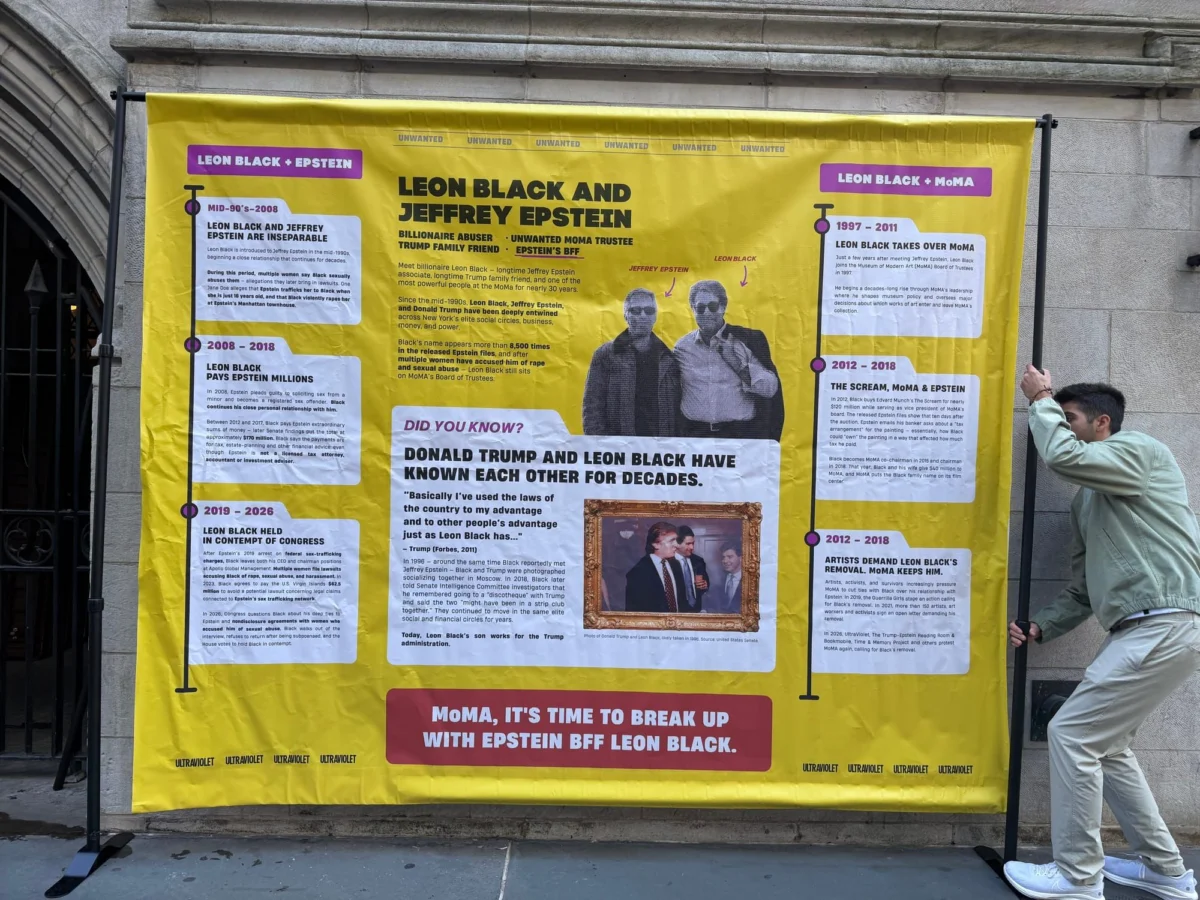
The October 6 action was notable not just for its target, but for the multimedia and educational approach employed by the coalition. A centerpiece of the protest was the mobile Epstein-Trump Reading Room, a free public installation created by the Institute for Primary Facts.
The installation travels across the United States, utilizing a two-pronged educational strategy:
- Chronological Mapping: Displaying a heavily documented timeline detailing political, financial, and social relationships with Jeffrey Epstein.
- The Source Material: Featuring thousands of books and physical copies of the declassified "Epstein Files," allowing everyday citizens and museum-goers to review the primary documents firsthand.
According to organizers, the inclusion of the files—which mention Black more than 8,500 times—serves to counter institutional opacity.
Nicole Regalado, Vice President of Campaigns at We Are UltraViolet, spoke directly to Hyperallergic during the demonstration about the insidious nature of board memberships for high-net-worth individuals facing misconduct allegations.
“By serving on MoMA’s board, whether it’s intentional or not, MoMA is helping to sanitize Leon Black’s reputation,” Regalado stated.
She emphasized that museum trustees wield a disproportionate amount of soft power in shaping public culture, education, and social values.
“Those folks determine what artists we celebrate and whose stories are told when millions of people and children visit MoMA each year,” Regalado added. “And we do not want an accused sexual predator who has been enabling Jeffrey Epstein’s crime ring to have that kind of power over shaping our culture.”
Official Responses and Institutional Silence
Despite stepping down as MoMA’s board chairman in 2021, Leon Black’s retention as a standard board member has proven to be a persistent thorn in the side of museum leadership.
Historically, cultural institutions faced with donor scandals resort to a playbook of cautious public relations: issuing non-committal statements, waiting out the news cycle, and relying on the financial contributions of wealthy patrons to sustain multi-million-dollar operational budgets. In Black’s case, MoMA leadership has largely avoided public engagement regarding his continued presence on the board, treating the matter as an internal governance issue rather than an urgent ethical crisis.

Representatives for Leon Black have consistently denied any wrongdoing regarding his business dealings with Epstein, maintaining that his interactions were strictly professional and focused on legitimate financial structuring. Regarding the separate allegations of sexual misconduct, Black’s legal representatives have similarly issued categorical denials, noting that none of the accusations have led to criminal convictions in a court of law.
However, activists argue that the threshold for holding a position of public trust at a world-class cultural institution should extend far beyond avoiding a criminal conviction. The ethical standard for a museum that serves millions of diverse visitors—including survivors of sexual trauma and abuse—demands absolute accountability and institutional integrity.
Broader Implications for the Art World and Philanthropy
The protest outside MoMA is part of a much larger global reckoning reshaping the relationship between philanthropy and the arts. For decades, museums relied heavily on ultra-high-net-worth individuals to fund endowments, construct new wings, and acquire priceless masterpieces. In exchange, donors received immense social prestige, elite networking opportunities, and the implicit cultural sanitization of their public images—often referred to by critics as “artwashing.”
In recent years, however, grassroots activism has fundamentally disrupted this transactional model. From protests against the Sackler family’s role in the opioid crisis—which successfully forced major museums worldwide to strip the Sackler name from galleries—to ongoing campaigns targeting fossil fuel magnates and figures linked to human rights abuses, the public is increasingly unwilling to separate the source of wealth from the art it sponsors.
The ongoing presence of Leon Black on MoMA’s board places the museum at a dangerous cultural crossroads. As long as institutions prioritize massive endowments and elite donor loyalty over public trust and ethical alignment, they risk alienating the very communities, artists, and audiences they were founded to serve.
As the Epstein Accountability Project and its allied coalitions made clear during their October action, the pressure on MoMA will not dissipate quietly. For cultural institutions entering the latter half of the 2020s, the message from the streets of Manhattan is unequivocal: the era of unconditional philanthropic impunity is over, and the public is watching closely to see who museums choose to shelter.
 Neng Nana
 Jia Lissa
 Lina Hope
